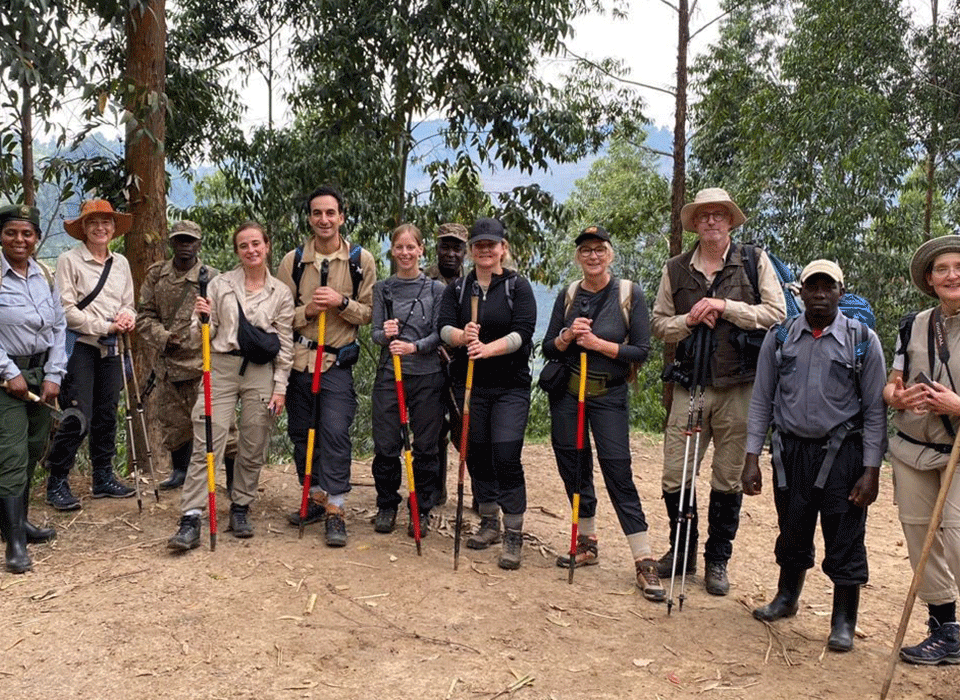
Why Do Gorillas Beat Their Chests? Meaning Explained
Why do gorillas beat their chests? The short answer
Gorillas beat their chests to communicate. The rapid, hollow-sounding drumming can advertise the signaller’s size and presence, and it occurs in social contexts that include displays between adults and play among younger gorillas. It is not a reliable sign that a gorilla intends to attack a person. The surrounding behaviour matters more than one sound alone.
On a guided trek, hearing a chest beat can be thrilling, but it is not a performance arranged for visitors. Mountain gorillas continue their own lives whether or not people are present. When a display occurs nearby, stay quiet, do not approach, and let the park rangers decide how your group should respond.


What actually happens when a gorilla chest beats?
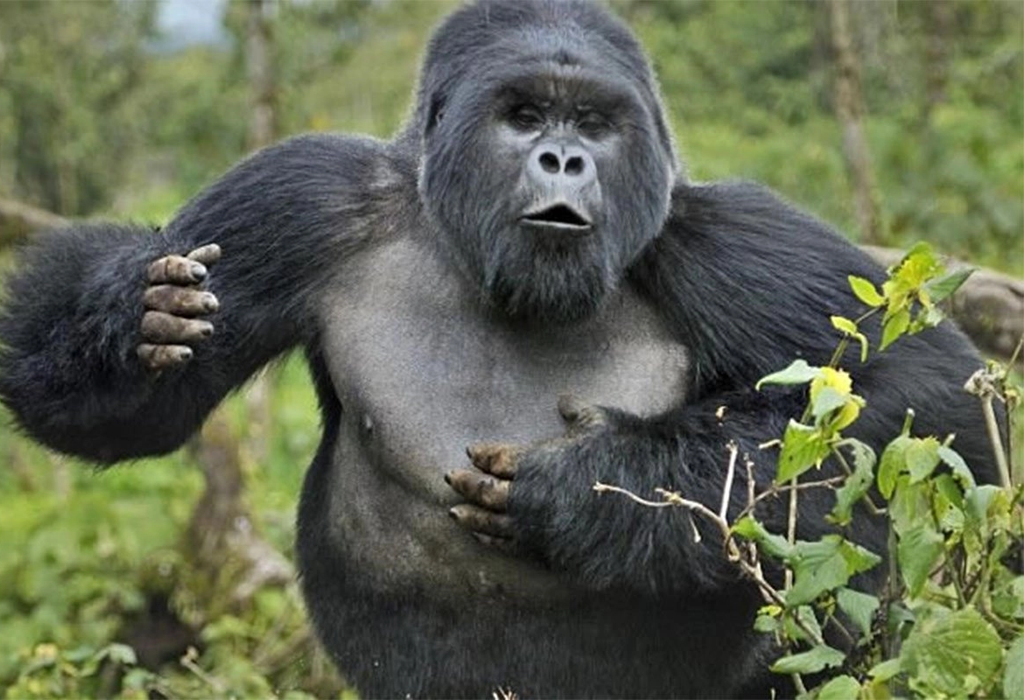
A gorilla commonly rises partly or fully upright, shapes the hands into open cups, and strikes the chest several times in quick succession. The result is a resonant, percussive sound. This is different from the familiar movie image of a gorilla punching its chest with closed fists: the natural display normally uses cupped hands.
Chest beating is described as a non-vocal acoustic signal: the central drumming sound comes from the physical movement, not from the vocal cords. A display may also involve hooting, growling, running, or vegetation movement, but those accompanying behaviours are not present every time. It is therefore both something nearby gorillas can see and something more distant gorillas can hear.
This combination makes sense in a thick mountain forest. Visibility can disappear behind leaves and stems within a few metres, while a distinctive sound can carry through the vegetation. Researchers describe chest beats as a multimodal signal, combining visible movement with acoustic information. Visitors new to the forest can read our first-time gorilla trekking guide for a broader picture of the encounter.


What the science tells us: the deeper sound of a larger male
A peer-reviewed study published in Scientific Reports in April 2021 provides one of the clearest pieces of evidence about the information in mountain gorilla chest beats. The research team, led by Edward Wright, studied wild adult males and compared their body dimensions with recordings of the drumming sounds. They found that larger males produced chest beats with lower peak frequencies than smaller males.
This matters because body size is relevant during competition between males. A lower-pitched drum may provide listeners with information about the sender without a direct confrontation. The study also discussed potential relevance to female choice, but it did not prove how every listening gorilla interprets each display or what action it will take.
Crucially, the same study did not find consistent evidence that larger males beat for longer, deliver more individual beats, or beat faster. So it would be inaccurate to tell travelers that a silverback’s speed or the number of strikes tells you how big or dangerous he is. The reliable finding concerns the sound’s frequency, not the pace of the display.
Research note
The 2021 paper analysed chest-beat sound recordings from six adult males and also used wider behavioural observations of male gorillas. It supports a body-size signal; it does not supply a universal translation of gorilla intentions. Source: Wright et al., Scientific Reports (2021).
For people booking gorilla trekking adventures, understanding that difference between evidence and interpretation makes the experience richer. You can enjoy the moment without assuming the gorilla is sending a message to you personally.

Why might a gorilla beat its chest when humans are nearby?
Chest beating is part of gorilla behaviour, not something that exists for tourists. A silverback might display in a context involving another gorilla, a disturbance, or his own movement through the forest. If trekkers are present at that moment, they can easily mistake coincidence for a deliberate message aimed at them.
Sometimes the group’s posture, facial expressions, vocal sounds and movement may indicate tension. An experienced ranger considers those cues together, including whether the gorillas are settled or becoming unsettled. From a distance, a visitor normally cannot determine a precise motive from chest beating alone.
Habituated gorillas have become accustomed to a carefully managed level of human observation, but they are still wild animals. They should never be teased, surrounded, or encouraged to perform. Guides working with gorilla families in Ruhija or families in the Rushaga sector follow the park’s designated approach rather than allowing guests to choose their own viewing position.
Is chest beating a warning, a challenge, or just play?
The answer depends on the animal and the situation. A powerful adult male may use a display during social competition, especially in contexts where another male is present or nearby. This can help communicate size and strength without necessarily leading to physical contact. A juvenile may perform smaller, less resonant chest beats as part of active play.
Other gorillas’ movements and vocalisations help explain whether an encounter looks calm, animated or tense. For example, a chest beat accompanied by a sudden advance toward a perceived intruder deserves the rangers’ immediate attention. By contrast, a young animal briefly drumming while playing does not mean the same thing.
| What you notice | What can reasonably be said |
|---|---|
| A silverback drums loudly | He is displaying; the sound can carry information about body size. His exact motive needs context. |
| A juvenile chest beats while moving and playing | The behaviour can form part of play, not a threat. |
| Chest beating occurs near trekkers | It is not automatically aimed at the people present. |
| A display is accompanied by a rapid advance or agitation | Stop taking photographs and follow the ranger’s instructions immediately. |
Travelers who enjoy observing these differences can learn about the social composition of Rwanda’s mountain gorilla families and the special setting of gorilla trekking in Mgahinga. Neither destination can promise a chest-beating sighting, because behaviour is spontaneous.
Do females and young gorillas beat their chests?
Yes. The popular idea that only silverbacks perform chest beats is incorrect. Adult males are the most conspicuous performers, and their powerful drumming has attracted the most acoustic research. Females and younger gorillas can also make chest-beating movements, although frequency, circumstances and sound quality may differ.
Juveniles commonly practise a range of social and motor behaviours during play. Their chest beats do not carry the same physical impact as those of a large adult male. In a gorilla family, play is an important part of development and interaction, and young animals can look remarkably lively beside resting adults.
The point for visitors is to observe rather than label every gesture as aggression. A gorilla photography guide can help you prepare for fleeting movements without intrusive camera work, while our guide to more accessible gorilla trekking sectors helps visitors think about the physical demands before booking.
What to do if a silverback chest beats during your trek
A chest beat can be surprising, especially when it sounds close. Stay still or move only as directed, remain with the group, and keep your voice low. Do not run, shout, imitate the sound, stare confrontationally at the animal, or move toward it for a better photograph. If a gorilla approaches, allow the ranger to direct your position; never reach out to touch it.
Rangers may ask visitors to stop, look away, lower their posture or move to a safer position depending on the situation. Follow that specific instruction rather than a fixed internet rule. Any instruction to end the viewing period early should be accepted immediately; protecting both people and gorillas takes precedence over photographs.
- Keep the viewing distance set by the park and the rangers. Uganda Wildlife Authority’s current tariff states 10 metres. Rwanda Development Board’s online gorilla-tracking guidance states 7 metres; follow any stricter instruction given at the briefing.
- Only persons aged 15 years and above may take part in standard mountain gorilla trekking.
- The standard group limit is eight visitors per gorilla family with up to one hour of observation.
- Do not trek with a contagious illness; never touch or feed the animals; turn off flash, and do not eat, drink or smoke in the gorillas’ presence.
Official sources: UWA conservation tariff, gorilla tracking rules and Rwanda Development Board booking guidance. Always follow the rules announced for your trekking date.
A short gorilla trekking safari can still provide an outstanding encounter when the day is properly paced. Think of the rangers’ briefing as part of the experience, not a formality.
Where can you see mountain gorillas in Uganda and Rwanda?
Uganda provides guided trekking in Bwindi Impenetrable National Park and Mgahinga Gorilla National Park. Bwindi has several trekking sectors, each with its own road access and lodge options. Mgahinga offers a different volcanic setting. Rwanda’s guided mountain gorilla visits take place in Volcanoes National Park, reached through the Musanze/Kinigi area.
A day with gorillas is unpredictable. You may watch feeding, grooming, resting or play; you may hear chest beating, or you may not. Neither a specific sector nor a premium tour can guarantee a particular behaviour. For seasonal conditions, consult the best time to see mountain gorillas, but remember that weather does not determine which displays the animals will perform.
If the forest terrain concerns you, use our Bwindi safari planning guide and describe your fitness or mobility needs before permits are booked.
Planning a respectful trek: practical steps
Book around the permit and the correct park sector, not around a promise of dramatic animal behaviour. Your safari operator can help with permits, accommodation, transport and a schedule that allows you to arrive at the briefing point without rushing. In Uganda, Bwindi sectors can be far apart by road, so lodge placement matters.
Pack secure hiking boots, long trousers, a rain jacket and a small waterproof daypack. Carry enough water for the walk and use it only where rangers permit. Make sure your phone or camera has flash disabled before reaching the gorillas. See our complete packing and clothing guide, gorilla trekking booking guide and Uganda gorilla permit guide for planning details.
Travelers considering Mgahinga should check Mgahinga permit information. If you select Bwindi, match the permit sector with accommodation using our advice on booking gorilla permits and lodges in Bwindi. Leave enough time for travel and a relaxed trek rather than squeezing long road transfers into trekking day.


Gorilla trekking and gorilla habituation are different experiences
Standard gorilla trekking involves visiting a fully habituated family under park ranger supervision, normally for up to one hour after the family is located. Uganda also has a separate Gorilla Habituation Experience involving a family undergoing the habituation process. It is a different activity with its own permit arrangements and greater time commitment.
Neither experience entitles visitors to encourage chest beating, approach a gorilla, or interfere with its behaviour. If you are deciding between them, read gorilla trekking versus gorilla habituation and how to combine trekking with a habituation experience. For practical planning, our gorilla habituation booking guide explains why arranging permits early is essential.
Rwanda offers standard gorilla trekking in Volcanoes National Park, but not the four-hour tourism habituation product offered in Uganda. See whether gorilla habituation is available in Volcanoes National Park for that distinction.
The best safari is an honest wildlife encounter, not a staged display
A chest beat can echo across a mountain forest and become the defining memory of a safari. Yet the quieter moments are just as meaningful: an adult sharing space with younger gorillas, a juvenile climbing through vegetation, or a family moving together to feed. Ethical gorilla tourism gives the animals freedom to choose their actions while people observe respectfully.
Our Uganda and Rwanda gorilla tours and gorilla trekking tour selection guide can help you compare travel styles, while a three-day Rwanda gorilla tour suits travelers with limited time. Visitors wanting another primate encounter may explore a gorilla and golden monkey trek in Rwanda.
For a wider regional journey, consider a combined Uganda and Rwanda gorilla safari. Travelers studying the destinations can begin with where gorilla trekking takes place in Rwanda and what makes Mgahinga special. Our complete Uganda trekking guide rounds out the practical preparation.
Frequently asked questions about gorilla chest beating
Why do gorillas beat their chests?
Chest beating is a visual and acoustic signal used in several social contexts. Research has shown that the pitch of adult male chest beats can convey information about body size.
Is a gorilla that beats its chest threatening a tourist?
Not necessarily. A display near tourists can occur for reasons unrelated to people. Rangers consider the animal’s wider behaviour, and visitors should follow their instructions.
Do gorillas beat their chests with fists?
No. The classic chest beat is generally performed using open, cupped hands, producing a deep drumming sound.
Can a female gorilla beat her chest?
Yes. Chest-beating behaviour is not exclusive to adult males, though silverbacks are the most prominent performers.
Do baby gorillas beat their chests?
Young gorillas can make chest-beating movements during play. Their displays differ from the powerful chest beats of mature males.
Does a deeper chest beat mean a bigger gorilla?
A 2021 study of male mountain gorillas found an association between larger body size and lower-frequency chest beats. It does not let visitors estimate an exact weight by ear.
Does faster chest beating mean a stronger silverback?
The 2021 study did not find a consistent relationship between body size and the beat rate, number of beats or duration of a display.
Can chest beats be heard from far away?
Researchers describe the sound as a long-distance signal that may be audible over a kilometre under suitable conditions. Distance varies with the terrain, vegetation and listening conditions.
What should I do if a silverback chest beats close to me?
Stay calm, remain with your group, do not run or approach the gorilla, and immediately follow your ranger’s instructions.
Can a gorilla charge after chest beating?
A display can sometimes accompany agitation or an advance, but a chest beat alone does not predict a charge. Never try to test a gorilla’s reaction.
Can I take photographs during a chest-beating display?
Only if the ranger permits and you can remain stationary and respectful. Do not use flash or reposition closer to the gorilla for the shot.
Where can I witness this behaviour in the wild?
It may be seen during guided gorilla trekking in Uganda’s Bwindi or Mgahinga, and Rwanda’s Volcanoes National Park. No operator can guarantee that a gorilla will chest beat on a particular visit.
Sources and further reading
The behavioural explanations above are based on published gorilla research and official ranger-led trekking guidance. The internal safari links are planning resources; scientific and park rules take precedence over older travel articles.
Wright and colleagues (2021), Scientific Reports: chest beats as an honest signal of male body size.
Uganda Wildlife Authority: Conservation Tariff 2027–2028, gorilla tracking rules.
Rwanda Development Board: Mountain Gorilla Tracking visitor guidance.
Smithsonian’s National Zoo: gorilla social behaviour and displays (western lowland gorillas).