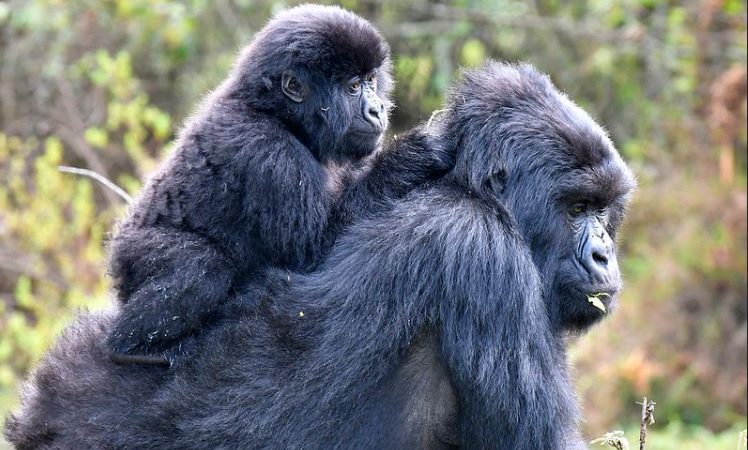
Major Threats To Mountain Gorillas

What Are The Major Threats To Mountain Gorillas?
It is unfortunate to say that the Gorilla, our closest relative and most intelligent mammal now is on the red list of IUCN as an endangered species (EN A2cd). Mountain Gorilla or gorilla beringei, is one of the three subspecies of Gorilla. Mountain gorillas are now under threat due to the degradation of their habitat, poaching, human contact, and illnesses. Commercial trade in bushmeat and poaching are intentional threats to gorillas from humans. We need to know the major threats to mountain gorillas so that we can know how to conserve them.
In Africa, Mountain Gorilla occurs in the national parks of Uganda, Rwanda, and the Democratic Republic of the Congo (DRC). Virunga National Park and Kahuzi National Park in Congo offer a gorilla trekking experience. Mgahinga National Park and Bwindi-Impenetrable National Park are the home for Mountain gorillas in Uganda. We are going to discuss about actual and potential threats behind the reduction of the population of gorillas.
Habitat Loss
Habitat loss and deforestation are some of the potential major threats to Mountain gorillas. Mountainous forests, Tropical Montane cloud forests, and Bamboo Forests are the major habitat for Mountain Gorillas. The modification for human settlement, wood extraction, and forest encroachment for agricultural purposes is the root of habitat loss. Others are Commercial logging interests, and subsistence agriculture for huge populations with poverty pressure. Infrastructure development like road-building activities is the main reason for deforestation.
The highest densities of the rural populations of Uganda, Rwanda, and Burundi, sustain their lives by forming land for subsistence agriculture from fragments of forests. In DRC, the clearance of forests is going on for the supply of firewood for refugees.
More than 1/3rd of the Volcanoes National Park of Rwanda was used for agricultural purposes. In Uganda, the incursion of local people and their livestock in Mgahinga National Park has a major impact on the habitat of Mountain Gorillas.
Disease
Humans and Gorillas are like the closest cousins on the base of genetics and intelligence. We share the same kind of DNA; the transmission of diseases from humans is easy. Oh Yes! They are getting infectious diseases from us that can be devastating to their population. A cold and an infectious virus can kill gorillas.
The first time exposure to a virus, which is not harmful to us, may lead to the destruction of the entire gorilla population. As they do not have an immune system the specific innocuous viruses can wipe out gorillas from a region.
In 1990, Ebola hemorrhagic fever became a big reason for the death of gorillas. 1/3 of the world’s Gorilla Population is killed by Ebola Virus. In 1994, an outbreak of the Ebola Virus killed the entire population of Gorillas and Chimpanzees at Minkebe National Park. Odzala National Park on the Northern side of DRC lost more than 92% of 600 identified gorillas. It was due to the Ebola Virus between 2002 and 2003.
Skin diseases like scabies, mange, and other respiratory diseases infect the gorillas through human contact. So, tourists should maintain a minimum distance of 7 meters from gorillas. In 1996, a male Gorilla died at the time of treatment for scabies during the outbreak of scabies in Biwindi Impenetrable National Park of Uganda.
Poaching
For decades, European and American scientists killed over 50 Mountain Gorillas to do their research. Poaching is the real threat that makes it hard for gorillas to sustain their life. After the end of the civil war in Sudan, the logging companies moved to the DRC and started living with gorillas, leading to the hunting of Gorillas. Recently, in 2013, rangers recovered a gorilla that poachers had held captive for poaching, outside of Virunga National Park.
From 1960 to 1970, the gorillas were used for trophy hunting. Though it is illegal to hunt gorillas in DRC, the poaching continues due to a lack of enforcement of national and international laws. Due to the high demand for bushmeat of gorillas, as a food of prestigious status of wealthy people, poaching and hunting continued for the commercial trade.
Also because of the weight of saleable meat, hunters largely favor hunting of gorillas. Sometimes hunters accidentally kill gorillas when targeting pigs or any antelope by using traps and snares. Humans use their body parts for medicine and magic charms.
Armed Conflict
During 1990, the genocide and conflict in Rwanda had expanded into DRC by 1994. The refugees who were the population of Rwanda population entered the gorilla habitat of Virunga National Park of DRC. To survive, refugees started the use of wood for fire and cleared the forests for agriculture.
The same fight broke out between the troops of Rwanda and Uganda and the DRC army. It resulted in a huge number of refugees entering the DRC. Huge refugees near Virunga National Park used wood for their survival which led to habitat loss. This armed conflict not only results in habitat loss. But also, led to the death of the highest population of Mountain gorillas to poaching.
There is a death of 15 to 17 mountain gorillas caused by the destruction of Virunga national park infrastructure due to conflict in DRC IN 1996.
According to the report, during the armed conflicts of 1992 to 2000, there is a death toll of 12 to 17 Mountain gorillas only in the Virunga volcanoes region of DRC as a result of military activities.
As a result of rebels and refugees, there is a huge population pressure which led to the conservation of protected areas being impossible.
Due to ongoing civil unrest and armed conflict, there is habitat loss and a lot of poaching. The Governments of Rwanda, Uganda, and Congo should allow jobs for the local people to sustain their lives. As the most intelligent species is now in danger, governments should continuously ban poaching and punish the hunters. The rules and regulations against poaching should be implemented on the root level so that the ongoing reduction of Gorillas can be prevented.