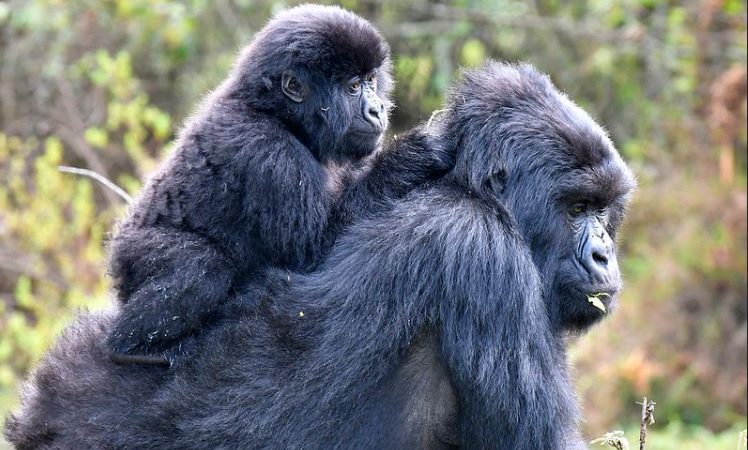
Comparing Gorillas in Virunga and Kahuzi Biega National Parks

Comparing Gorillas in Virunga National Park and Kahuzi Biega N.P
Comparing Gorillas in Virunga and Kahuzi Biega. We can not talk about gorilla trekking safaris in Congo and not mention Virunga National Park or Kahuzi Biega National Park. Both national parks offer visitors a different kind of experience when it comes to gorilla trekking. Virunga National Park offers you a chance to track Mountain gorillas. Meanwhile, Kahuzi Biega offers eastern lowland gorilla trekking.
In this article, you’ll discover their various traits, such as behavior, diet, size, and habitat. Those with an interest in gorilla conservation must understand the distinctions between Mountain and Lowland gorillas. Learn about the challenges that each species faces, as well as how you may help with conservation efforts.
Kahuzi Biega National Park covers a large area of primary tropical forest. The two stunning extinct volcanoes, Kahuzi and Biega, dominate the park, and it has diversity and plenty of wildlife. You can find one of the remaining populations of eastern lowland gorillas in this park. They are around 250 individuals, dwelling between 2,100 and 2,400 meters above sea level.
Virunga National Park, encompassing an area of 790,000 hectares has an exceptional range of ecosystems. These range from marshes and steppes to the Rwenzori snowfields. These are at a height of almost 5,000 m, and from lava plains to savannahs on volcanic slopes. The park is home to mountain gorillas, 20,000 hippopotamuses, and birds from Siberia that spend the winter there.
Basis for Comparing Gorillas in Virunga National Park and Kahuzi Biega N.P
If you come across Mountain Gorillas in Virunga National Park and Lowland Gorillas in Kahuzi Biega National Park at the same time on your Congo gorilla safari, chances are you won’t be able to tell the difference, especially if you’re a first-time trekker. Mountain and lowland gorillas are two separate ape species. They share around 98.3 percent of their genetic DNA with humans. This makes them our closest cousins after chimpanzees and bonobos. Let’s look at the key distinctions between Mountain and Lowland Gorillas.
Physical Characteristics
Mountain gorillas are larger than lowland gorillas, having longer, darker hair and shorter arms. Their (mountain gorillas’) bodies are designed in such a manner that they can adapt to their environment. You find them in mountainous places with subzero temperatures. Lowland gorillas live in significantly milder climates and do not require as thick of a coat.
Furthermore, mountain gorillas are considerably heavier. They have an average mountain gorilla weight of around 200kg (440 pounds). Meanwhile, the average lowland gorilla weighs approximately 150kg (330 pounds). Mountain gorillas have a larger nose, jaw, and teeth than lowland gorillas. They also have reddish-brown fur on their backs.
Social Life of Mountain Gorillas Vs Lowland Gorillas
Mountain and lowland gorillas both live in groups or families of roughly 30 individuals. Mountain gorillas live in groups of 5 to 25 people, with a silverback generally heading the group. However, lowland gorillas (Eastern lowland gorillas) might live in families of 4 to 8 people. Lowland gorillas, on the other hand, can live in bigger groups. These groups tend to have many silverbacks heading separate families, averaging more than 50 individuals.
Mountain gorillas have a slightly different social life than their lowland counterparts. They have regular contact with group members. Lowland gorilla families significantly scatter more and move less than mountain gorilla families. This tends to keep them together with less individual activity.
Mountain gorillas famously release a strong stench from the glands under their arms. This often happens especially when they are anxious. Additionally, research on lowland gorillas shows that smell communication doesn’t play a significant part in their culture in the wild.
Furthermore, mountain gorillas groom each other for around 15 minutes each day. However, lowland gorillas do not interact frequently and exhibit significantly less wing-grooming behavior. In general, gorillas are clever creatures with amazing communication abilities. They produce around 25 unique noises and employ tools to do various activities, similar to chimpanzees.
Habitat of Mountain Gorillas Vs Lowland Gorillas
Mountain gorillas live in mountains at heights ranging from 8,000 to 13,000 feet. You can only find them in three countries: Uganda, Rwanda, and the Democratic Republic of the Congo.
Lowland gorillas, on the other hand, dwell on the outskirts of rainforests and swampland. They scavenge for food on nearby savannah grasslands. You can find them in the Democratic Republic of the Congo, Cameroon, Equatorial Guinea, the Central African Republic, Gabon, and Angola.
Mountain gorillas have evolved to tougher temperature conditions since they live at higher elevations. These are often cooler than lowland cousins. Lowland gorillas, on the other hand, have been able to survive in captivity and conservationists can simply relocate them.
Diet of Mountain Gorillas Vs Lowland Gorillas
Gorillas are herbivores in general, but western lowland gorillas rely on vines, stems, leaves, roots, and around 100 different kinds of fruits. They may eat insects and tiny reptiles. Mountain gorillas eat only plant material such as shoots, branches, flowers, tree bark, and leaves.
Mountain gorillas have also been recorded feeding insects, particularly in locations where there is little vegetation to consume. Overall, they graze on the same foods, with the only difference being the environment. Lowland gorillas have more food possibilities than mountain gorillas.
Cost of Gorilla Permits for Mountain gorillas and Lowland Gorillas
Gorilla permits cost USD400 for both Mountain gorillas and Lowland gorillas. You can book your gorilla permits or gorilla safari to Virunga or Kahuzi Biega national parks directly through the parks. Alternatively, you can book through a trusted tour operator company such as Safari Vacations and Travel Services.
How to get to Virunga and Kahuzi Biega National Parks in Congo?
Getting to Virunga National Park.
Virunga National Park is in the eastern part of the Democratic Republic of Congo. You may access it by air and road, with flights to Goma Airport followed by a driving trip to the Park Headquarters. Tourists can also fly into Kigali International Airport and then drive to the park. Connect by road from Bukavu town to the Park Headquarters in 5-6 hours, or via Rwanda and Uganda to the Park via some of the recognized border stations.
Getting to Kahuzi Biega National Park.
The best way to get to Kahuzi-Biega is to go from Kigali to Congo via the Cyangungu border and then to the town of Bukavu. The majority of overseas visitors arrive at Kigali Airport in the afternoon or evening. Because the drive from Kigali to the Congo border takes seven hours, it is vital to rest for the night before continuing to Bukavu the next day. Travelers from Burundi can utilize the Uvira border crossing, while those from Goma can take the Lake Kivu route.
You must now be able to tell the similarities and differences among the two gorilla species. You are just left with planning your ultimate gorilla safari. Contact us by filling out the form below. We’ll arrange everything for you, and you’ll just have to show up on your travel dates.