Top Most Animals to See on a Uganda Safari

Top Animals to See on a Uganda Safari
Top Most Animals to See on a Uganda Safari: Uganda offers amazing wildlife experiences. You’ll see Mountain Gorillas in misty forests and lions prowling the savannah. Since the country sits on the equator, it creates many different habitats. As a result, over 1,000 bird species and about 345 mammal species call Uganda home. Therefore, Uganda ranks among Africa’s best wildlife spots. In fact, Safari Vacations and Travel Services designs trips that ensure unforgettable experiences across Uganda’s parks.
Primates: Uganda’s Jungle Stars: Top Most Animals to See on a Uganda Safari
Uganda claims the title “Primate Capital of the World.” In fact, it hosts 13 primate species—more than any other country. These creatures range from mighty Mountain Gorillas to playful monkeys. Consequently, they offer some of Earth’s most sought-after wildlife encounters.
Mountain Gorillas: The Ultimate Wildlife Encounter
Mountain Gorillas stand as Uganda’s top attraction. Moreover, they create the most powerful animal encounter anywhere. These gentle giants share 98% of their DNA with humans. However, fewer than 1,100 remain worldwide. They live only in mountain forests across Uganda, Rwanda, and Congo. Thus, seeing them is both a rare privilege and a conservation success.
Where to Find Mountain Gorillas in Uganda
Uganda protects about half the world’s Mountain Gohttps://www.ugandarwanda-safaris.com/rwanda-cycling-tour/rillas. Specifically, they live in two protected areas: Bwindi Impenetrable National Park and Mgahinga Gorilla National Park.
Bwindi Impenetrable National Park
First, UNESCO named this a World Heritage Site. It shelters about 459 gorillas across four sectors: Buhoma, Ruhija, Rushaga, and Nkuringo. Notably, each sector has several gorilla families that are used to tourists. Meanwhile, officials carefully control permits to minimize human impact.
Mgahinga Gorilla National Park
On the other hand, this smaller park forms part of the Virunga Conservation Area. Three extinct volcanoes dominate the landscape and create dramatic scenery. Currently, one gorilla family lives here—the Nyakagezi group. Occasionally, they cross into Rwanda since their territory spans borders.
What to Expect During Gorilla Trekking
Initially, your trek starts with an early morning briefing. During this time, rangers explain how to approach the gorillas. Treks last from one to eight hours, depending on where the gorillas are. Along the way, you’ll walk through steep, muddy terrain and dense plants. However, the challenge vanishes when you find them. You’ll see a massive silverback weighing up to 220 kilograms. He feeds calmly while babies play nearby. Ultimately, these memories last a lifetime.
Planning Your Gorilla Trek
Safari Vacations and Travel Services handles everything. First, they secure permits for you at $800 per person in Uganda. In comparison, Rwanda charges $1,500. Additionally, they arrange hotels near the park and provide experienced guides. Furthermore, they supply walking sticks and rain gear. Their expertise helps you navigate the permit system. They also choose the best sector for your fitness level.
The Human-Gorilla Connection
Gorillas behave much like humans. As a result, this creates deeply moving experiences. For instance, you’ll watch mothers care for babies and teenagers test boundaries. At the same time, silverbacks show both power and gentleness while protecting their families. You get only one hour with each family. Officials strictly enforce this to minimize stress and disease risks. Nevertheless, that hour passes quickly and leaves you satisfied yet wanting more.
Chimpanzees: Top Most Animals to See on a Uganda Safari
Chimpanzees share even more DNA with us than gorillas do. Specifically, they’re 98.7% similar to humans. Consequently, Uganda protects about 5,000 chimps. Several communities have grown used to tourists and researchers.
Kibale National Park
People call it the “Primate Capital.” Indeed, it’s Uganda’s best place for chimps. This 795-square-kilometer rainforest hosts about 1,500 chimps. That’s the highest density in Africa. Furthermore, 13 primate species call Kibale home. These include red colobus monkeys, L’Hoest’s monkeys, and blue monkeys. Clearly, it’s a true primate paradise.
Chimp tracking succeeds over 90% of the time. This is thanks to decades of research with these communities. Both morning and afternoon sessions work well. However, morning treks often show more active behavior. This is because chimps forage after leaving their night nests. Moreover, the forest’s open understory allows better photos and easier movement.
Chimps behave very differently from gorillas. They display complex social groups and sophisticated tool use. Additionally, they hunt cooperatively and have advanced communication systems. For example, you might see chimps using sticks to extract insects from logs. At the same time, babies practice acrobatic moves in the trees. Meanwhile, whole communities make dramatic “pant-hoot” calls that echo through the forest.
Beyond standard tracking, Kibale offers the Chimpanzee Habituation Experience. Here, you can spend entire days with chimps still getting used to people. Throughout the experience, you’ll watch them wake up, feed, groom, patrol, and settle into evening nests.
Queen Elizabeth National Park
Alternatively, the Kyambura Gorge sector offers chimp tracking too. This “underground forest” is unique. It’s a sunken ribbon of rainforest surrounded by savannah. Fewer chimps live here than in Kibale. However, the distinctive landscape allows you to combine primate tracking with savannah game drives.
Budongo Forest
Similarly, this forest sits in the Murchison Falls Conservation Area. It hosts another important chimp population. The Kaniyo Pabidi sector offers tracking in beautiful mahogany forests. Therefore, it’s perfect if you’re already visiting Murchison Falls. You won’t need a separate trip to Kibale.
Safari Vacations and Travel Services arranges chimp permits. Standard tracking costs $250 while habituation experiences cost $300. They coordinate logistics across locations. They also provide knowledgeable guides who explain behavior and forest ecology.
Golden Monkeys: Rare Mountain Treasures: Top Most Animals to See on a Uganda Safari
Golden Monkeys are a subspecies of blue monkeys. They’re one of Africa’s most beautiful and endangered primates. Their gold-orange fur contrasts dramatically with black limbs and faces. As a result, they create stunning photos against volcanic forests.
Golden Monkeys live only in the Albertine Rift’s highland forests. Therefore, Mgahinga Gorilla National Park is Uganda’s sole location for them. The park hosts two groups totaling about 100 individuals. Unlike gorillas, Golden Monkeys love trees. In fact, they leap between bamboo stands with amazing grace.
Golden Monkey tracking differs from gorilla tracking. These smaller primates weigh only 4-7 kilograms. They move rapidly and often travel several kilometers daily while feeding. They prefer bamboo forests that create easier terrain. However, you must keep up with fast-moving troops.
Typically, the experience lasts 2-4 hours. First, you start with a briefing at park headquarters before climbing into the bamboo zones. Once you find them, you get one hour. During this time, you’ll watch them feed on bamboo shoots and leap between stands. They also groom each other. Meanwhile, young ones provide great entertainment through playful antics.
Golden Monkey permits cost much less than gorilla permits at $100 per person. This makes them an affordable addition. Therefore, Safari Vacations and Travel Services often suggests combining them with gorilla trekking. This maximizes your trip to remote Mgahinga while supporting both species’ conservation.
Other Primates: Top Most Animals to See on a Uganda Safari
Uganda’s primate diversity extends far beyond the famous species. In fact, many monkey species appear throughout forests and even in savannah parks.
Black-and-white Colobus Monkeys have flowing white capes and long white-tufted tails. These leaf-eaters live in troops of 3-15 individuals. Their distinctive look makes them photography favorites. Notably, Kibale Forest has particularly large populations. You often see them during chimp tracking.
Red-tailed Monkeys get their name from their coppery tails. They’re one of Uganda’s most common forest primates. Large, active troops forage through the canopies. Often, they join other monkey species. Their adaptability helps them thrive in many locations.
L’Hoest’s Monkeys live on forest floors with distinctive white bibs. Long backward-swept whiskers frame their faces. They’re one of Africa’s least-known primates. Kibale provides excellent viewing opportunities for these shy monkeys. They forage in small family groups.
Grey-cheeked Mangabeys are large forest monkeys with distinctive cheek whiskers. Their loud “gobble” calls announce their presence. They live in Uganda’s lowland and mid-altitude forests. Large troops create dramatic encounters.
Olive Baboons are Africa’s most widespread baboon species. They live in savannah parks, including Queen Elizabeth, Murchison Falls, and Lake Mburo. These intelligent primates live in complex social groups. As a result, they provide endless behavioral observations. You’ll see dominance displays and alliances as well as maternal care and juvenile play.
Safari Vacations and Travel Services ensures comprehensive primate experiences. They design itineraries with multiple habitats. This combines intensive gorilla and chimp encounters with forest walk,s highlighting Uganda’s monkey diversity.
The Big Five: Classic Safari Icons
Primates dominate Uganda’s wildlife reputation. However, the country also protects four of Africa’s “Big Five.” These are lion, leopard, elephant, and buffalo. Additionally, rhinos have returned through conservation efforts. Originally, big game hunters named these animals. They were the most difficult and dangerous to hunt. Now they’re safari tourism’s most sought-after sightings.
Lion: The Savannah Kings
Lions are Africa’s largest predators. They symbolize wild Africa. Uganda protects about 400 lions. Conservation programs work hard to maintain these populations while addressing human-wildlife conflicts.
Queen Elizabeth National Park
First and foremost, this park hosts Uganda’s largest lion population. It provides the country’s most reliable lion viewing. The Kasenyi plains sector offers classic open savannah. Here, lion prides rest in shade during hot days. Then, they become active during cooler morning and evening hours. Game drives through Kasenyi regularly find lions. Sometimes you’ll see entire prides with cubs.
Meanwhile, the Ishasha sector has famous tree-climbing lions. Lions exhibit this behavior in only a few places worldwide. Seeing massive predators lounge in fig tree branches creates surreal scenes. Theories vary about why they do this. Some say they escape heat and insects. Others think they get better views of prey.
Murchison Falls National Park
This is Uganda’s largest protected area. It supports a growing lion population on its northern bank. This is especially true around the Buligi area. Prides hunt abundant Uganda kob and buffalo. Lions here often display bold behavior. Sometimes they approach vehicles closely during hunts. This creates dramatic safari moments.
Kidepo Valley National Park
Despite its remoteness, Kidepo has healthy lion numbers. These prides have minimal exposure to tourism. As a result, they display particularly natural behaviors. However, their wariness sometimes makes close approaches challenging. Nevertheless, the park’s vast landscapes support sustainable lion communities. Excellent prey populations help.
Lake Mburo National Park
Interestingly, this park historically lacked lions. Officials removed them due to conflicts with surrounding communities. Their absence makes the park unique. As a result, it allows certain activities impossible elsewhere. These include walking safaris and horseback riding.
Safari Vacations and Travel Services positions you for optimal lion encounters. They schedule morning and late afternoon game drives when lions are most active. Their guides understand pride territories and movement patterns. They show patience by waiting for behavioral moments rather than rushing.
Lion social dynamics provide fascinating observations. Prides typically consist of related females and their cubs. A coalition of adult males defends the pride. These males won dominance through competition. You’ll watch lionesses coordinate hunts. Meanwhile, males defend territories through thunderous roars. Entire prides feast on fresh kills. This illuminates their complex societies.
Leopard: The Elusive Ghost
Leopards are perhaps Africa’s most adaptable large predators. They live in virtually all Ugandan protected areas. However, they’re notoriously difficult to observe. They’re solitary and mostly nocturnal. Their camouflage is exceptional. These powerful cats can haul prey heavier than themselves into trees. Therefore, they represent the ultimate wildlife challenge.
Leopard populations remain healthy across Uganda. Estimates suggest several thousand individuals. However, their secretive nature makes sightings rare. This adds excitement when encounters do occur.
Queen Elizabeth National Park
This park probably offers Uganda’s best leopard viewing. Particularly, the Kasenyi plains and Mweya peninsula work well. Early morning and late evening game drives occasionally reveal leopards. They return from hunts or begin evening patrols. The park’s fig trees sometimes harbor resting leopards. Their spotted coats provide perfect camouflage.
Murchison Falls National Park
This park hosts substantial leopard populations. However, sightings remain opportunistic. Riverine forests along the Victoria Nile provide preferred cover. Isolated tree stands across the savannah also work. Extremely lucky visitors might witness leopards with kills hoisted into trees. This secures them from scavenging lions and hyenas.
Kidepo Valley National Park
Rocky kopjes and acacia woodlands provide ideal leopard habitat. The park’s leopards are less used to vehicles. As a result, they demonstrate natural wariness. This makes encounters brief but thrilling.
Even forests have leopards. Both Bwindi Impenetrable and Kibale support leopard populations. However, encounters rarely occur given the dense vegetation and nocturnal hunting patterns. Forest leopards prey on primates and duikers. They play crucial roles as apex predators.
Safari Vacations and Travel Services enhances your chances. They schedule multiple game drives across prime habitats. Their guides read tracks and signs. They know where leopards were recently seen. Night game drives, where available, significantly increase encounter possibilities. These cats hunt mostly after dark.
African Elephant: The Gentle Giants
African Elephants are Earth’s largest land animals. About 5,000 roam Uganda’s protected areas. These highly intelligent mammals are socially complex. They create constant highlights during game drives through their massive size and fascinating behaviors.
Murchison Falls National Park
This park hosts Uganda’s largest elephant population. Over 1,200 individuals live here. The park’s northern bank provides excellent viewing. This is especially true around waterholes and the Victoria Nile. Families come to drink and bathe. You’ll watch herds emerge from riverine forests. Matriarchs lead complex family groups toward water. Meanwhile, juveniles play while babies struggle to coordinate their trunks. These are timeless African scenes.
Queen Elizabeth National Park
About 2,500 elephants live across various sectors. The Kasenyi plains regularly host family groups. Kazinga Channel launch cruises provide unique perspectives. You’ll watch elephants bathing and swimming. Yes, elephants swim excellently. In fact, they use their trunks as snorkels during deep-water crossings.
Kidepo Valley National Park
About 650 elephants live here. Despite smaller numbers, encounters are particularly dramatic. The park’s landscape creates spectacular backdrops. Vast savannah plains meet mountain ranges. This makes elephant photography amazing. Kidepo’s elephants recovered from severe poaching. Now they thrive in relative safety. Breeding herds indicate population health.
Lake Mburo National Park
This small park hosts a small elephant population. It provides reliable, close-up viewing during game drives and walking safaris. The park’s compact size means frequent encounters.
Even forest parks host elephants. For instance, Kibale protects a forest elephant population. However, dense vegetation makes sightings rare. Some scientists consider forest elephants a separate species. They display slight differences, including smaller sizes and straighter tusks.
Elephant behavior provides endless fascination. These matriarchal societies follow experienced older females. These leaders remember water sources, migration routes, and danger locations. Elephants demonstrate remarkable intelligence and complex communication. They show emotional depth, too. For example, elephants grieve their dead and celebrate births. They maintain strong family bonds across years. They also demonstrate amazing problem-solving abilities.
Safari Vacations and Travel Services positions elephant encounters throughout its itineraries. You’ll see them on game drives and boat cruises. You might visit elephant research projects or community-based conservation initiatives. These addressthe human-elephant conflict.
Cape Buffalo: The Dangerous Herbivore
Many consider the Cape Buffalo the most dangerous of Africa’s Big Five. They have unpredictable temperaments and formidable defensive capabilities. These powerful animals weigh up to 900 kilograms. Curved horns make them devastating. They demand respect despite being herbivores.
Uganda hosts substantial buffalo populations.
Queen Elizabeth National Park
This park alone protects about 10,000 individuals. Herds number in the hundreds. They create dramatic sights as they move across plains. They congregate near water sources. The park’s diverse habitats support these adaptable grazers year-round.
Murchison Falls National Park
Large buffalo populations live here. This is especially true on the northern bank. Extensive grasslands provide optimal grazing. Buffalo herds often include numerous calves. Their reddish coats contrast with adults’ dark hides. Watching massive herds move together is spectacular. Dust clouds rise from thousands of hooves. This recalls Africa’s great wildlife spectacles.
Kidepo Valley National Park
Significant buffalo numbers live here. They create impressive concentrations during dry seasons. At that time, they gathered near permanent water in the Narus Valley. The park’s buffalo are less used to vehicles. As a result, they display particularly alert, wild behaviors.
Lake Mburo National Park
Despite its smaller size, healthy buffalo populations live here. Walking safaris often encounter buffalo. This creates adrenaline-charged moments. Armed rangers navigate safe passages around these potentially dangerous animals.
Buffalo social structures differ from elephants’ matriarchal systems. Large mixed herds sometimes number hundreds. They consist of females, calves, and subordinate males. Meanwhile, dominant bulls form bachelor groups or patrol alone. Old “dagga boys” are solitary bulls covered in mud from wallowing. They develop particularly aggressive reputations. Their unpredictability makes them genuinely dangerous.
Watching buffalo interact with predators provides spectacular drama. Lions regularly hunt buffalo. However, successful kills typically involve cooperative pride efforts. They target calves or weakened adults. Buffalo form defensive formations when threatened. Adults form protective circles around vulnerable individuals. This demonstrates sophisticated anti-predator strategies.
Safari Vacations and Travel Services ensures multiple buffalo encounters. However, they emphasize safety protocols. Professional guides understand buffalo behavior. They recognize warning signs like fixed stares, raised heads, and approach movements. These signal potential charges.
Rhino: The Conservation Success Story: Top Most Animals to See on a Uganda Safari
Rhinos once went extinct in Uganda’s wild. However, dedicated conservation brought them back. While not yet in natural national parks, you can reliably see them at Ziwa Rhino Sanctuary. It’s located about 176 kilometers north of Kampala. Specifically, it’s along the route to Murchison Falls National Park.
The Birth of Ziwa Rhino Sanctuary
Officials established Ziwa in 2005 to protect Uganda’s only wild rhinos. Initially, the sanctuary began with six rhinos from foreign zoos and other African countries. Through careful management, the population has grown. Now, over 40 individuals live here. Calves are born regularly. This indicates program success.
Understanding Southern White Rhinos
The sanctuary protects Southern White Rhinos. This is one of two African rhino species. The other is black rhinos. Interestingly, white rhinos are actually grey. The “white” possibly came from Afrikaans “wyd” (wide). This refers to their broad, square lips adapted for grazing. White rhinos are the second-largest land mammals after elephants. Males weigh up to 2,300 kilograms.
The Rhino Tracking Experience
Rhino tracking at Ziwa provides exceptional close-up encounters. Armed rangers accompany you through the savannah and wetland habitats. Sanctuary staff monitor rhinos 24/7 to prevent poaching. Once you find them, you can approach within 5-7 meters. You’ll observe these magnificent animals as they graze, wallow, or rest in shade.
Conservation Goals and Future Vision
The sanctuary’s goal extends beyond tourist encounters. Conservation breeding aims to establish a viable population. Eventually, they’ll reintroduce rhinos to Uganda’s national parks. Murchison Falls is a likely location. Rhinos historically roamed there. Unfortunately, poaching drove them to extinction by the early 1980s. Each calf born represents progress.
Beyond Rhinos: Additional Wildlife at Ziwa
Ziwa hosts diverse wildlife beyond rhinos. These include leopards, hippos, and crocodiles. You’ll also see Uganda kob, oribis, bushbucks, and waterbucks. Over 350 bird species live here. The wetlands attract shoebills and other water birds. Night walks reveal nocturnal animals. These include potto primates and white-tailed mongooses.
Planning Your Visit
Safari Vacations and Travel Services incorporates Ziwa into itineraries. It works well when heading to Murchison Falls. It’s a strategic stop that breaks long journeys. Additionally, it adds significant wildlife encounters. Rhino tracking typically lasts 2-3 hours. The sanctuary has accommodation options. You can stay overnight for extended exploration.
Other Must-See Wildlife
Beyond primates and the Big Five, Uganda hosts numerous other species. These create memorable safari moments. They range from national symbols to peculiar birds found nowhere else in East Africa.
Uganda Kob: The National Symbol
Uganda Kob is a medium-sized antelope endemic to East and Central Africa. In fact, it holds special significance as Uganda’s national animal. Notably, it appears on the country’s coat of arms. These beautiful antelopes are striking. For example, males sport elegant lyre-shaped horns and rich golden-brown coats. They live in savannah grasslands across multiple protected areas.
Queen Elizabeth National Park hosts Uganda’s densest kob populations. As a result, thousands create spectacular sights across the Kasenyi plains.
Similarly, Murchison Falls supports massive numbers. Their herds often number hundreds grazing together. Kidepo Valley Park’s populations are smaller. However, they display particularly bold behaviors due to minimal human disturbance.
Uganda Kob breeding behavior creates fascinating observations. Males establish small breeding territories called leks. They perform elaborate displays and battle rivals for mating opportunities. Successful males mate with numerous females. Meanwhile, defeated competitors retreat to bachelor groups awaiting future opportunities. Witnessing these mating arenas during breeding seasons provides insights into antelope breeding strategies.
Kob serve crucial ecological roles as primary prey for major predators. These include lions, leopards, and hyenas. Their abundance supports healthy predator populations. This creates the wildlife spectacles that make Ugandan safaris memorable.
Hippopotamus: The River Giants
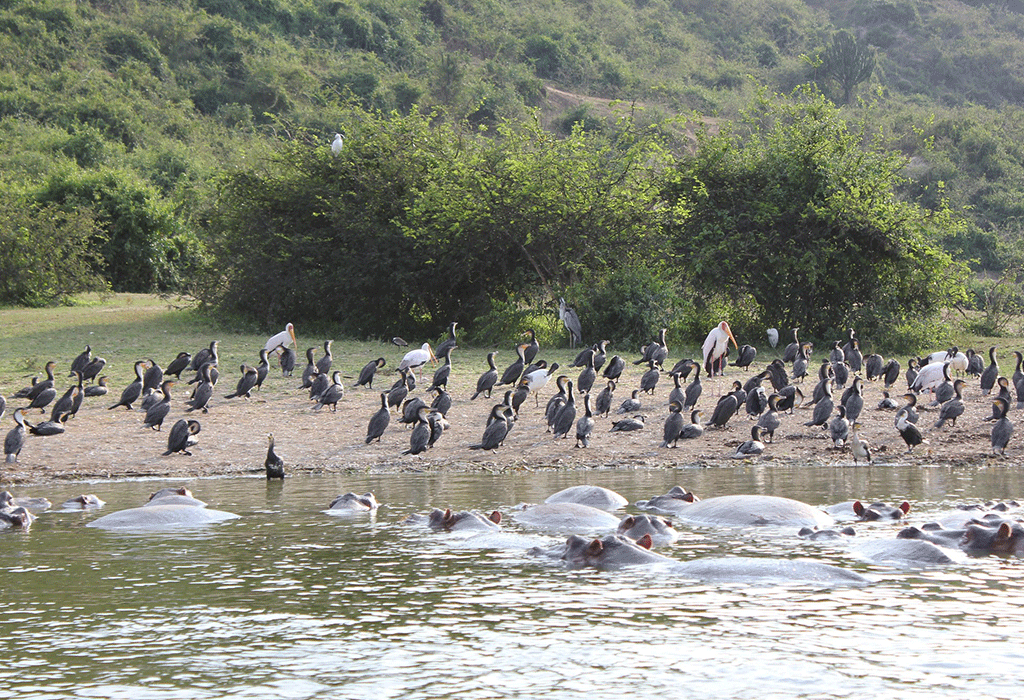
Hippos are Africa’s third-largest land mammals. Only elephants and white rhinos are bigger. They live in Uganda’s rivers, lakes, and wetlands in substantial numbers. These semi-aquatic giants weigh up to 1,500 kilograms. They have strong tusks and aggressive temperaments. Surprisingly, they rank among Africa’s most dangerous animals despite their herbivorous diets.
Queen Elizabeth National Park’s Kazinga Channel
This provides Uganda’s premier hippo viewing. This 32-kilometer natural channel connects Lake Edward and Lake George. It hosts one of the world’s highest hippo concentrations—over 5,000 individuals. Launch cruises along the channel provide spectacular close-up encounters. Massive pods bask in water. Their eyes, ears, and nostrils protrude above the surface while their bodies remain submerged.
Murchison Falls National Park
Significant hippo populations live along the Victoria Nile. Launch cruises from Paraa toward the falls regularly encounter hippo pods. Game drives along riverbanks sometimes reveal these animals emerging at dusk. They come out to graze on land vegetation.
Lake Mburo National Park
Top Most Animals to See on a Uganda Safari: Five lakes and extensive wetlands create an ideal habitat. Healthy hippo populations thrive here. Boat safaris on Lake Mburo provide easy viewing. The park’s compact size makes hippo viewing virtually guaranteed.
Even rivers passing through towns occasionally harbor hippos. For instance, the Nile in Jinja sometimes hosts individuals. They wander from upstream populations. This creates unusual urban wildlife encounters.
Top Most Animals to See on a Uganda Safari: Hippo behavior interests observers. Despite their bulk, hippos move gracefully underwater. They “walk” along river bottoms while holding their breath for up to five minutes. They’re active on land at night during grazing expeditions. Sometimes they travel several kilometers from water. They create highways of paths connecting water bodies to feeding grounds. Territorial bulls defend water territories aggressively through dramatic displays. They yawn to reveal powerful tusks. They charge at intruders and make roaring vocalizations. This demonstrates why these animals command respect.
Safari Vacations and Travel Services incorporates multiple hippo viewing opportunities. Particularly, boat safaris on the Kazinga Channel and Nile work well. They provide guaranteed close encounters in safe, controlled settings.
Nile Crocodile: The Ancient Predator
Nile Crocodiles are Africa’s largest reptile. They’re one of the continent’s most formidable predators. They live in Uganda’s rivers and lakes wherever suitable habitat exists. These prehistoric survivors have remained essentially unchanged for millions of years. They reach lengths exceeding 5 meters and weights over 750 kilograms. Exceptional individuals grow even larger.
The Victoria Nile
Murchison Falls National Park hosts massive crocodile populations. In fact, launch cruises from Paraa toward the falls provide excellent viewing. These reptiles bask on river edges with jaws agape for body temperature control. As a result, the riverbanks sometimes appear lined with crocodiles. Consequently, their numbers create impressive spectacles. Moreover, witnessing large crocodiles slide into water demonstrates their power. Similarly, observing feeding frenzies around fishing areas shows why these predators have fearsome reputations.
Queen Elizabeth National Park’s Kazinga Channel
This channel similarly hosts substantial crocodile numbers. Launch cruises pass numerous basking crocodiles. Particularly large individuals claim prime basking spots along banks. Some exceed 4 meters. Their enormous sizes prompt gasps from visitors.
Lake Mburo
Top Most Animals to See on a Uganda Safari: Top Most Animals to See on a Uganda Safari: Healthy crocodile populations live here. Boat safaris provide easy viewing. The lake’s relatively calm waters create optimal conditions. Accessible shorelines help you photograph these impressive reptiles.
Crocodile hunting behavior rarely gets observed. However, it creates dramatic moments when seen. These ambush predators wait motionless near the water’s edge. Suddenly, they burst into action when prey ventures within range. Their powerful jaws can crush bone and hold large prey underwater until drowned. This makes them efficient killers. Crocodiles play crucial ecological roles. They manage fish populations and consume dead animals. They help maintain aquatic ecosystem health.
Safari Vacations and Travel Services ensures multiple crocodile viewing opportunities. These happen during boat safaris and game drives along rivers. You’ll safely observe these magnificent predators. Additionally, they teach safety protocols near water bodies where crocodiles occur.
Giraffe: The Gentle Giants
Rothschild’s Giraffes are one of nine giraffe subspecies. They’re among the most endangered. They live in Uganda’s northern savannah parks. These are the tallest land animals. Bulls reach heights of 5.5 meters. They create unmistakable sights while browsing on acacia trees. Their elegant outlines shape African savannah landscapes.
Murchison Falls National Park
Here’s your text with smooth transition words added:
This park hosts Uganda’s largest giraffe population. In fact, about 1,400 individuals live here. Moreover, the park’s northern bank provides excellent viewing. Giraffes often approach roads to browse on nearby trees. As a result, their gentle nature makes them safari favorites. Additionally, they’re very photogenic. Notably, watching them spread their front legs to drink is memorable.
. This is a vulnerable position during which they remain alert for predators.
Kidepo Valley National Park
A smaller giraffe population lives here. In fact, it enhances the park’s wildlife diversity. Giraffes here often appear against dramatic mountain backgrounds. As a result, this creates spectacular photographic compositions.
Giraffe social structures differ from those of many mammals. For example, they form loose groups. However, giraffes lack stable herd structures. Consequently, individuals frequently join and leave groups. Males engage in “necking” behaviors. In this process, they swing their necks against rivals to establish dominance. Therefore, this determines breeding access.
Shoebill Stork: The Prehistoric Bird
Top Most Animals to See on a Uganda Safari: Shoebill Storks are among Africa’s most wanted bird sightings. In fact, they represent one of Uganda’s unique wildlife treasures. These massive, prehistoric-looking birds stand up to 1.5 meters tall. Moreover, their wingspan exceeds 2.5 meters. They live in papyrus swamps and wetlands. Notably, their enormous shoe-shaped bills catch lungfish and other prey. As a result, these bills create distinctive profiles. Therefore, shoebills are instantly recognizable.
Uganda hosts several reliable shoebill locations. Mabamba Bay Wetland sits on Lake Victoria’s northern shore. It provides the most accessible viewing. Canoe trips through papyrus waterways usually find these remarkable birds. Ziwa Rhino Sanctuary’s wetlands host resident shoebills. This allows combined rhino and shoebill experiences. Similarly, Semliki Wildlife Reserve and swamps near Queen Elizabeth National Park also provide shoebill possibilities.
Shoebill behavior captivates birders. These solitary, patient hunters stand motionless for hours. Then, they explode into action when prey surfaces within range. Their powerful bills dispatch prey efficiently, and their slow, deliberate movements create an almost otherworldly presence. Their intense stares add to this effect.
Safari Vacations and Travel Services incorporates specialized birding trips for shoebill enthusiasts. They know many visitors specifically seek these incredible birds. Therefore, they combine them with traditional mammal-focused safaris.
Conclusion
Uganda’s wildlife diversity is extraordinary. Mountain Gorillas and chimps live in lush forests. Meanwhile, lions, elephants, and buffalo roam wide grasslands. Tree-climbing lions are unique. Shoebills are prehistoric. All these create safari experiences that rival Africa’s best. Moreover, the country’s compact size helps too. You can visit multiple ecosystems in a single trip. This maximizes wildlife encounters across diverse habitats.
Safari Vacations and Travel Services brings extensive expertise. They craft comprehensive itineraries that showcase Uganda’s spectacular animals. They handle all logistics, including gorilla permits and park access. also they arrange accommodations and expert guides. Whether you prioritize primate tracking, traditional Big Five safaris, or specialized birding trips, Uganda delivers. You’ll experience unforgettable wildlife encounters. Ultimately, you’ll create lifelong memories of Africa’s most magnificent creatures in their natural habitats.