Chimpanzee Permit and Habituation Cost: 3 Smart Choices

Chimpanzee Permit and Habituation Cost: 3 Smart Choices
A permit in Kibale forest can cover either standard tracking or a habituation experience. These activities are not interchangeable. The permit price depends on your travel date and eligibility category, while the complete safari also includes Accommodation and transport.

Chimpanzee permit price comparison
| Kibale activity, foreign nonresident | 2026 reference | Published 2027 tariff |
|---|---|---|
| Ordinary tracking | US$250 | US$250 |
| Ordinary tracking in April, May, November | US$200 | US$200 |
| Habituation experience | US$300 | US$400 |
The 2026 reference uses the earlier published UWA tariff and the February 2026 low-season notice. The February circular proposed a US$300 regular Kibale rate for 2027, but the subsequently published 2027–2028 tariff lists US$250. Confirm the operative permit price in writing before payment. Discounted tickets cannot be rescheduled under the February notice.
Chimpanzee permit: what does the extra fee buy?
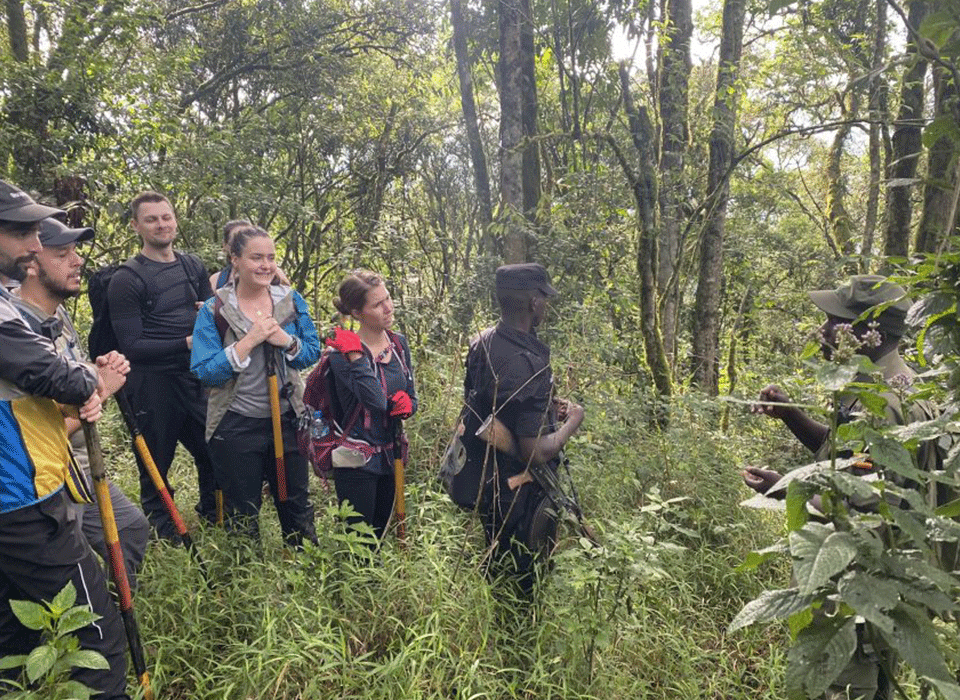
Standard tracking normally provides up to one hour of viewing once the animals are located. The habituation experience allows up to four hours with chimpanzees under the published rules. It can appeal to photographers and visitors interested in feeding patterns, communication and social relationships. It is not permission to approach more closely or to interfere with animal behavior.
How to decide between the activities
Match the activity to your priorities
Standard tracking fits a compact itinerary with an afternoon wetland or community activity, provided the actual trek ends in time.
The habituation experience gives more time for watching a community change its location and activity.
Compare the permit price alongside additional lodging, early transfers and packed meals, not simply the difference between the two ticket types.
Kibale forest is the principal setting for this comparison. Unlike Kibale forest, Budongo and Kyambura have separate tariffs. Do not assume a ticket is transferable between locations.
For two foreign nonresident guests, 2026 regular standard tracking at the reference rate totals US$500 in permits, compared with US$600 for the longer encounter. Both examples exclude the surrounding safari services. A lodge near Kibale forest can reduce early driving, particularly for an activity with an early briefing.
For Kibale forest, check the traveler category, session, cancellation terms and final permit price before requesting confirmation. Tell us whether you favor standard tracking or the habituation experience so the route can be organized accordingly.
Rates are per person.
Permit budgeting and encounter selection in practice
All sample transport and accommodation amounts are hypothetical; the dated activity rates in the earlier table are the relevant published references.
Reading the correct tariff document
The applicable permit charge depends on the activity date, visitor category and official schedule in force; older announcements can differ from later published tariffs.
| Illustrative situation | Practical decision and calculation |
|---|---|
| Quotation refers to an earlier tariff period |
Identify whether a price refers to a historic reference, a current booking or a future effective date. |
| Visitor claims a resident category without documentation |
For an international visitor, verify the nonresident category rather than assuming any advertised rate applies. Before making the next payment, separate the service that is actually confirmed from those that remain provisional. A hypothetical group of 2 guests may need 2 individually valid activity bookings even when accommodation or transport is reserved together. Record any conditions that differ among participants, including eligibility or amendment restrictions. When planning chimpanzee permit, require the booking provider to resolve discrepancies in writing rather than accepting an assurance that the issue can be handled after arrival. |
| Future date falls under a later published schedule |
A resident or citizen should confirm the documentation required to qualify for another tariff. The useful distinction is between a request, a quotation and an accepted reservation. In the chimpanzee permit plan, keep the date, activity name, traveler details and location together in one booking record. If any one changes, ask which other payments are affected before approving the amendment. A room reservation or driver message cannot prove that a controlled wildlife place is confirmed. Ask the responsible supplier to show the current status and applicable terms in writing, particularly when flights or other nonrefundable services depend on it. |
Ask the operator to identify the source and date of the tariff used for the quotation.
The two products in Kibale
Ordinary tracking and habituation are separate activity types, not different room categories within the same tour.

| Illustrative situation | Practical decision and calculation |
|---|---|
| Ordinary product compared with longer habituation |
A visitor with limited time may prefer the standard observation allowance and a separate afternoon plan. |
| Photographer has one extra lodge night available |
A researcher-minded traveler or photographer may value a longer period with chimpanzees under the applicable rules. |
| Short itinerary includes another afternoon activity |
A longer ticket does not guarantee constant visibility or a particular individual being present. |
Confirm exactly which product is available before comparing prices.
A four-hour allowance is not a fixed appointment
The longer encounter allows more observation time under the published rules, but the search itself can be variable.

| Illustrative situation | Practical decision and calculation |
|---|---|
| Chimpanzees travel in the canopy during observation |
Chimpanzees may move through the canopy or travel at ground level, affecting viewing opportunities. Look for observable details rather than demanding a particular encounter. Note the habitat, visibility, movement and any signs the guide points out. If the species or behavior cannot be identified confidently, record it as uncertain rather than turning a brief glimpse into a definite claim. Keep the viewing arrangements within the guide’s authorized instructions. In the context of chimpanzee permit, a useful observation includes what could not be seen as well as what was visible; that keeps the account honest. |
| Group moves between feeding areas |
A visitor should be prepared to follow the authorized group rather than remaining at a personal viewing spot. Observe the relationship between the animal or sign and its surroundings. A feeding movement, track or plant may reveal useful ecological context, but a brief view does not establish a complete diet, route or behavioral pattern. Ask the guide to explain the evidence without disturbing the vegetation or approaching wildlife independently. Record only the features actually visible. For chimpanzee permit, ask questions at an appropriate moment and give the guide time to manage the encounter before discussing its interpretation. |
| Visitor expects four uninterrupted hours of clear views |
A packed meal and suitable equipment may matter more for the longer activity than for a compact excursion. |
Ask when participants report and what the guide recommends bringing.
The difference between the fee and package price
A complete trip may include accommodation, transfers, vehicle days, meals and other activities as well as the permit.
| Illustrative situation | Practical decision and calculation |
|---|---|
| One traveler pays the full private vehicle charge |
A solo traveler may carry the full private vehicle price in addition to the individual ticket. |
| Two guests share transport and each buy a ticket |
Two guests can share the transfer cost, but each needs a valid eligible booking. An illustrative budget of US$830 for a set of local services leaves US$200 after the assumed US$280 shared component and US$350 in individual extras are deducted. The remaining money is not automatically a saving: it may be needed for excluded meals, assistance, an extra transfer or an unexpected change. Keep the actual chimpanzee permit fee on its own line and confirm any tax or currency conversion charges. This method is more useful than averaging unrelated items into an unexplained daily rate. |
| Longer encounter adds a separate lodge night |
A longer forest day may alter meal arrangements or the number of lodge nights needed. For 1 eligible foreign nonresident participant, the two reference amounts of US$300 and US$400 per person produce permit-only totals of US$300 and US$400. The difference is US$100. This is a comparison of the relevant dated reference figures, not a quotation for a current booking. The rate must correspond to the same product and travel date before the numbers can be used. Add the actual accommodation, transport and other separately quoted costs only after identifying the applicable chimpanzee permit charge. |
Compare itemized quotations using the same trip duration and service level.
The 2026 discount window
The February 2026 notice identifies April, May and November for eligible discounted ordinary tracking products.
| Illustrative situation | Practical decision and calculation |
|---|---|
| Regular date compared with April discount |
A flexible traveler can compare a discounted date with a regular date while checking the actual available inventory. For 5 eligible foreign nonresident participants, the two reference amounts of US$200 and US$250 per person produce permit-only totals of US$1,000 and US$1,250. The difference is US$250. This is a comparison of the relevant dated reference figures, not a quotation for a current booking. The rate must correspond to the same product and travel date before the numbers can be used. Add the actual accommodation, transport and other separately quoted costs only after identifying the applicable chimpanzee permit charge. |
| November booking is less flexible than another date |
A fixed-date traveler should not assume that the discount extends to other months or products. |
| Habituation product incorrectly advertised as discounted |
The notice restricts rescheduling of discounted permits, so consider the consequences of a changed itinerary. |
Verify that the lower tariff is actually available for the intended activity and category.
A future booking for 2027
The later published 2027–2028 tariff is a relevant reference when the trip takes place after the revised schedule begins.
| Illustrative situation | Practical decision and calculation |
|---|---|
| 2027 standard and longer activity references differ |
Distinguish an earlier proposed change from the subsequently published regular rate. For 1 eligible foreign nonresident participant, the two reference amounts of US$300 and US$400 per person produce permit-only totals of US$300 and US$400. The difference is US$100. This is a comparison of the relevant dated reference figures, not a quotation for a current booking. The rate must correspond to the same product and travel date before the numbers can be used. Add the actual accommodation, transport and other separately quoted costs only after identifying the applicable chimpanzee permit charge. |
| Early proposal shows another regular price |
For a longer habituation product, account for the higher reference charge before comparing the package total. |
| Operator has not updated an earlier estimate |
Ask for written confirmation of the operative rate when the booking is accepted. |
Do not use an old blog headline as a substitute for the current authority schedule.
Other chimpanzee forests
Kibale is the central comparison here, but Budongo and Kyambura involve separate booking and tariff arrangements.

| Illustrative situation | Practical decision and calculation |
|---|---|
| Murchison route passes a different chimpanzee forest |
A traveler headed toward Murchison may find Budongo geographically more convenient than adding a long journey solely for a ticket. On a sample route, allow 100 minutes for the main road and 15 minutes for the last approach. The total is 115 minutes before stops or formalities. An extra 35-minute buffer brings the planning allowance to 150 minutes. The point of breaking the chimpanzee permit journey into legs is to identify the uncertain connection instead of treating a park, town or regional gateway as one precise address. Substitute a local driver’s estimates for these hypothetical inputs. |
| Queen Elizabeth itinerary includes a local chimpanzee product |
A Queen Elizabeth itinerary can consider the appropriate Kyambura product, subject to availability and its own conditions. A proposed location may look convenient if it is described only by the wider destination. Request two distinct journey estimates: from the arrival point to the property, and from that property to the reserved activity. As an illustration, 100 minutes plus 20 minutes equals 120 minutes of road time across the two legs, potentially on different days. A chimpanzee permit quotation should show which driver is responsible for each leg, whether the vehicle waits and how a change of location affects the remaining itinerary. |
| Kibale booking requires extra road and lodge time |
Different habitats, group movements and search experiences mean the lowest advertised price is not the only criterion. Test two hypothetical approaches to the same reserved activity: one has a 100-minute road journey and the other 130 minutes. The difference is 30 minutes each way, or 60 minutes if the same journey is repeated on the return. Before judging one lodge or gateway cheaper, establish which approach actually serves the confirmed meeting point. For chimpanzee permit, the map distance alone is not a reliable estimate of usable time; ask for the named road, vehicle and access conditions. |
Confirm the exact location, product and inclusion details before treating rates as directly comparable.
Morning logistics and accommodation
A lodge convenient for the confirmed starting point can reduce driving before an early forest activity.
| Illustrative situation | Practical decision and calculation |
|---|---|
| Early meeting point far from a cheaper property |
Ask the operator for the meeting location and actual road duration from the property. Imagine that the planned arrival window is shortened by 40 minutes because of a delay. Establish which arrangements can be prepared remotely: the meal request, room access, pickup instructions and any essential equipment. Keep the essential requirements protected and move only optional tasks. The accommodation should be able to confirm what it actually provides, rather than leaving the driver to arrange everything on arrival. This matters for chimpanzee permit because the next morning’s fixed activity does not move automatically with a delayed lodge arrival. |
| Extended forest day requires a packed meal |
Arrange breakfast and the required food or drinking water the evening before departure. Work back from an illustrative reporting time of 07:00. With 30 minutes on the road and 15 minutes of contingency, a vehicle would leave at 06:15. If guests need another 25 minutes to eat, dress and load the vehicle, the preparations would start at 05:50. Discuss those timings with the actual property before arrival. A chimpanzee permit plan becomes much more comfortable when the kitchen, reception and driver are working from the same appointment rather than three different assumptions. |
| Afternoon activity booked at a fixed hour |
A traveler taking a longer product should allow the rest of the day to remain flexible. Think of a lodge arrival as the beginning of preparation, not the end of the travel day. If check-in, a meal and sorting equipment take an illustrative 25, 45 and 30 minutes, they require 100 minutes in total. Add time for sleep and an early departure before accepting a late arrival. A practical chimpanzee permit arrangement identifies which needs can be organized before the guests arrive, particularly where reception services or kitchen hours differ from those at a city hotel. |
Avoid booking an onward activity that depends on the search finishing at a precise time.
Behavioral observation and photography
More time with chimpanzees can reveal changes in feeding, communication and travel, but behavior remains unpredictable.

| Illustrative situation | Practical decision and calculation |
|---|---|
| Chimpanzees call before they are visible |
Bring equipment that can cope with changing light without interfering with the group. A sound or display is an observation, not proof of the animal’s motive. Note whether the sound is repeated, where it appears to come from and what other activity is visible; do not try to recreate or answer it. The guide can distinguish a reliable identification from an uncertain one and decide whether listening quietly or moving on is appropriate. In the context of chimpanzee permit, a useful observation includes what could not be seen as well as what was visible; that keeps the account honest. |
| Fast movement creates a low-light photography challenge |
Listen for calls and allow the guide to interpret activity before moving or taking photographs. |
| Guest expects a longer ticket to permit closer contact |
Respect current distance, health and photography rules regardless of which product is booked. The safety and conservation rules apply even when an animal looks calm or a visitor has traveled a long distance. Do not attempt contact or handle food near wildlife, and report any relevant illness to park staff. The guide’s instructions about distance, movement and participation take precedence over a visitor’s preferred photograph or activity. The value of chimpanzee permit is not measured by proximity or by a dramatic recording. A short, undisturbed view can be an informative encounter. |
Choose the longer experience because observation is important, not because it promises closer contact.
Cancellation and payment
The February 2026 notice ended the seven-day unpaid reservation arrangement from March 2026, requiring payment to secure the booking.
| Illustrative situation | Practical decision and calculation |
|---|---|
| Operator provides an unpaid price indication |
An emailed price indication is therefore not necessarily proof of an allocated place. |
| Booking paid but product name is unclear |
Request the booking confirmation, date, activity name and visitor category after the payment is accepted. |
| Traveler wants to move a discounted date |
Review the conditions for cancellation, date changes and inability to participate before buying nonrefundable services. The useful distinction is between a request, a quotation and an accepted reservation. In the chimpanzee permit plan, keep the date, activity name, traveler details and location together in one booking record. If any one changes, ask which other payments are affected before approving the amendment. A room reservation or driver message cannot prove that a controlled wildlife place is confirmed. Ask the responsible supplier to show the current status and applicable terms in writing, particularly when flights or other nonrefundable services depend on it. |
Keep correspondence and payment records available if the operator needs to resolve a discrepancy.
Eligibility and health
Great ape tourism has minimum-age and health requirements, which can differ between products and locations.
| Illustrative situation | Practical decision and calculation |
|---|---|
| Family has different activity eligibility ages |
Check each family member’s age and eligibility before paying for a group booking. Consider the full chain of access, starting at the vehicle and ending at the room after the activity. A lodge path or steep step may create a difficulty even if the forest plan appears suitable. The traveler should explain the type of assistance needed at each stage to the operator. For chimpanzee permit, ask which arrangements are confirmed, which depend on the ranger’s assessment and what appropriate alternative exists if conditions change. This avoids a last-minute attempt to improvise support in unsuitable terrain. |
| Guest develops infectious symptoms before the trip |
A traveler with symptoms of infectious illness should report them and follow the authority’s directions. Start with the visitor’s actual needs rather than a general label such as fit or unfit. Identify whether the difficulty concerns carrying weight, maintaining balance, negotiating steps, endurance, or access to the vehicle and accommodation. The appropriate support for one problem may not solve another. For chimpanzee permit, agree the help that the guide or porter is authorized and able to provide, and discuss what will happen if the route proves unsuitable. No assistance arrangement should be represented as a guarantee of access. |
| Traveler is concerned about walking endurance |
Someone concerned about walking difficulty should describe their actual needs rather than relying on a generic fitness label. A practical example is to distinguish items that can remain in a carried daypack from essentials the visitor should have within easy reach. Then discuss the route itself: whether help is needed on descents, during rest stops or only while crossing difficult ground. For chimpanzee permit, the person receiving assistance should be able to communicate preferences and discomfort. Verify the availability, cost and limitations of the arrangement before paying, especially when the visitor cannot safely complete the activity without it. |
Consider appropriate insurance and alternative plans if a participant cannot take part.
Budgeting a two-activity Uganda circuit
A chimpanzee visit may be combined with gorillas, but each controlled activity has its own price and date.
| Illustrative situation | Practical decision and calculation |
|---|---|
| Combined gorilla and chimpanzee circuit |
Confirm both products before finalizing the lodges between the forest regions. Consider an illustrative shared service costing US$440 and an individual extra charge of US$60 for each of 2 travelers. The total for these two sample components is US$560; the per-person amount is US$280.00. That calculation does not include a controlled activity fee unless it is explicitly named in the quote. For the actual chimpanzee permit plan, request the supplier’s figures and identify which line items are shared and which remain payable by every eligible participant. |
| Lower forest ticket requires another night and transfer |
A lower permit charge can be offset by extra driving or accommodation if the chosen location does not fit the route. |
| Four guests compare the total multi-activity package |
Choose the activity combination that reflects wildlife priorities, not simply the largest number of protected areas. |
Request a route-level cost comparison covering all nights, transport and activity charges.
Making the final selection
The most useful comparison asks what the traveler wants from the encounter, how much time is available and what the total budget can support.
| Illustrative situation | Practical decision and calculation |
|---|---|
| Visitor values a short encounter and more destinations |
Choose ordinary viewing if it meets the wildlife objective and leaves room for other experiences. |
| Behavioral photographer wants additional observation time |
Choose a longer observation product if its extra time has genuine value and the physical demands are appropriate. Compare a compact plan with a version that adds one night. The extra night is worthwhile when it solves a real constraint: protecting a confirmed booking, allowing recovery, enabling a second independently scheduled activity or protecting the onward journey. It is less useful if it simply duplicates an existing transfer day. For chimpanzee permit, identify the exact purpose of each night and which activity or road leg it supports, then request a quotation for both sequences rather than comparing trip duration in isolation. |
| Flexible traveler considers the restricted discounted date |
If a lower-priced month is attractive, assess the date restrictions and seasonal conditions alongside the saving. Draw the proposed days as separate blocks rather than treating the entire stay as one pool of available hours. Put the confirmed activity first, then identify the arrival and departure requirements on either side. A chimpanzee permit program should have a genuinely optional component that can be dropped if the main activity takes longer than expected. If another booking has a fixed start, allow a separate day or sufficient realistic margin. The resulting route should still work even when the optional experience does not happen. |
Confirm the product, price, location and exact date together before making a final payment.
Compare My Chimpanzee Permit Options
Travel date, residency category, activity and number of participants.
Compare My Chimpanzee Permit Options →
Email: info@ugandarwanda-safaris.com