What Makes Chimpanzees So Smart: The Science Behind Their Amazing Abilities

Chimpanzee Intelligence & Behaviour
What Makes Chimpanzees So Smart?
Tool use, remarkable memory, social alliances, communication and learned traditions reveal an extraordinary intelligence. Discover how chimpanzees think, learn and interact—and where you can observe these abilities in the wild in Uganda.
Inside the Chimpanzee Mind
Intelligence Built for Life in a Complex Forest World
Watching a wild chimpanzee can quickly change the way you think about animal intelligence. A chimpanzee may select an object for a particular purpose, remember where food can be found, recognise individuals, respond to subtle gestures, cooperate with companions or adjust its behaviour according to what other members of the community are doing.
Chimpanzee intelligence is not defined by one extraordinary skill. It comes from a combination of memory, problem-solving, social awareness, communication, learning and behavioural flexibility. These abilities help chimpanzees survive in environments where food availability changes, relationships matter and individuals must constantly make decisions.
For travellers, this is one reason chimpanzee trekking in Uganda can be so fascinating. You are not simply searching for an animal in the forest. You may witness members of an intelligent primate society feeding, communicating, grooming, competing, playing and caring for young.

The Foundations of Intelligence
Why Chimpanzees Impress Scientists
Tool Use
Chimpanzees can select, modify and use objects to solve practical problems such as accessing food.
Memory
They can remember useful locations, individuals, relationships and information needed for future decisions.
Social Intelligence
Life in a chimpanzee community requires navigating friendships, alliances, competition and hierarchy.
Social Learning
Young chimpanzees learn many behaviours by closely observing other members of their community.

01 — Tool Use
Chimpanzees Don’t Just Find Objects—They Can Turn Them Into Tools
One of the clearest demonstrations of chimpanzee intelligence is their ability to use tools. Across Africa, researchers have documented chimpanzees using sticks, stems, stones, leaves and other natural objects to achieve particular goals.
A chimpanzee searching for insects, for example, may select a suitable stem and manipulate it before using it. In other situations, leaves can function like sponges for collecting water. Some populations have developed specialised techniques for obtaining foods that would otherwise be difficult to access.
The important point is not simply that a chimpanzee can hold a stick. Intelligent tool behaviour involves understanding that an object can help achieve an objective, selecting something appropriate and sometimes modifying it before use.
02 — Learning & Culture
Chimpanzees Learn From One Another
Some of the most interesting chimpanzee behaviours are not performed identically by every population. Different communities can develop different behavioural traditions, providing scientists with an important window into social learning and animal culture.
Observation
Young chimpanzees spend years close to their mothers and other community members, giving them extensive opportunities to observe behaviour.
Practice
Complex behaviours may require repeated attempts. Youngsters can experiment before becoming proficient at particular techniques.
Tradition
Behaviour can spread socially within communities, allowing certain techniques or customs to persist across generations.
Chimpanzees Can Adapt When the Problem Changes
Intelligence becomes especially valuable when an animal faces a problem that cannot be solved by repeating exactly the same behaviour. Chimpanzees show considerable behavioural flexibility. They can investigate objects, learn relationships between actions and outcomes and change strategies when circumstances require it.
Research in controlled settings has demonstrated sophisticated abilities involving object manipulation, sequence learning and problem-solving. In natural environments, similar cognitive flexibility is useful when locating seasonal foods, extracting difficult resources, choosing travel routes and responding to the unpredictable behaviour of other chimpanzees.
This ability to adapt is one reason chimpanzees are so interesting to watch in the wild. Their behaviour is dynamic. Individuals may make different decisions depending on their age, social position, companions, available food and what is happening around them.
04 — Memory
A Powerful Memory Helps Chimpanzees Navigate Their World
Chimpanzees live in environments filled with information. Fruit-bearing trees are scattered across large forest areas, food availability changes through the year and community members constantly move and interact.
Remembering where resources occur, which individuals are socially important and what happened during previous interactions can therefore be extremely valuable.
Laboratory research has also revealed impressive performance by chimpanzees in certain visual and working-memory tasks. These findings should not be interpreted as meaning that chimpanzees are universally “better” than humans at memory. Instead, they demonstrate that chimpanzee cognition has specialised strengths of its own.
Memory Can Help With:
✓ Remembering food locations
✓ Recognising community members
✓ Navigating familiar forest areas
✓ Remembering previous social interactions
✓ Learning successful techniques
✓ Adjusting behaviour based on experience
05 — Communication
Chimpanzees Communicate With More Than Their Voices
Chimpanzee communication involves vocalisations, gestures, facial expressions, body movements and physical contact. Understanding the message often depends on the social situation in which it occurs.
Pant-Hoots
Powerful calls can carry through the forest and help chimpanzees communicate over considerable distances.
Gestures
Hand, arm and body movements can communicate intentions during play, grooming, travel and other interactions.
Facial Expressions
Faces provide additional information during social encounters and can accompany vocal or physical signals.
Touch
Grooming, embracing and other forms of physical contact play important roles in chimpanzee social relationships.
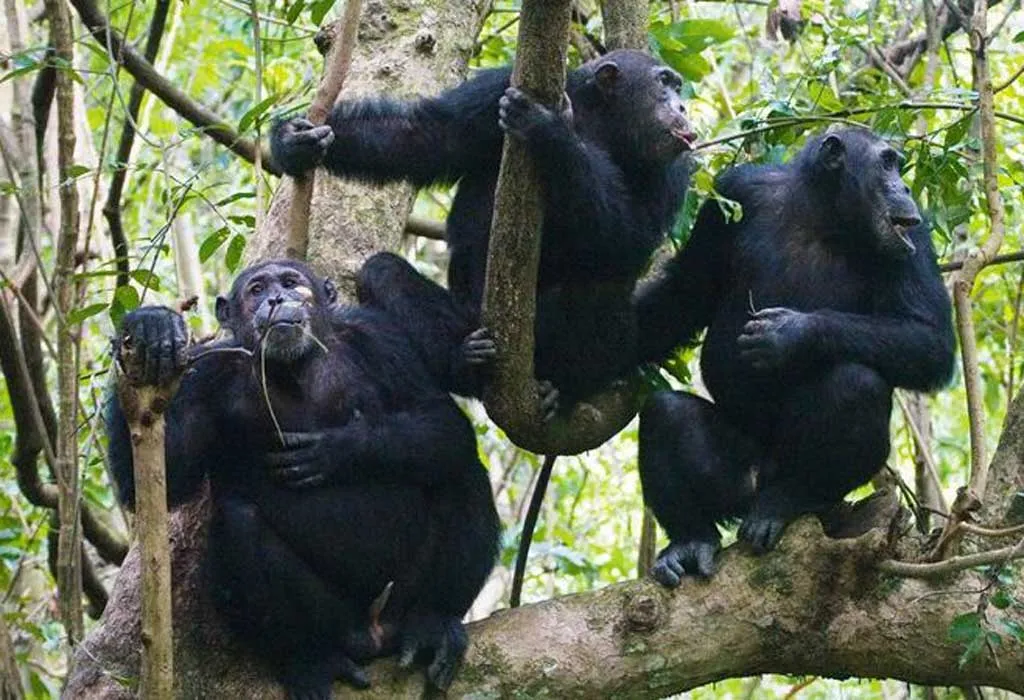
During a Kibale chimpanzee trek, you may actually hear the chimpanzees before seeing them as calls travel through the forest canopy.
06 — Social Intelligence
Sometimes the Hardest Problem Is Another Chimpanzee
Chimpanzees live in complex communities where social knowledge matters enormously. Individuals develop long-term relationships, compete for status and resources, cooperate, form alliances and maintain bonds through grooming and other interactions.
A successful chimpanzee therefore needs more than knowledge of the forest. It also benefits from understanding its social environment: who is nearby, who is dominant, which individuals are friendly, where tensions exist and when cooperation may be useful.
These relationships can change over time. That creates a constantly shifting social world in which flexibility and memory become especially valuable.
Do Chimpanzees Have Emotions?
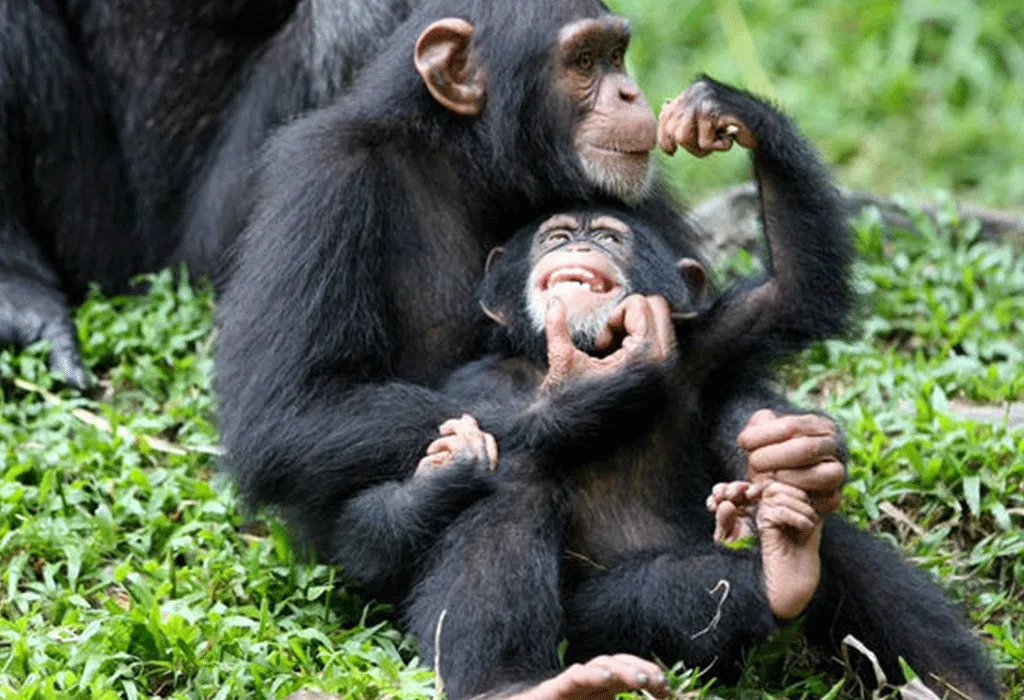
Chimpanzees display a wide range of behaviours associated with social bonding, excitement, fear, distress, reassurance and conflict. Mothers maintain close relationships with their offspring, youngsters play enthusiastically and adults may groom one another for extended periods.
Researchers are careful about automatically interpreting every chimpanzee action in purely human terms. Nevertheless, long-term observation makes it clear that social relationships are central to chimpanzee life.
Grooming is a particularly good example. It helps maintain hygiene, but it is also an important social activity. Who grooms whom, when and for how long can reflect relationships within a community.
08 — Chimpanzee Culture
Different Communities Can Have Different Traditions
One of the most remarkable discoveries from decades of chimpanzee research is that behaviour can vary between populations. Certain tool-use techniques, grooming customs and other behaviours may be common in one community yet absent in another even when ecological conditions alone do not fully explain the difference.
Scientists therefore use the concept of chimpanzee culture to describe behaviours that are socially learned and maintained within communities. It challenges the old assumption that meaningful cultural traditions belong exclusively to humans.
09 — Evolution
What Chimpanzee Intelligence Can Tell Us About Ourselves
Chimpanzees are among humanity’s closest living evolutionary relatives. Humans did not evolve from the chimpanzees alive today; instead, humans and chimpanzees share ancestry deep in evolutionary history.
Studying chimpanzee cognition therefore gives researchers valuable comparative evidence. Abilities involving tool use, cooperation, social learning, communication and problem-solving can help scientists investigate how different aspects of cognition evolved in the ape lineage.
At the same time, chimpanzees should not simply be viewed as incomplete versions of humans. They have followed their own evolutionary path and possess cognitive abilities adapted to their own ecological and social challenges.
From Science to Safari
What Chimpanzee Intelligence Looks Like in the Wild
You are unlikely to see a laboratory-style intelligence experiment during a forest trek. Instead, chimpanzee cognition reveals itself naturally through everyday behaviour.
Feeding Decisions
Watch individuals select foods, move between feeding sites and manipulate natural resources.
Social Grooming
Observe relationships being maintained through one of the most important social behaviours in chimpanzee society.
Mother & Infant Behaviour
Young chimpanzees spend years learning within a rich social environment, especially through their mothers.
Communication
Listen for calls and watch gestures, expressions and physical interactions between individuals.
Chimpanzee Destinations
Where to See Chimpanzees in Uganda
Uganda offers several opportunities to encounter wild chimpanzees, making it an excellent destination for travellers interested in primates and behavioural observation.

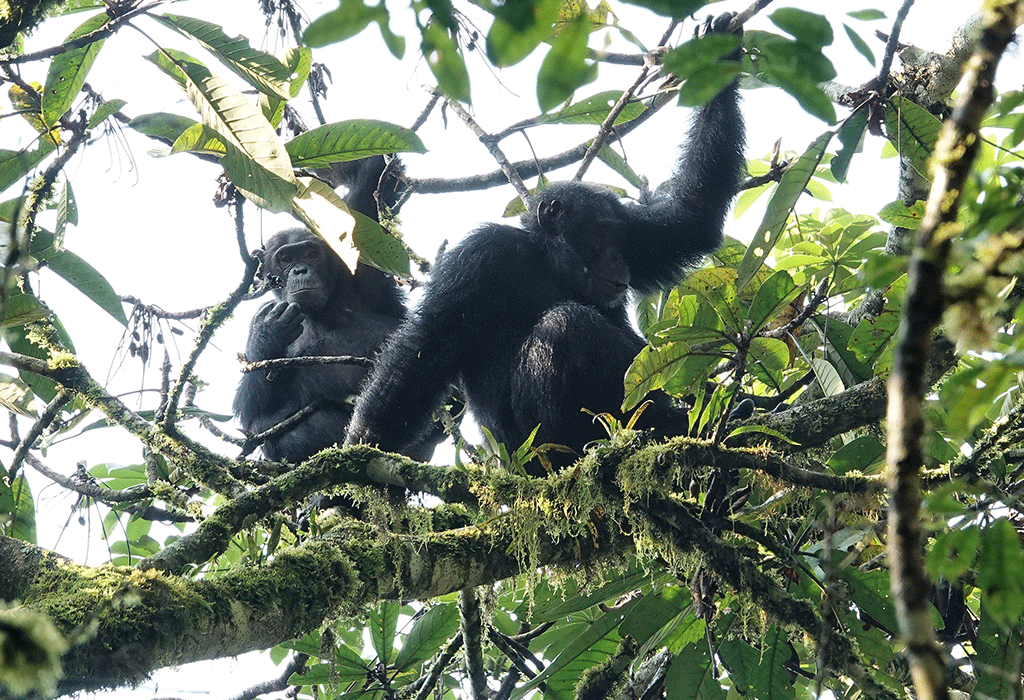
Uganda’s Primate Highlight
Why Kibale Is the Leading Choice for Chimpanzee Trekking
Kibale National Park is one of Uganda’s most important primate destinations. Its established chimpanzee tourism program gives visitors an opportunity to enter the forest with trained guides and trackers in search of habituated chimpanzees.
Regular chimpanzee tracking works well for most visitors. Travellers who want a more immersive experience can consider the chimpanzee habituation experience, which provides extended time associated with the process of gradually familiarising wild chimpanzees with carefully managed human presence.
Kibale also fits naturally into a longer Uganda safari combining chimpanzees with Queen Elizabeth National Park and mountain gorillas in Bwindi.

Choose Your Experience
Chimpanzee Tracking vs Habituation
| Feature | Chimpanzee Tracking | Habituation Experience |
|---|---|---|
| Style | Classic forest trek | More immersive observation |
| Time with chimps | Typically about 1 hour after locating them | Extended experience |
| Best for | First-time visitors and general safari travellers | Primate enthusiasts, photographers and keen observers |
| Planning | Permit required | Limited permits; advance planning recommended |
Planning Information
Kibale Chimpanzee Permit Prices
Permit fees vary by visitor category and experience. Rates can change, so availability and the applicable rate should always be reconfirmed before payment.
| Visitor Category | Chimpanzee Tracking – 2026 | Habituation – 2026 |
|---|---|---|
| Foreign Non-Resident | USD 250 | USD 300 |
| Foreign Resident | USD 200 | USD 250 |
| East African Citizen | UGX 180,000 | UGX 250,000 |
Always confirm current Uganda Wildlife Authority rates and permit availability when planning your safari.
Two Great Apes, Two Different Experiences
Chimpanzees vs Gorillas: What Feels Different?
| Characteristic | Chimpanzees | Mountain Gorillas |
|---|---|---|
| Movement | Often fast and highly mobile | Often more settled while feeding or resting |
| Forest position | Frequently ground and canopy | Frequently observed on or near the ground |
| Vocal atmosphere | Can be energetic and noisy | Often quieter |
| Safari character | Dynamic primate tracking | Close observation of a gorilla family |
For many travellers, the ideal primate safari includes both. Read more about gorilla trekking in Uganda and consider combining Bwindi with Kibale.
Build a Complete Safari
Combine Chimpanzees, Wildlife and Mountain Gorillas
Chimpanzee trekking works exceptionally well as part of a wider western and southwestern Uganda itinerary.
Entebbe
Arrival and safari preparation.
Kibale
Chimpanzee trekking and primate encounters.
Queen Elizabeth
Game drives and the Kazinga Channel.
Bwindi
Mountain gorilla trekking.
Protecting the Chimpanzees You Have Travelled to See
Chimpanzees are biologically close enough to humans that disease transmission is an important concern. Responsible trekking therefore requires visitors to follow ranger instructions carefully and respect the rules established for primate encounters.
Follow your ranger’s instructions throughout the encounter.
Respiratory infections can pose risks to great apes.
Food can alter natural behaviour and create health risks.
Experienced guides manage both visitor safety and responsible observation.
Frequently Asked Questions
What Makes Chimpanzees So Smart FAQs
Why are chimpanzees considered intelligent?
Chimpanzees demonstrate sophisticated abilities involving problem-solving, tool use, memory, social learning, communication and management of complex social relationships.
Can chimpanzees use tools?
Yes. Wild chimpanzees have been documented using and sometimes modifying natural objects for purposes including food extraction and obtaining water.
Do chimpanzees have language?
Chimpanzees have sophisticated communication systems involving vocalisations, gestures, facial expressions and body movements, but these should not simply be equated with the full symbolic language used by humans.
Are chimpanzees smarter than gorillas?
There is no single meaningful intelligence score that makes one species universally “smarter.” Chimpanzees and gorillas have different behavioural and cognitive adaptations, although chimpanzees are especially well known for complex tool use and dynamic social behaviour.
Where is the best place to see chimpanzees in Uganda?
Kibale National Park is generally the leading choice for a dedicated chimpanzee experience because of its established trekking program. Kyambura Gorge and Kalinzu Forest are useful alternatives, particularly when combining primates with a Queen Elizabeth National Park safari.
Can I combine chimpanzee and gorilla trekking?
Yes. A popular Uganda primate route combines Kibale National Park for chimpanzees with Queen Elizabeth National Park and Bwindi Impenetrable National Park for mountain gorilla trekking.
Experience It in the Wild
See Chimpanzee Intelligence for Yourself in Uganda
Reading about chimpanzee intelligence is fascinating. Hearing pant-hoots echo through a rainforest and then watching a community interact only metres away turns the science into an unforgettable wildlife experience.
Safari Vacations and Travel Services can arrange your chimpanzee permits, accommodation, private 4×4 transport and a complete Uganda itinerary combining Kibale with wildlife safaris and mountain gorilla trekking.