The Most Intelligent Creature in the World and Where to Find It

The Most Intelligent Creature in the World and Where to Find It
When we think about intelligence in the animal kingdom, two species often come to mind: chimpanzees and dolphins. Both exhibit remarkable cognitive abilities, complex social structures, and the capacity for problem-solving. However, in this blog, Safari Vacations and Travel Services will delve deeper into a chimpanzee, the most intelligent creature in the world, and highlight the best places where to find it.
Understanding Chimpanzee Intelligence
Chimpanzees (Pan troglodytes) are considered one of the most intelligent animals due to their advanced problem-solving skills, ability to use tools, and complex social behaviors. They share approximately 95% of their DNA with humans, making them our closest living relatives. This genetic similarity contributes to their remarkable cognitive abilities, which include:
- Tool Use: Chimpanzees have been observed using sticks to extract termites from mounds, stones to crack nuts, and leaves to soak up water. This ability to create and use tools demonstrates a level of foresight and understanding of their environment that is rare in the animal kingdom.
- Social Learning: They can learn from one another, passing knowledge and skills through generations. For instance, young chimps often learn to use tools by observing their mothers.
- Complex Communication: Chimpanzees communicate using a variety of vocalizations, gestures, and facial expressions. Their social interactions are rich and nuanced, allowing them to express emotions such as joy, sadness, and empathy.
- Problem-Solving Skills: In various studies, chimpanzees have shown the ability to solve complex puzzles and tasks, often demonstrating a level of reasoning comparable to that of young children.
How chimpanzees communicate with each other
Chimpanzees, our closest living relatives, possess a rich and complex communication system that encompasses a variety of vocalizations, gestures, and facial expressions. Their ability to convey messages reflects not only their intelligence but also the social structures and dynamics within their communities. Here’s an overview of how chimpanzees communicate with each other.
Vocalizations
Chimpanzees use a range of vocal sounds to communicate different messages. Some of the most common vocalizations include:
- Pant-Hoots: This is a distinctive vocalization that serves various purposes, such as signaling presence, attracting attention, or expressing excitement. Pant-hoots can vary in intensity and duration, often depending on the context of the interaction.
- Screams and Grunts: These sounds can indicate distress, aggression, or submission. For example, a scream may signal fear or alarm, while grunts can be used during social interactions to express contentment or reassurance.
- Barks and Hoots: These are often used to alert other group members to potential threats or to communicate during foraging.
Research indicates that chimpanzees adjust their vocalizations based on the attentional state of their audience. For instance, they tend to use more vocalizations when their audience is not paying attention to them, suggesting an awareness of social dynamics and the need to capture attention.
Gestures
Gestural communication is a significant aspect of chimpanzee interactions. Chimpanzees employ a variety of manual gestures to convey messages, including:
- Hand Signals: These can include reaching out, pointing, or tapping another chimpanzee. Such gestures often serve as requests for grooming, food sharing, or social bonding.
- Body Postures: The way a chimpanzee positions its body can communicate intentions or emotions. For example, a relaxed posture may indicate friendliness, while a tense posture could signal aggression or discomfort.
- Facial Expressions: Chimpanzees use facial cues, such as baring teeth or raising eyebrows, to express emotions. These expressions can accompany gestures to enhance the meaning of the communication.
Studies have shown that chimpanzees often combine gestures with vocalizations to create more nuanced messages. This multimodal communication allows them to convey complex information and adapt their signals based on the social context and the responses of their audience.
Turn-Taking Dynamics
Recent research has highlighted that chimpanzee communication exhibits turn-taking dynamics similar to human conversations. During interactions, chimpanzees often engage in back-and-forth exchanges, where one chimp gestures or vocalizes, and the other responds in kind. This process can involve multiple exchanges, resembling the structure of human dialogue.
Contextual Communication
Chimpanzees are adept at adjusting their communication based on the context of their interactions. They exhibit a sensitivity to the social environment, modifying their gestures and vocalizations depending on factors such as the presence of other individuals, the nature of the interaction (e.g., friendly versus aggressive), and the visibility of their audience. For instance, they may use more vocal signals when their audience is out of sight, indicating an understanding of the need to ensure their message is received.
How do chimpanzees use tools in their daily lives?
Chimpanzees are renowned for their sophisticated tool use, which plays a significant role in their daily lives. Here are some of the key ways chimpanzees utilize tools:
Termite Fishing
Chimpanzees use long, slender sticks to “fish” for termites from their mounds. They carefully insert the stick into the termite nest, wait for it to be covered in termites, then withdraw it and use their teeth to remove the termites.
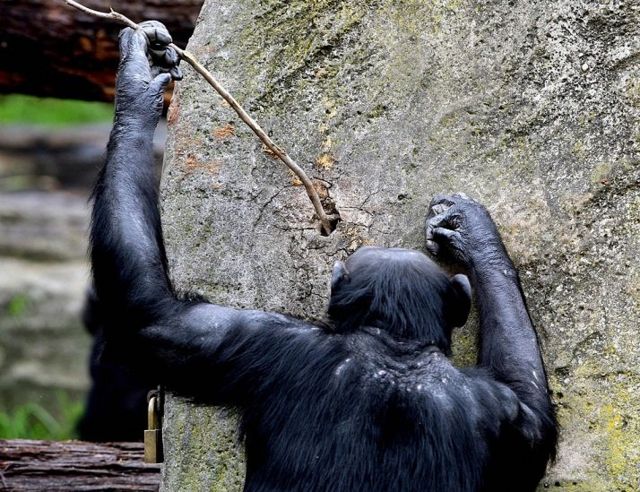
Chimpanzee termite fishing
Nut Cracking
Chimpanzees use stone hammers and anvils to crack open hard nuts. They select appropriately sized stones for the task, and some populations have even been observed modifying the hammers by removing flakes to create a better grip.
Honey Extraction
To extract honey from beehives, chimpanzees use a complex toolset. This includes using sticks to puncture the hive, leaves to wipe the honey, and a stick to scoop out the honey.
Leaf Sponging
Chimpanzees use leaves to soak up water from hard-to-reach places. They either chew the leaves to create an absorbent sponge or fold the leaves into a scoop shape.
Hunting
Some chimpanzee populations have been observed using tools to hunt other animals. In Senegal, they use spears to hunt bushbabies, carefully modifying the sticks by trimming off the side branches.
Social Grooming
Chimpanzees use twigs or grass stems to groom each other’s fur and remove dirt and parasites. This social grooming helps maintain strong social bonds within the group.
Displaying Aggression
Chimpanzees will sometimes use sticks or rocks as weapons when displaying aggression towards other individuals or groups. They may also throw these objects. The use of tools is not innate in chimpanzees but rather a learned behavior that is socially transmitted within their communities. Young chimpanzees observe and learn from their elders, and it can take up to seven years for them to fully master these complex techniques.
Where to Find Chimpanzees
Chimpanzees are among the most intelligent and socially complex animals on the planet. Observing them in their natural habitat is a thrilling experience that allows us to connect with our closest relatives in the animal kingdom. For those eager to witness these incredible creatures, Africa offers several prime locations for chimpanzee trekking. Here are the best places to see chimpanzees in their natural habitat.
Kibale National Park, Uganda
Kibale National Park is often referred to as the “primate capital of the world.” This park boasts the highest density of primates in Africa, including a large population of chimpanzees. Visitors can embark on guided treks through the lush rainforest, where they have a high chance of encountering these fascinating animals.
- Highlights:
- Over 13 species of primates, including red colobus and L’Hoest’s monkeys.
- Well-established trekking infrastructure with experienced guides.
- Scenic landscapes featuring tropical forests and diverse wildlife.
Mahale Mountains National Park, Tanzania
Mahale Mountains National Park is renowned for its stunning scenery and rich biodiversity. Located on the shores of Lake Tanganyika, this park is home to a significant population of chimpanzees. The trekking experience here is often described as one of the best in Africa due to the high likelihood of close encounters with habituated chimpanzee groups.
- Highlights:
- Remote and picturesque setting with breathtaking views of the lake and mountains.
- Excellent opportunities for multi-day tracking, increasing chances of intimate encounters.
- Luxurious lodges such as Greystoke Mahale, provide a unique wildlife experience.
Nyungwe National Park, Rwanda
Nyungwe National Park is one of Africa’s oldest rainforests and is rich in biodiversity. It is home to a thriving population of chimpanzees, making it an excellent destination for primate enthusiasts. Visitors can combine their chimpanzee trekking experience with a visit to the famous mountain gorillas in nearby Volcanoes National Park.
- Highlights:
- A diverse range of wildlife, including 12 species of primates.
- Stunning landscapes featuring tea plantations and ancient forests.
- High-quality accommodations, such as One & Only Nyungwe Forest Lodge.
Gombe Stream National Park, Tanzania
Gombe Stream National Park is famous for being the site of Jane Goodall’s groundbreaking research on chimpanzees. This small park, located on the shores of Lake Tanganyika, offers visitors a chance to observe chimpanzees in a setting steeped in scientific history.
- Highlights:
- Opportunities to see the Kasekela chimpanzee community, known for their social interactions.
- Beautiful hiking trails with stunning views of the lake.
- A more intimate trekking experience due to the park’s smaller size.
Kyambura Gorge, Uganda
Located within Queen Elizabeth National Park, Kyambura Gorge is a lesser-known but excellent location for chimpanzee trekking. The gorge is home to a small population of chimpanzees that can be observed in a unique landscape of lush vegetation and cliffs.
- Highlights:
- Affordable trekking permits compared to other locations.
- Stunning scenery with diverse ecosystems.
- Opportunities to see other wildlife, including birds and various mammals.
Kaniyo Pabidi, Budongo Forest Reserve, Uganda
Kaniyo Pabidi is part of the Budongo Forest Reserve and is known for its excellent chimpanzee trekking opportunities. This area is less crowded than other parks, providing a more serene experience while observing chimpanzees.
- Highlights:
- A good location for spotting chimpanzees before heading to nearby Murchison Falls National Park.
- Experienced guides who provide insights into chimpanzee behavior and habitat.
- Rich biodiversity, including various bird species and other primates.
Kalinzu Forest, Uganda
Kalinzu Forest is another fantastic spot for chimpanzee trekking, located near Queen Elizabeth National Park. This forest is home to a healthy population of chimpanzees and offers a variety of trekking options.
- Highlights:
- Proximity to Queen Elizabeth National Park, allowing for combined wildlife experiences.
- Opportunities to see different primate species, including the black-and-white colobus monkeys.
- Less touristy than other locations, providing a more intimate experience.
Ngamba Island Chimpanzee Sanctuary, Uganda
While not a natural habitat, Ngamba Island offers a unique opportunity to see and learn about chimpanzees. This sanctuary is home to orphaned chimpanzees rescued from the illegal pet trade and provides a safe environment for them.
- Highlights:
- Educational programs about chimpanzee conservation and welfare.
- Opportunities to observe chimpanzees up close in a semi-natural setting.
- Guided tours that provide insights into the challenges facing chimpanzees in the wild.
Chimpanzees are extraordinary creatures that captivate the hearts of those who encounter them. The best places to see them in their natural habitat are primarily located in Uganda and Tanzania, with Rwanda also offering excellent opportunities. Each of these locations provides a unique experience, allowing visitors to witness the intelligence and social complexity of chimpanzees while supporting conservation efforts. Whether you’re trekking through the lush forests of Kibale or enjoying the stunning views at Mahale, observing chimpanzees in the wild is an unforgettable adventure that highlights the importance of protecting these remarkable animals and their habitats.
Conservation Challenges
Despite their intelligence and adaptability, chimpanzees face significant threats in the wild. Habitat loss due to deforestation, hunting, and the illegal pet trade has led to a dramatic decline in their populations. Conservation efforts are crucial to ensure the survival of these remarkable creatures. Organizations like the Jane Goodall Institute and Project Chimps work tirelessly to protect chimpanzees and their habitats.
Conclusion
Chimpanzees are undoubtedly among the most intelligent creatures on our planet. Their cognitive abilities, social structures, and emotional depth are a testament to their evolutionary success. For those looking to witness their intelligence firsthand, Uganda, Tanzania, and Rwanda offer some of the best opportunities to observe these incredible animals in their natural habitats. By supporting conservation efforts and responsible tourism, we can help ensure that future generations will also have the chance to marvel at the intelligence of chimpanzees.
Whether you are a wildlife enthusiast, a researcher, or simply someone who appreciates the wonders of nature, a trip to see chimpanzees in the wild is an unforgettable experience that highlights the importance of preserving our planet’s biodiversity.