Ramsar Sites in Uganda
Ramsar Sites in Uganda
There are 12 Ramsar sites in Uganda, which are mainly wetland systems. These include Nabajjuzi, Lutembe Bay, Mabamba, Makanaga, lake Opeta, lake Bisina, and Lake Nakuwa. Others include Lake Nabugabo, Lake Albert, Nile Delta, and Lake Mburo Nakivale. They’re under the class of Important Bird Areas (IBAs)
A Ramsar site is a wetland site that is designated by the Ramsar Convention to be of international importance. Ramsar Convention, also famous as “The Convention on Wetlands”, is an intergovernmental environmental treaty. UNESCO established it in Ramsar, Iran on Feb 2, 1971, and came into force on Dec 21, 1975. The treaty provides for national action and international cooperation regarding the conservation of wetlands and the wise sustainable use of their resources.
Ramsar sites and wildlife in Uganda
Wetlands in Uganda serve multi-purpose functions including offering some of the best bird-watching destinations in the country. One of the rare African bird species, the shoebill stork can be seen at all 12 sites. The shoebill dwells in permanent and primary freshwater shallow papyrus wetland habitats rich in biodiversity.
Those coming to see the shoebill also get the opportunity to spot other species with over 1,061 bird species in Uganda. This is almost 11% of the bird population in Africa. The endangered gray-crowned crane is the national bird of Uganda. You mostly find the Ramsar wetlands around the great lakes of Victoria, Nyanza, Albert, Edward, and Kyoga, and along the Nile River.
How to get there
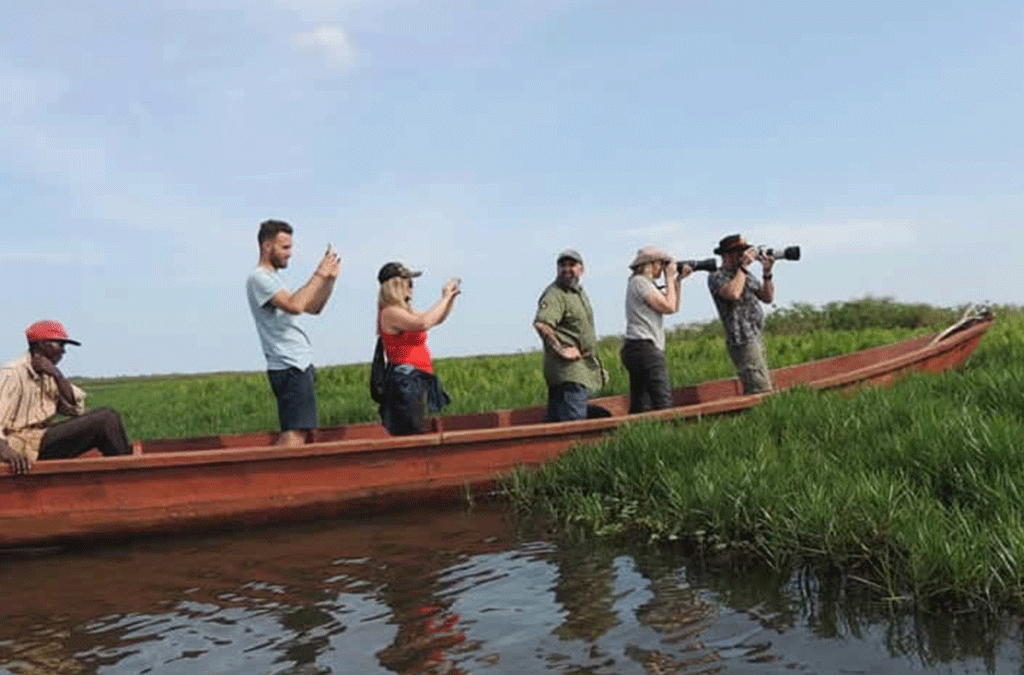
Small motor boats and canoes from wood are used to navigate the wetland channels in search of birds. There are professional bird guides who will take care as you sit and enjoy the trip. Birding experience in the wetlands reminds you how much local people depend on nature, for instance through fishing. The freshwater lakes are home to a variety of fish species including the lungfish that the shoebill mainly feeds on.
The Baganda people in Buganda kingdom call this fish Mamba which is a totem of the Mamba clan. People from this clan don’t eat it. Rather, they prefer other species such as tilapia, catfish, and bichir, which are also part of the shoebill diet. This means that people compete with birds over fish and other natural resources. For instance, wetlands are a source of medicinal herbs, water, and reeds to make handicrafts.
There’s also a need for land to grow food, create livestock farms, and mine sand and clay for construction, which degrades the wetlands. Besides the socio-economic roles, these natural areas also provide ecological services. These include regulation of pollution, floods, soil erosion, climate change, and providing shelter to wildlife.
Ramsar sites in Uganda
Birders have recorded the Shoebill stork in Uganda at 12 Ramsar sites including Mabamba Bay, Makanaga, and Lutembe Bay. Others are Nabujuzi wetland and Lake Nabugabo on the west shores of Lake Victoria. Then, others are the Nile Delta in Murchison Falls, Nakivale in Lake Mburo, lake Bisina, Opeta, and Nakuwa in the east of Lake Kyoga basin), and Lake Edward in Queen Elizabeth National Park. According to the Uganda Bird Guides Association, sightings are most successful at 5 of the 12 sites. These include Murchison Falls, lake Mburo, and Queen Elizabeth National Parks, Mabamba and Makanaga wetlands. Shoebill birding tours are available for booking through a tour operator like Safari Vacations and Travel Services.
Mabamba and Makanaga swamp
Mabamba Bay Wetland is 47 km west of Entebbe town via Kawuku-Nakawuka rd and 12 km via Kasange Road. You can also go on a birding day trip to Mabamba from Kampala capital city. The swamp stretches for 16,500 hectares including the adjacent Makanaga wetland. Both are home to the shoebill, the main attraction with higher chances of seeing the bird. Makanaga is 60 km west of Entebbe and is reached through Kamengo off the Masaka-Kampala highway.
In particular, the Mabamba swamp is home to over 260 bird species including Lake Victoria basin endemics such as papyrus gonolek and white-winged swamp warbler. Mabamba also attracts migratory species such as blue swallow and white-winged black, gull-billed, and whiskered terns. Those intending to stay close to Mabamba can get a room at Nkima Forest Lodge, with a view of the marsh. You can do Birding on both wetlands using a wooden canoe, in which guests sit with a guide and pilot. The canoe does not emit sound like motorized canoes, it is easier to navigate the swamp canals with lookout points to spot birds.
The Kyoga Basin satellite lakes
Kyoga is Uganda’s most shallow lake, southeast of Murchison Falls and East of Lake Albert. The eastern part of the lake consists of 3 lakes including Bisina, Opeta, and Nakuwa. Both are Ramsar sites and IBAs and are home to the shoebill stork. The sites were gazetted, however, tourism is not fully developed.
There’s still a need for more projects that not only provide accessibility but also support the communities living around them. Opeta, which covers 68,912 hectares, is largely a papyrus wetland. However, it also contains thatching (hyparrhenia) and hippo grasses to the north, where it borders the Pian Upe Wildlife Reserve.
Besides the shoebill, the site is famous for harboring Uganda’s only endemic bird, the fox’s weaver (ploceus spekeoides). The bird is classified as a Near Threatened species, however, there is insufficient data about its status and range. A study done by Nature Uganda in 2010 “Survey of the Fox’s Weaver, the only Ugandan Endemic bird species’ ‘ confirmed that Opeta and the adjacent Lake Bisina wetland system are significant breeding grounds of the fox’s weaver.
Lake Bisina Wetland
This is one of the top Ramsar sites in Uganda. Lake Bisina wetland 54,229 hectares, in particular, is also a Ramsar site important for shoebill conservation. Unlike Bisina and Opeta, the Lake Bisinawetland system is unique and consists of suds (floating vegetation that forms obstructive masses that characterize much of the white Nile). In addition to being important sites for shoebill conservation, the Kyoga satellite lakes are rich in biodiversity. This includes haplochromine cichlid fish species, which are endemic to East African Great Lakes.
These species have become extinct in Lake Victoria due to the introduction of the Nile perch that preys on them. The Kyoga satellite lakes remain as the last habitat for the haplochromine cichlid fish species given that the suds prevent the Nile perch from accessing these wetlands. The Bisina and Opeta wetlands are home to over 12 different weaver species. These include Compact, northern Brown-throated, Yellow-backed, Lesser Masked, Grosbeak, and Slender-billed weavers. Others include Jackson’s Golden-backed, Black-necked, Heuglins Masked, and Spectacled weavers.
Nile Albert Delta Wetland
Located within Murchison Falls National Park, the Nile Albert Delta offers the best chances to spot the shoebill stork. There’s a significant number of shoebills being a protected area and you also guarantee the sightings. The swamp covers 17,293 ha in the area around the confluence of the Victoria Nile and Lake Albert within the protected area.
Murchison Falls is home to over 460 species of birds of which most water bird species can be seen at the delta including the great snipe, which is under threat. You access the delta whilst in the north sector of the park by motor canoes. You can’t use Wood canoes due to the presence of crocodiles.
In addition to being a great place to go bird watching, Murchison offers fantastic opportunities to see wildlife. This includes lions, elephants, leopards, giraffes, buffaloes, Uganda kob, Jackson’s hartebeest, oribi, waterbucks, and warthogs. The most important activities to do there are game drives and a boat cruise along the Victoria Nile. Also, you can embark on a visit to the top of the falls. The southern part of the park contains Budongo Central Forest Reserve, which offers opportunities for chimpanzee tracking.
Nakivale wetland system
The Ramar site forms part of Lake Mburo National Park and consists of 13 lakes of which 5 are within the protected area. Savanna woodlands, acacia, and euphoria trees with metamorphic rocks protruding above the relief make up the rest of the park. The diverse habitats support rich biodiversity including 370 bird species and 69 mammal species. You track the shoebill on foot along the Kyempitsi trail on the shores of lake Mburo. Other water bird species include the African finfoot, papyrus gonolek, African water rail, water thick-knee, and hammerkops.
Lutembe bay wetland
This Ramsar site is 13 km from Kajjansi town off Kampala-Entebbe Rd and can also be reached by boat from the Entebbe Zoo. Lutembe Bay is easy to visit on a day trip from Kampala or Entebbe. Nature Uganda identified the presence of over 70 species including the Palearctic migrants such as the Malagasy pond herons and white-winged terns in huge flocks. The shoebill isn’t regularly seen, however. Keen birders can identify over 50 Indigenous species such as the green-backed heron, knob-billed duck, greenshank, lesser black-backed gull, and Klaas’s cuckoo.
Lake Nabugabo wetland system
Situated 18 km from Masaka municipality, lake Nabugabo wetland system covers 22,000 hectares. There’s Sand Beach Resort which offers accommodation, conference facilities, food, and a wide range of water sports and adventure activities alike such as zip lining. Unlike other Ramsar sites, Nabugabo wetland system is unique.
There are 3 smaller lakes detached from Lake Victoria by a 2 km wide barrier of sand where water seeps through. The area contains papyrus vegetation as well as tropical forests with over 100 plant species including carnivorous species called insectivorous such as Droseraceae.
Nabugabo wetland system was designated a Ramsar site in 2004 to protect endangered bird species including the shoebill stork and papyrus gonolek, one of the Lake Victoria basin endemics. The site also attracts migratory species and is famous for harboring 15% of the world’s Blue swallow population. Over 5 globally threatened species of birds have been recorded at Nabugabo including the pallid harrier and the great snipe.
Nabujjuzi wetland system
Designated in 2006, the Ramsar site covers 1,753 hectares extending from Masaka, Mpigi to Sembabule districts in Budu county Buganda kingdom. Some parts of Nabajjuzi wetland systems are in the river Katonga basin which flows from Lake Victoria to Wamala and empties into Lake Edward in Queen Elizabeth National Park.
The vegetation in the wetland includes the dominant Papyrus sedge, silver grass (miscanthus violaceus), and some water lilies such as blue lotus (nymphaea nuchal va). Some of the bird species recorded at Nabajjuzi are considered endemic such as the papyrus yellow warbler (chloropeta gracilirostris) and papyrus gonolek (laniarius mufumbiri) as well as the shoebill stork, and gray crowned crane.
In addition, the Sitatunga, swamp-dwelling antelope is also regularly seen. Also, a variety of fish species including lung and mudfish support the livelihoods of many people who live around the wetland. Among the main threats to Nabajjuzi wetland include water pollution resulting from chemicals at the Novelty Tannery factory, car washing and the use of pesticides in the agricultural areas of the wetland, and brick making.
The communities depend on it and there are conservation and livelihood programs to enhance sustainable utilization of resources. The site is under the Lake Victoria Conservation Environmental Education Programme sponsored by the Wetlands Department in partnership with Nature Uganda and the African Wildlife Foundation.