
Tanzania Safaris: Complete Safari Guide for 2026/2027
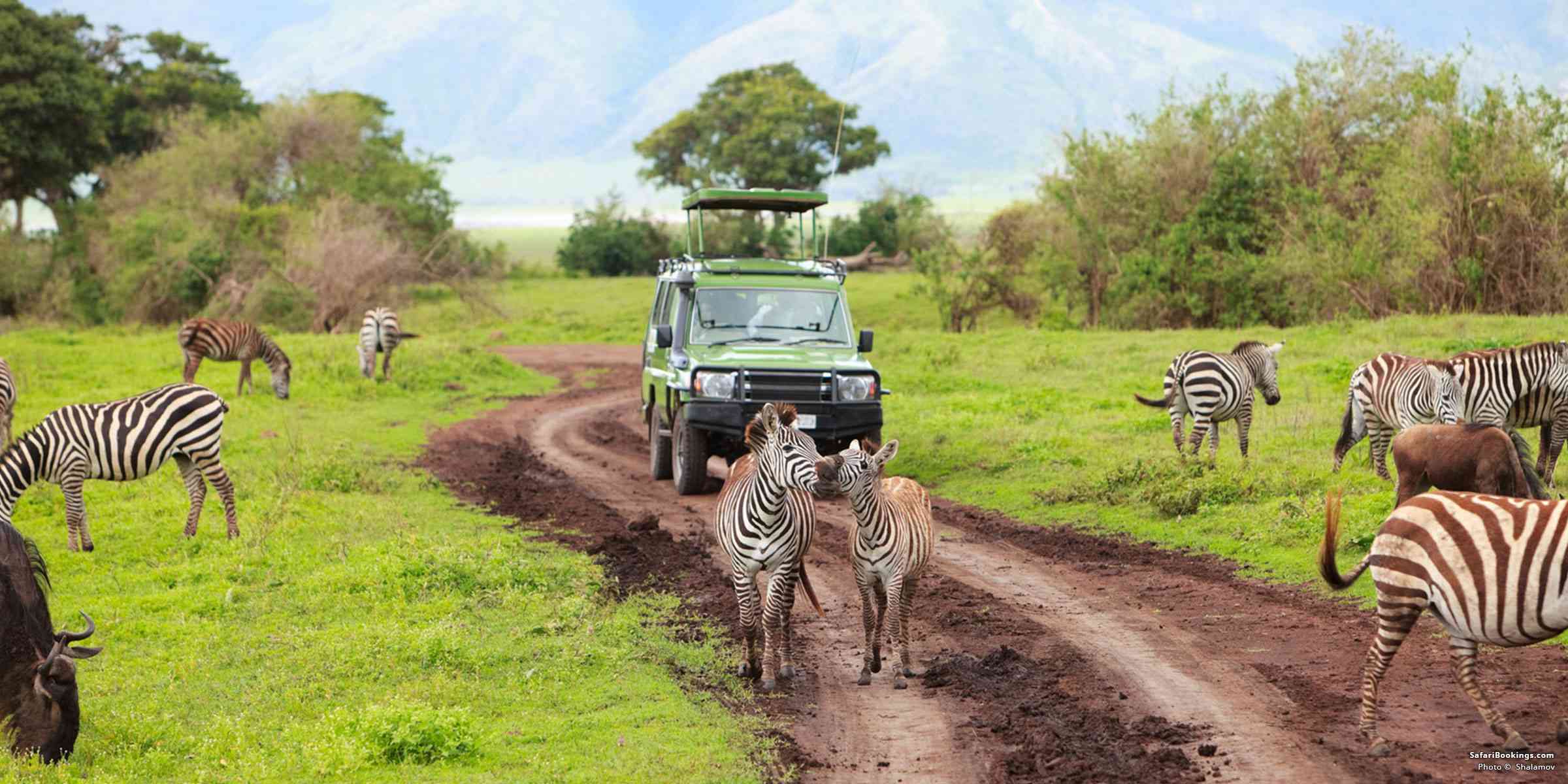
A classic Tanzania safari game drive as zebras gather around a 4×4 safari vehicle in the heart of the African wilderness.
Tanzania safaris bring together some of Africa’s most celebrated wildlife landscapes, from immense savannahs and volcanic highlands to river valleys, woodlands and remote wilderness areas. For travelers dreaming of lions on open plains, enormous elephant herds, spectacular predator encounters and the seasonal movement of wildebeest across the Serengeti ecosystem, Tanzania offers an exceptional range of possibilities. A carefully planned Tanzania safari can combine several contrasting environments within one journey, allowing travelers to experience much more than a conventional game drive.
Safari Vacations and Travel Services Ltd. designs Tanzania safaris around the traveler’s available time, preferred comfort level, wildlife interests and wider East African travel plans. Rather than treating every journey as the same itinerary, the objective is to create a logical safari route with sufficient time for wildlife viewing while avoiding unnecessary transfers. Travelers beginning their research can also use our African safari planning guide to understand some of the key decisions involved in building a rewarding wildlife holiday.
Why Tanzania Is One of Africa’s Leading Safari Destinations
The scale of Tanzania is one of its greatest safari advantages. Wildlife areas extend across large portions of the country, creating opportunities for everything from classic northern-circuit journeys to longer adventures into remote southern and western regions. Tanzania is particularly famous for the Serengeti ecosystem, Ngorongoro Conservation Area and Tarangire National Park, but these celebrated names represent only part of the country’s safari potential.
For many first-time visitors, the attraction is the possibility of observing numerous large African mammals during a single holiday. Lions, elephants, buffaloes, giraffes, zebras, wildebeest, hippos, several antelope species and numerous smaller animals can form part of the experience. Travelers particularly interested in elephants can include Tarangire National Park, while travelers fascinated by vast plains and predator-rich ecosystems can devote more time to the Serengeti.
Tanzania also works extremely well as part of a wider East African journey. A traveler does not necessarily have to choose between savannah wildlife and primate trekking. Tanzania can be combined with Uganda or Rwanda, creating an itinerary that contrasts open grasslands with tropical mountain forests. Our Uganda gorillas and Serengeti safari guide illustrates how these very different wildlife experiences can complement each other within one East African holiday.
What Makes a Tanzania Safari Different?
A defining characteristic of Tanzania safaris is variety. One morning might begin with a sunrise game drive across open grassland, while another day may involve descending from a highland rim into a volcanic caldera. Elsewhere, safari routes pass through baobab woodland, seasonal wetlands, river systems and isolated wilderness areas. The constantly changing scenery makes a multi-destination safari particularly rewarding.
Game drives remain central to the experience. Safari vehicles allow travelers to cover substantial distances while guides search for wildlife, interpret animal behavior and explain the surrounding ecosystem. Travelers interested in learning more about this style of exploration can read Anthill Safaris’ guide to African game drives.
Tanzania is also strongly associated with the Great Migration. The movement of wildebeest, zebras and other grazing animals through the wider Serengeti-Mara ecosystem is influenced by rainfall, water and fresh grazing rather than a fixed human calendar. For this reason, migration-focused travelers should plan around the particular phase they hope to experience rather than assume that the herds remain in one location throughout the year. Our dedicated Great Migration guide provides additional background, while the detailed seasonal pattern will be covered separately in Section 3 of this Tanzania safari guide.
Wildlife You Can See on a Tanzania Safari
Wildlife diversity is one of the strongest reasons to choose Tanzania. The exact animals encountered depend on the destination, season, habitat and simple luck, because these are wild animals moving freely through natural ecosystems. Nevertheless, a well-designed safari can provide opportunities to observe many of Africa’s most recognizable species.
Lions are among the most sought-after predators, while leopards and cheetahs reward patient observation. Large herbivores include African elephants, buffaloes, giraffes, zebras and wildebeest. Hippos occupy rivers, pools and wetlands, while spotted hyenas, jackals, warthogs and numerous antelope species add further diversity. Travelers who want to combine classic savannah wildlife with another major East African wildlife experience can consider a Rwanda gorilla and Tanzania Big Five safari.
Birdlife adds another dimension. Raptors, waterbirds, ground birds and colorful savannah species can transform even quiet periods between large-mammal sightings into rewarding wildlife encounters. Travelers with a strong interest in birding should allow their safari consultant to know this during itinerary design so that suitable habitats and sufficient observation time can be incorporated rather than treating birding as an afterthought.
For travelers who want to understand the broader range of experiences beyond conventional vehicle safaris, Anthill Safaris’ guide to Tanzania safari activities provides useful supplementary reading.
The Big Five in Tanzania
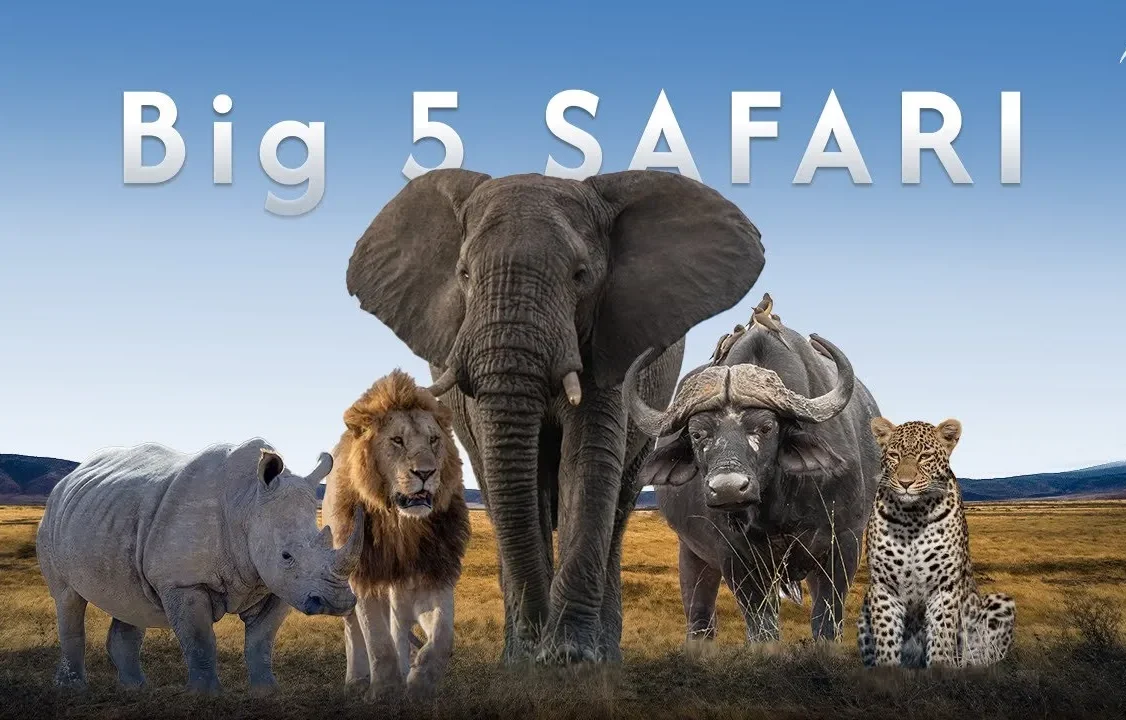
Tanzania’s legendary Big Five—elephant, lion, leopard, rhinoceros and African buffalo—represent some of the most sought-after wildlife encounters on an African safari.
The term Big Five refers to the African lion, leopard, elephant, buffalo and rhinoceros. Tanzania offers opportunities to encounter all five, although no responsible safari operator should guarantee sightings of every species. Wildlife viewing depends on natural movement, habitat, weather, time of day and the ability of guides to locate animals.
A well-planned northern Tanzania itinerary can provide strong Big Five opportunities by combining complementary ecosystems. The Serengeti is particularly celebrated for predators and extensive plains wildlife, while the Ngorongoro area adds a dramatically different environment. Travelers interested in how these landscapes fit into a longer journey can explore our 7-day Tanzania safari itinerary.
The objective should not, however, be reduced to ticking five animals off a checklist. Some of Tanzania’s most memorable encounters involve cheetahs scanning grasslands, giraffes crossing the horizon, elephant families interacting around water, hyenas communicating around a den or thousands of grazing animals spread across an enormous plain. A Tanzania safari becomes richer when travelers observe behavior and ecosystems rather than concentrating exclusively on famous species.
Tanzania’s Main Safari Circuits
Understanding Tanzania’s safari circuits is one of the easiest ways to begin planning. The country can broadly be approached through northern, southern and western safari regions. These circuits differ considerably in accessibility, landscapes, visitor numbers and the amount of time normally required to explore them.
The Northern Safari Circuit is the best known internationally. Arusha commonly acts as the gateway for journeys toward Tarangire, Lake Manyara, Ngorongoro and Serengeti. This concentration of famous wildlife areas makes the north particularly suitable for travelers visiting Tanzania for the first time. The Arusha safari gateway is also useful for travelers planning to connect Tanzania with gorilla trekking elsewhere in East Africa.
Southern Tanzania offers a different style of journey. The landscapes and logistics are more dispersed, and itineraries can be designed for travelers who value wilderness and want to venture beyond the most familiar northern safari route. Western Tanzania is even more remote and generally requires more careful logistical planning, particularly when combining distant protected areas.
We will examine the individual national parks in detail in Section 2 rather than repeating their descriptions here. This introduction is intended to help travelers understand the geographical structure of a Tanzania safari before deciding which destinations belong in their itinerary.
Main Tanzania Safari Route Map
The following route framework shows how the principal Tanzania safari regions fit together. It is a planning overview rather than a fixed itinerary; the final route should always be adjusted to available days, seasonal wildlife priorities, accommodation availability and flight connections.
Northern Tanzania Safari Circuit
Arusha → Tarangire → Lake Manyara → Ngorongoro → Serengeti
Southern Tanzania Safari Circuit
Dar es Salaam → Nyerere → Mikumi → Ruaha
Western Tanzania Safari Circuit
Western Tanzania → Katavi → Mahale Mountains
The northern circuit is particularly practical for travelers seeking a classic first Tanzania safari because several major wildlife areas can be linked within one journey. A route such as Arusha–Tarangire–Serengeti–Ngorongoro is demonstrated in our Tanzania wildlife safari itinerary. Travelers should nevertheless resist trying to include too many parks in too little time; spending meaningful time observing wildlife is generally more rewarding than continuously transferring between destinations.
Combining Tanzania With a Wider East African Safari
One of Tanzania’s greatest geographical advantages is its position within East Africa. Travelers with sufficient time can connect Tanzania’s savannah wildlife with Kenya, Uganda or Rwanda. A Tanzania and Uganda combination is especially contrasting: Tanzania provides extensive plains and classic game viewing, while Uganda introduces rainforest environments and mountain gorilla trekking. Our Uganda wildlife and gorilla safari guide can help travelers understand what an extension into Uganda adds to the journey.
Kenya and Tanzania can also form a natural safari combination, particularly for travelers interested in the wider Serengeti-Mara ecosystem. Anthill Safaris provides a detailed overview of combining Kenya and Tanzania, including the practical logic behind connecting major wildlife regions across the two countries.
Travelers interested in cultural, natural and conservation heritage can also incorporate internationally recognized sites into a longer itinerary. Our guide to East African UNESCO World Heritage Sites introduces several significant locations, including important Tanzanian landscapes.
Start Planning Your Tanzania Safari
A successful Tanzania safari begins with matching the route to the traveler rather than forcing the traveler into a predetermined program. The number of available days, preferred accommodation standard, wildlife priorities, photography interests, travel month and whether Tanzania will be combined with another East African country should all influence the final itinerary.
Safari Vacations and Travel Services Ltd. can help design a private journey around these priorities, whether the objective is a first African wildlife holiday, a longer regional adventure or a combination of Tanzania’s savannahs with primate trekking elsewhere in East Africa. Travelers ready to begin planning can contact our safari specialists with their travel dates, number of travelers and preferred safari duration.
Best Tanzania Safari Destinations and National Parks
Choosing the right destinations is one of the most important decisions when planning Tanzania safaris because the country is far too large and diverse to experience properly in a single short journey. Tanzania’s protected landscapes range from the endless grasslands of Serengeti to the baobab country of Tarangire, the volcanic setting of Ngorongoro and the remote wilderness of southern and western Tanzania. Travelers following a classic Tanzania safari itinerary normally concentrate on several complementary destinations rather than attempting to visit every national park.
The best choice depends on the wildlife you hope to see, available safari days, preferred level of remoteness and whether your priority is traditional game viewing, birding, photography, primate encounters or wilderness exploration. This section introduces Tanzania’s principal safari destinations without repeating the seasonal Great Migration information reserved for Section 3 or the detailed itinerary planning that will appear later in this guide.
Serengeti National Park
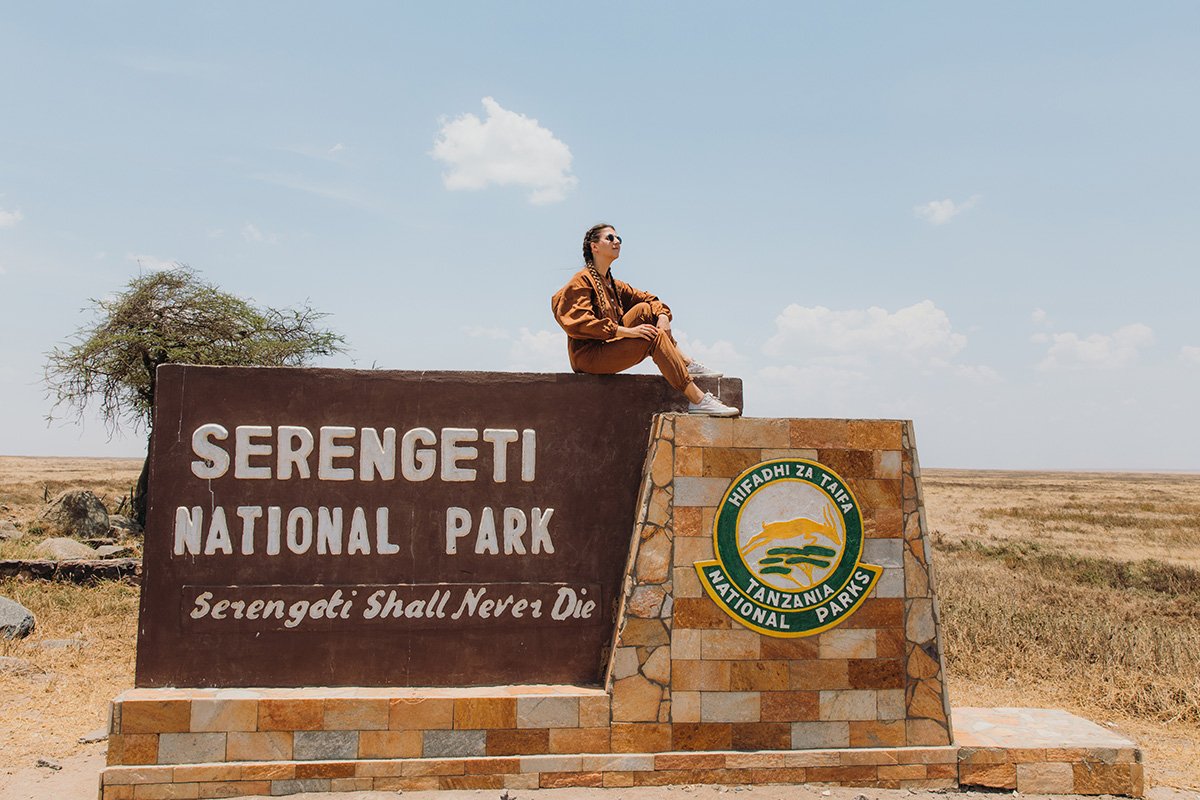
A traveler at the iconic Serengeti National Park entrance, gateway to one of Tanzania’s most celebrated wildlife safari destinations.
Serengeti National Park is the centerpiece of many Tanzania safaris and one of Africa’s most recognizable wildlife landscapes. Its sweeping grasslands, kopjes, woodland and river systems support exceptional concentrations of plains game and predators. Lions, cheetahs, leopards, spotted hyenas, elephants, giraffes, buffaloes, zebras, wildebeest and numerous antelope species can all form part of a Serengeti game drive.
The park is enormous, which means travelers should think about Serengeti as several wildlife regions rather than one sightseeing stop. Central Serengeti around Seronera is especially important for year-round wildlife viewing, while northern, western and southern areas become strategically important according to wildlife movements and seasonal conditions. Understanding access points is therefore useful when building a route; our guide to the gates of Serengeti National Park explains how different entrances connect travelers with different areas of the ecosystem.
Serengeti deserves sufficient time. Rushing through the park for a single game drive rarely does justice to its scale. Two or more nights provide a better opportunity to explore different habitats, observe animal behavior and enjoy morning and afternoon game drives. Travelers particularly interested in the annual movement of wildebeest should also consult the dedicated Great Migration safari guide; we will examine that phenomenon separately in Section 3 rather than duplicate it here.
Ngorongoro Conservation Area and Ngorongoro Crater
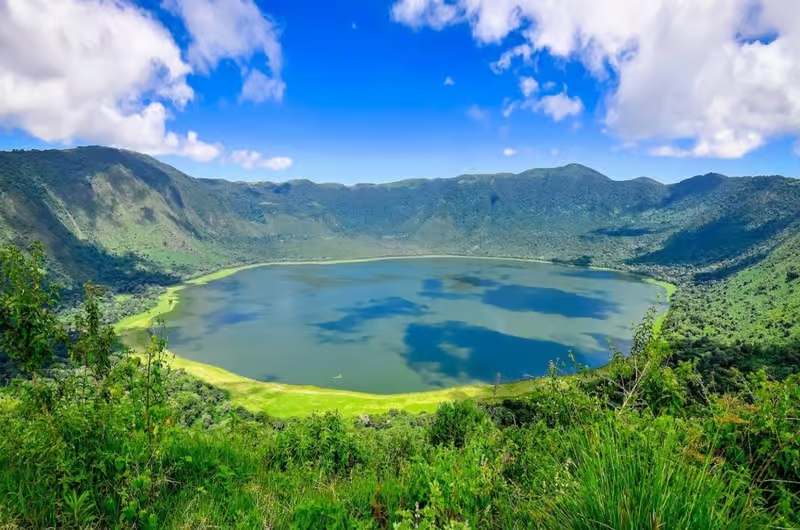
A spectacular view across the Ngorongoro Crater, one of Tanzania’s most iconic safari landscapes and an important wildlife destination on the Northern Safari Circuit.
Ngorongoro offers one of Tanzania’s most distinctive safari landscapes. The Ngorongoro Crater is a vast volcanic caldera containing grasslands, wetlands, woodland and permanent water sources. The concentration of wildlife within the crater makes it particularly rewarding for travelers who want productive game viewing within a comparatively compact area.
Lions, buffaloes, zebras, wildebeest, hippos, hyenas and elephants may be encountered during a crater game drive, while the area is also important for the possibility of seeing black rhinoceros. Sightings of any wild species should never be guaranteed, but Ngorongoro can add considerable diversity to a northern Tanzania safari.
Ngorongoro is also significant beyond wildlife. The wider conservation area contains landscapes associated with pastoral communities and internationally important archaeological heritage. Travelers interested in this broader context can explore our guide to East African UNESCO World Heritage Sites, which discusses Ngorongoro and Olduvai Gorge.
The crater works particularly well when combined with Serengeti because the two areas can form part of the same northern circuit journey. A practical example is our Tanzania Big Five safari, which incorporates Ngorongoro alongside other major northern Tanzania wildlife destinations.
Tarangire National Park
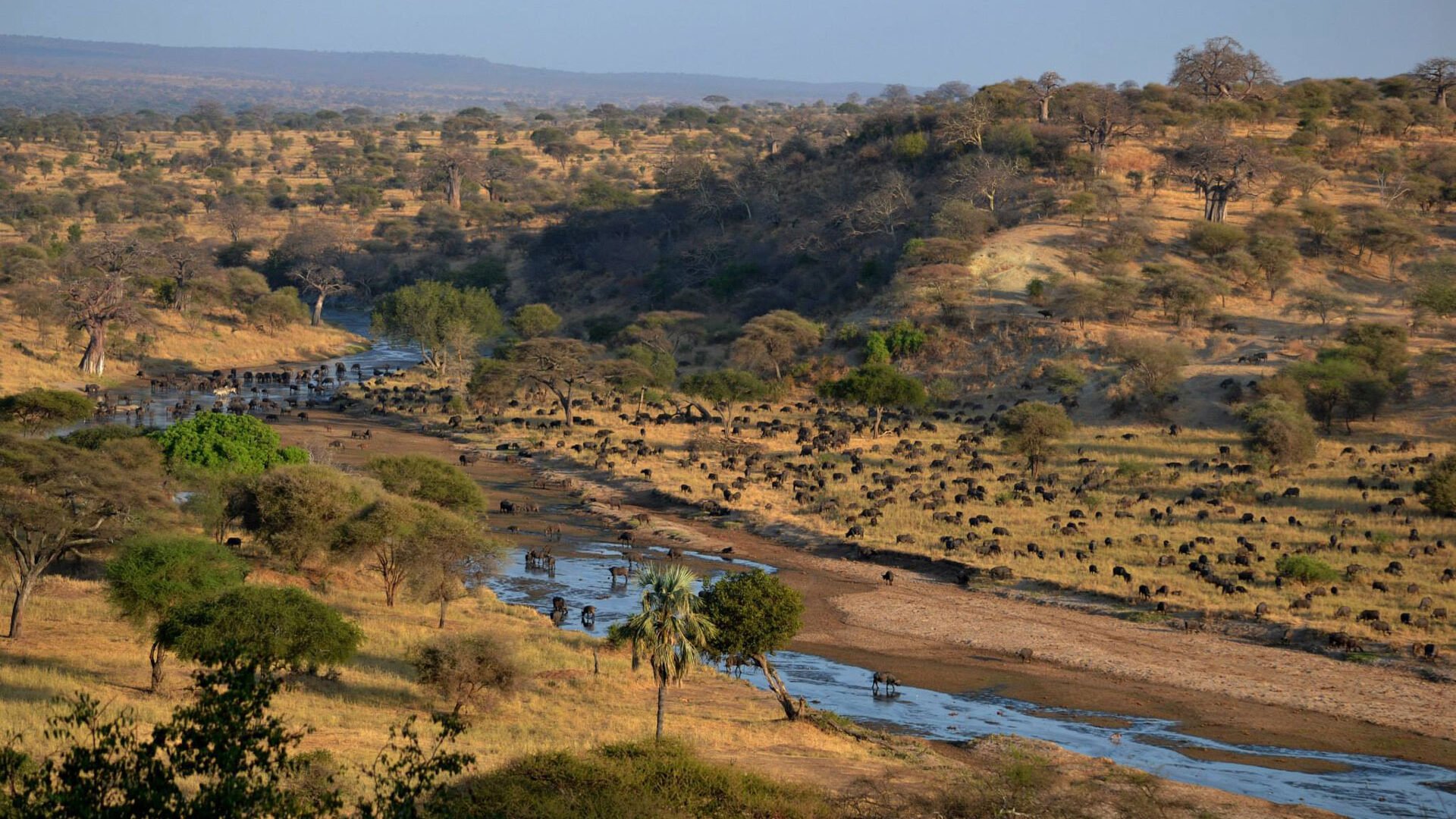
Large herds of elephants gather around the Tarangire River, showcasing the remarkable wildlife and classic savannah scenery of Tarangire National Park in Tanzania.
Tarangire National Park introduces travelers to a noticeably different environment from the open Serengeti plains. Ancient baobab trees, seasonal wetlands, woodland and the Tarangire River create a beautiful landscape with particularly strong appeal for elephant enthusiasts and photographers.
The Tarangire River becomes especially important to wildlife during dry conditions when animals concentrate around dependable water. Elephants are among the park’s signature attractions, but visitors can also encounter giraffes, buffaloes, zebras, wildebeest, impalas, lions and other wildlife. Birdlife is another major strength, making Tarangire useful for travelers who want more than large-mammal viewing.
Its position within northern Tanzania also makes the park convenient at the beginning or end of a longer circuit. Travelers can learn more from our dedicated Tarangire National Park guide.
Travelers wanting to understand how game drives work across Tanzania’s protected areas can also read Anthill Safaris’ guide to guided African game drives.
Lake Manyara National Park

Thousands of flamingos and other waterbirds gather along the shallow waters of Lake Manyara, creating a spectacular birding scene in northern Tanzania.
Lake Manyara National Park provides a compact but varied landscape along the base of the Great Rift Valley escarpment. Forest, woodland, open areas and the lake environment create habitats for elephants, buffaloes, giraffes, zebras, hippos, primates and numerous bird species.
Manyara is often associated with tree-climbing lions, although travelers should treat these as a possible sighting rather than a guaranteed attraction. Its birdlife can be equally rewarding, particularly for visitors who enjoy observing water-associated and woodland species. Safari travelers with a deeper interest in the region’s avifauna can read our East African bird migration guide.
Lake Manyara’s strategic location allows it to fit naturally between Arusha and the Ngorongoro highlands. It is therefore useful when designing a northern circuit that needs variety without adding major logistical detours.
Nyerere National Park
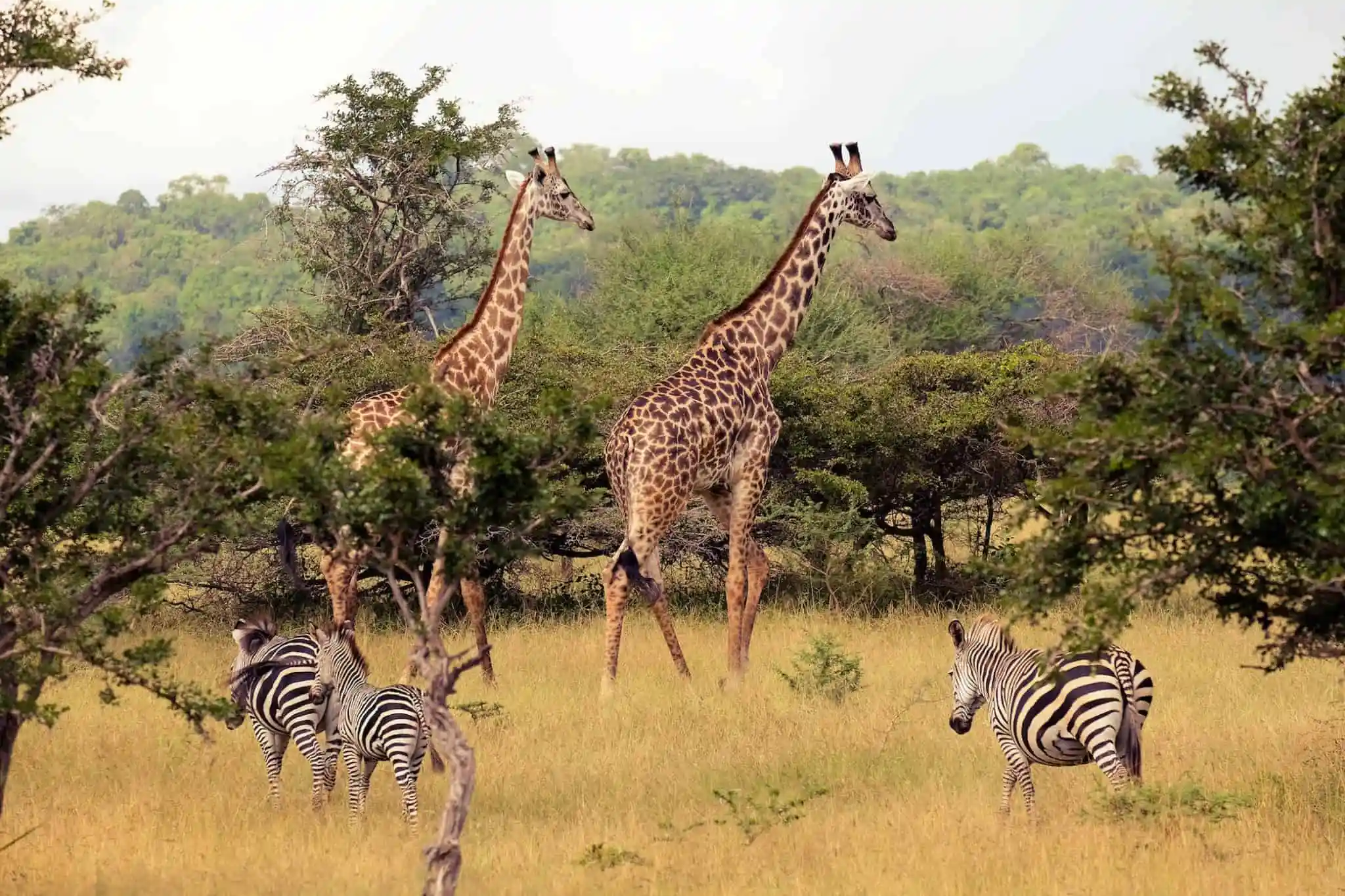
Giraffes and zebras wander through the scenic woodland and golden savannah of Nyerere National Park, one of southern Tanzania’s premier wildlife safari destinations.
Nyerere National Park represents a very different side of Tanzania safaris. Located in southern Tanzania, it offers an immense wilderness environment shaped by rivers, lakes, woodland and open areas. Travelers who have already experienced northern Tanzania, or those who prioritize a less conventional safari route, may find the south particularly attractive.
Wildlife includes elephants, buffaloes, lions, giraffes, hippos, crocodiles and many other species. One of the qualities that distinguishes this region is the possibility of experiencing the wilderness in ways that can extend beyond conventional vehicle-based wildlife viewing, depending on the activity, location and applicable park arrangements.
Nyerere also pairs naturally with other southern Tanzania destinations rather than with a rushed overland transfer to the far north. The objective should be to create a coherent southern circuit with sufficient time in each wilderness area.
Ruaha National Park
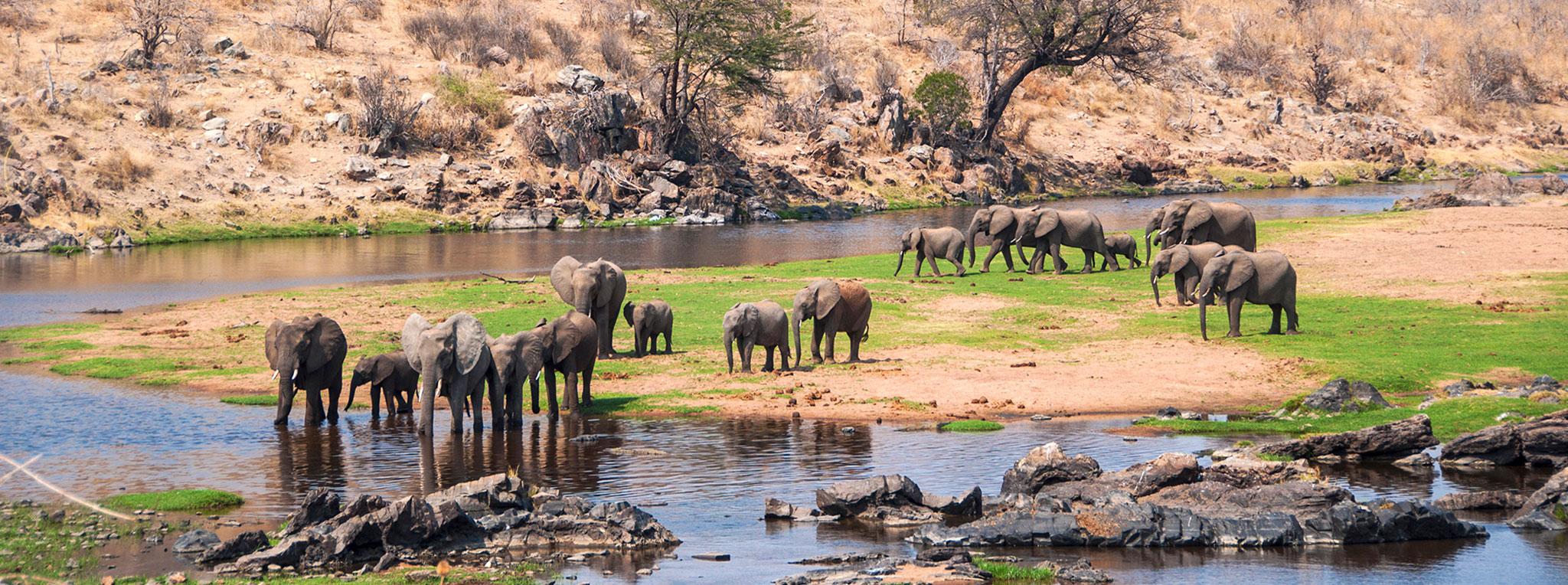
A large herd of African elephants gathers along a river in Ruaha National Park, showcasing the remote wilderness and exceptional wildlife of southern Tanzania.
Ruaha National Park is one of Tanzania’s important southern wilderness destinations. Its landscapes combine river systems, rocky areas, woodland and open plains, producing a safari atmosphere that feels markedly different from the northern circuit.
The park is particularly attractive to experienced safari travelers seeking wildlife viewing in a more remote environment. Elephants, lions, buffaloes, giraffes, antelopes and other species occur across the ecosystem, while the varied habitats also support impressive birdlife.
Ruaha rewards travelers who allow enough time rather than treating the park as a quick addition. Distances and access logistics make careful planning important. For travelers comparing activities available across Tanzania, Anthill Safaris’ guide to popular Tanzania safari activities provides additional ideas beyond standard game drives.
Mikumi National Park
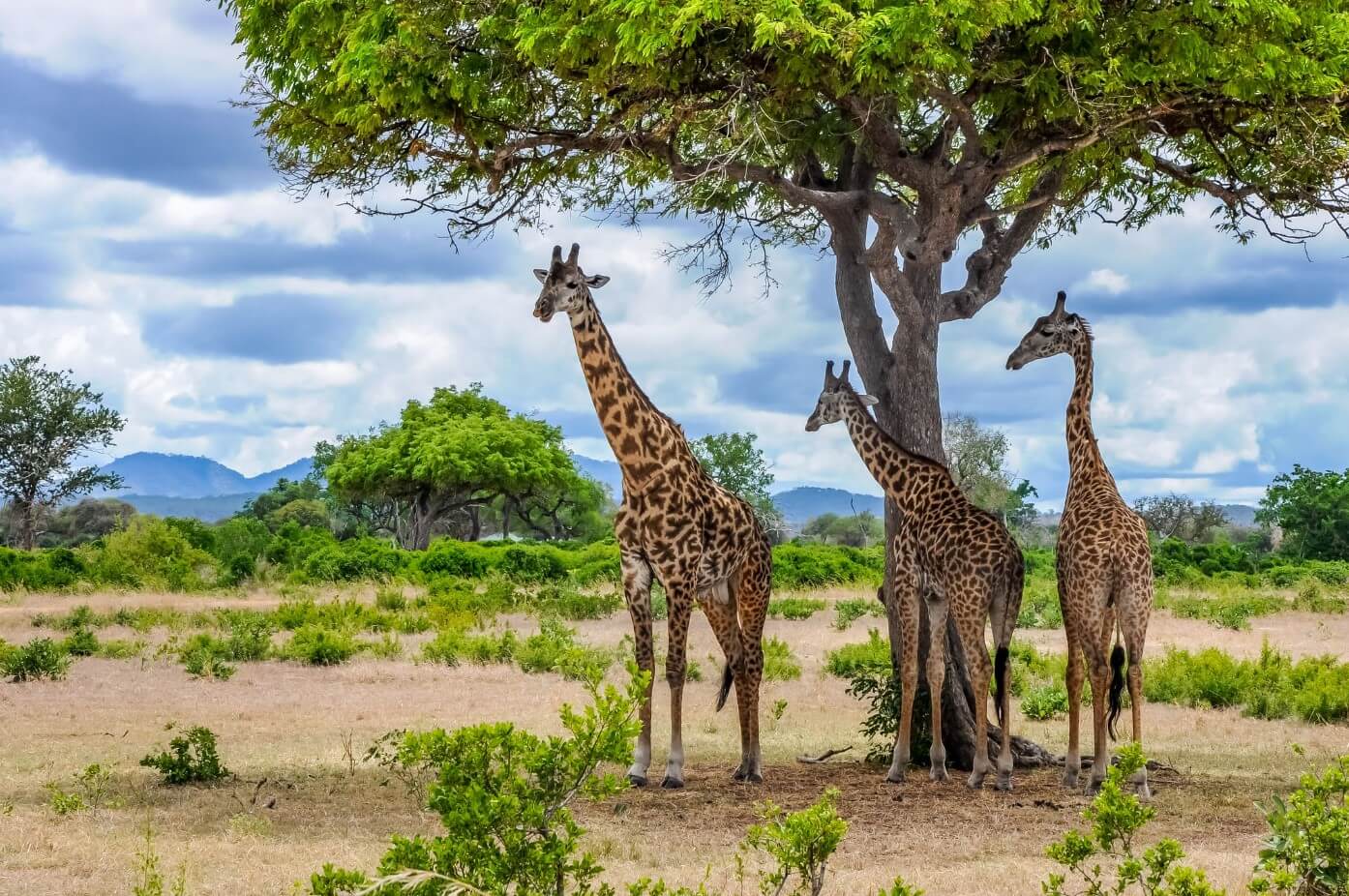
Giraffes gather beneath a shady tree in Mikumi National Park, highlighting the beautiful savannah landscapes and diverse wildlife of southern Tanzania.
Mikumi National Park provides another important option within southern Tanzania. Its accessibility relative to some of the country’s more remote protected areas can make it suitable for travelers beginning from Dar es Salaam or integrating wildlife viewing into a broader southern Tanzania journey.
The park contains open grasslands, woodland and seasonal water environments supporting buffaloes, elephants, giraffes, zebras, wildebeest, antelopes and predators. Mikumi can be especially useful for travelers who have fewer days available but still want a traditional savannah wildlife experience outside the northern circuit.
Rather than presenting Mikumi as a substitute for Serengeti, it is better understood as a distinct destination with different logistics and safari character. Combining it logically with other southern areas can produce a more coherent journey than attempting to cover both ends of Tanzania by road within a short holiday.
Arusha National Park
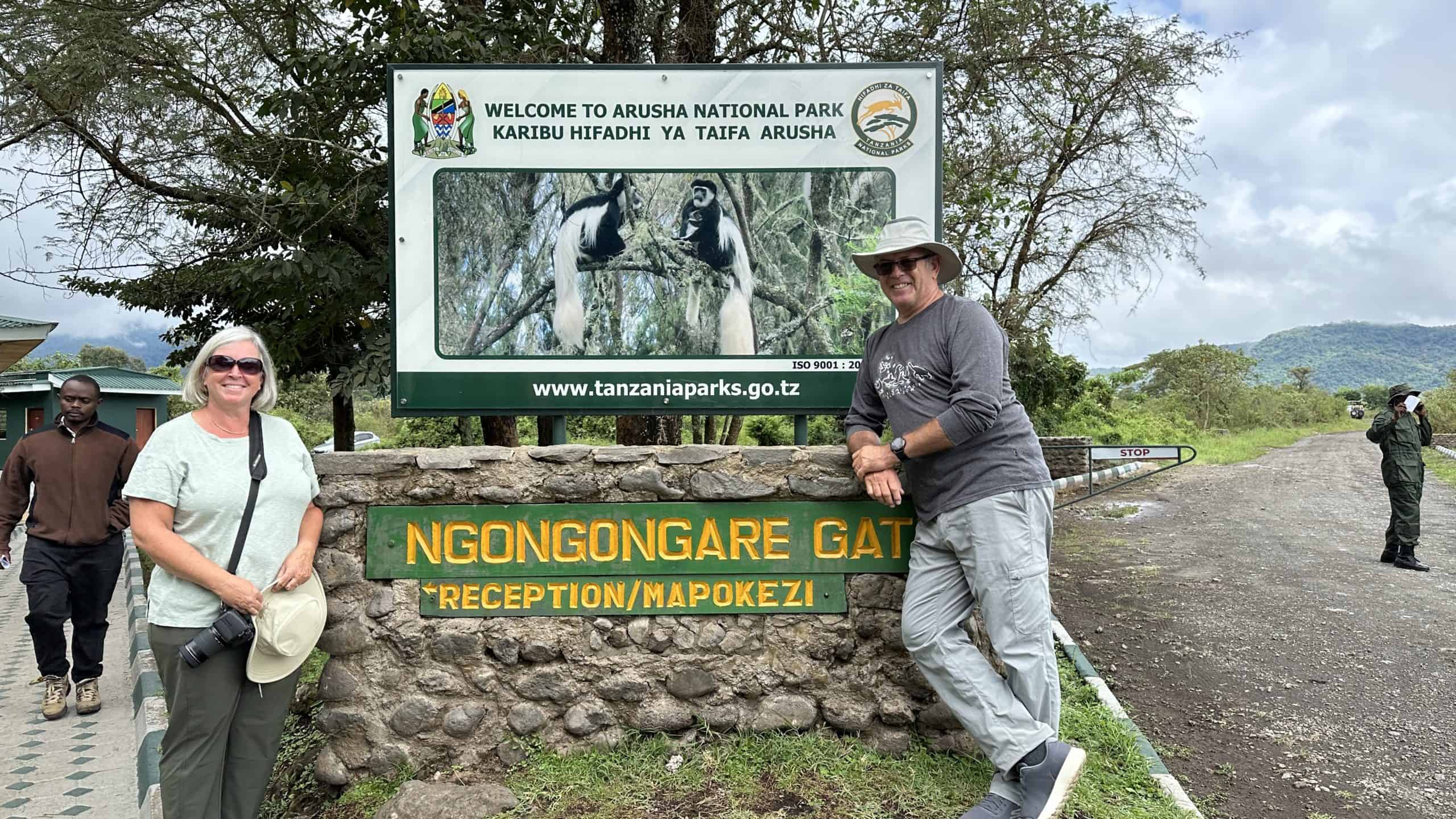
Travelers arrive at Ngongongare Gate, the entrance to Arusha National Park, ready to explore one of northern Tanzania’s scenic and wildlife-rich safari destinations.
Arusha National Park is conveniently positioned near Tanzania’s principal northern safari gateway. Although it does not provide the same vast plains experience as Serengeti, its combination of forest, crater landscapes, lakes and views toward Mount Meru gives travelers a different introduction to northern Tanzania.
The park can work particularly well for travelers with an additional day around Arusha, those interested in scenery and birdlife, or visitors wanting a softer introduction before beginning a longer wildlife circuit. Its proximity to the northern gateway also makes it useful when arrival or departure schedules leave insufficient time for a more distant park.
Arusha is additionally important for travelers combining Tanzania with Uganda or Rwanda. Our guide to gorilla trekking from Arusha explains how a Tanzania wildlife journey can be extended into the mountain-gorilla regions of East Africa.
Katavi National Park
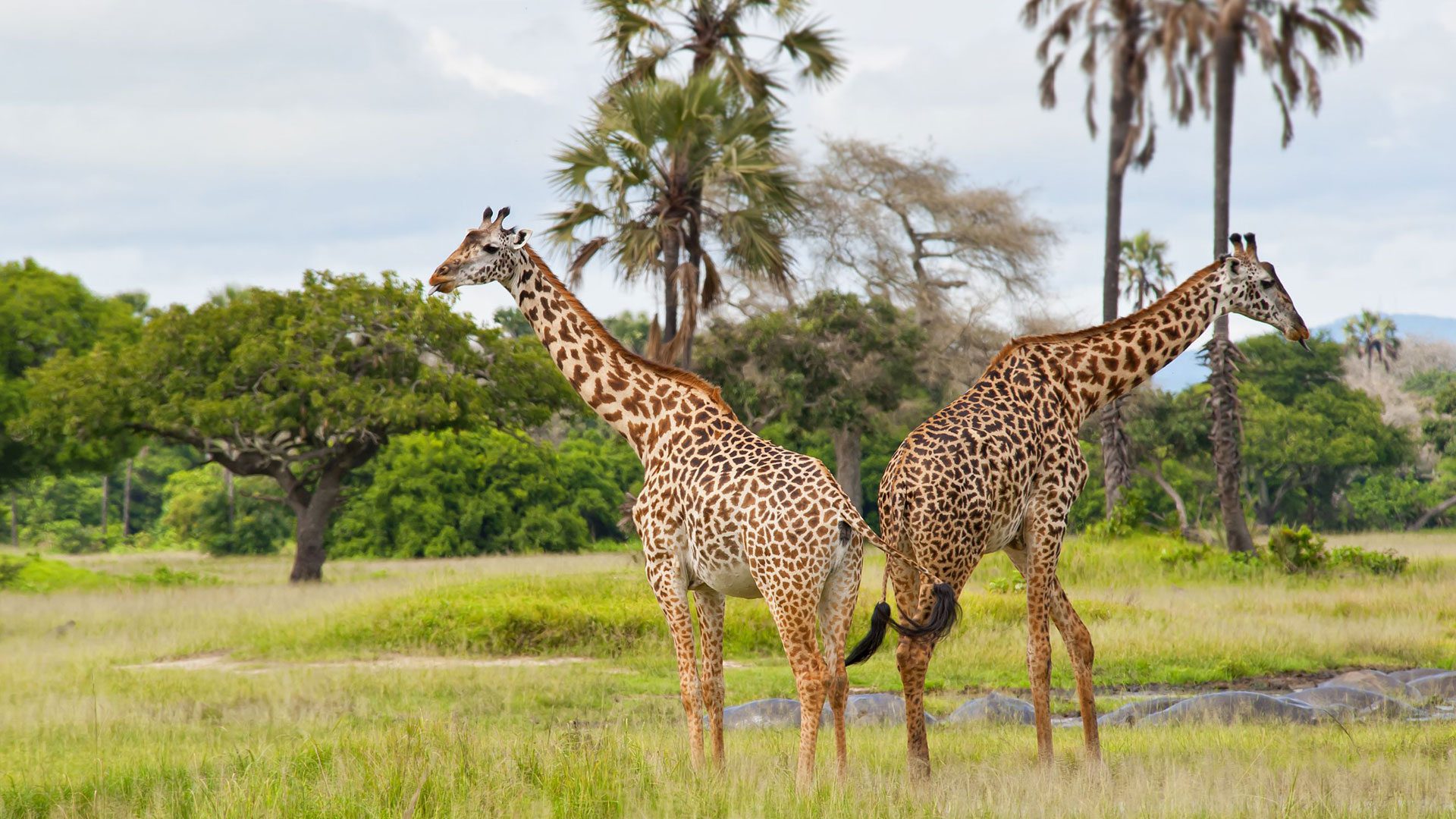
Two giraffes stand amid the open grasslands and palm-dotted wilderness of Katavi National Park, one of western Tanzania’s remote safari destinations.
Katavi National Park appeals to travelers seeking one of Tanzania’s more remote safari environments. Located in western Tanzania, its isolation is part of its attraction. This is not generally the park chosen for a rushed first-time northern circuit; it is better suited to travelers with enough time and budget to handle more complex logistics.
Seasonal floodplains, woodland and river environments support large mammals and predators, while the sense of space can be as important as individual sightings. Katavi is especially compelling for experienced safari travelers who value wilderness, low-density tourism and time spent away from the country’s most established circuits.
Air connections often play an important role in realistic western Tanzania itinerary design. We will therefore address transportation choices in the dedicated logistics section rather than repeating them here.
Mahale Mountains National Park
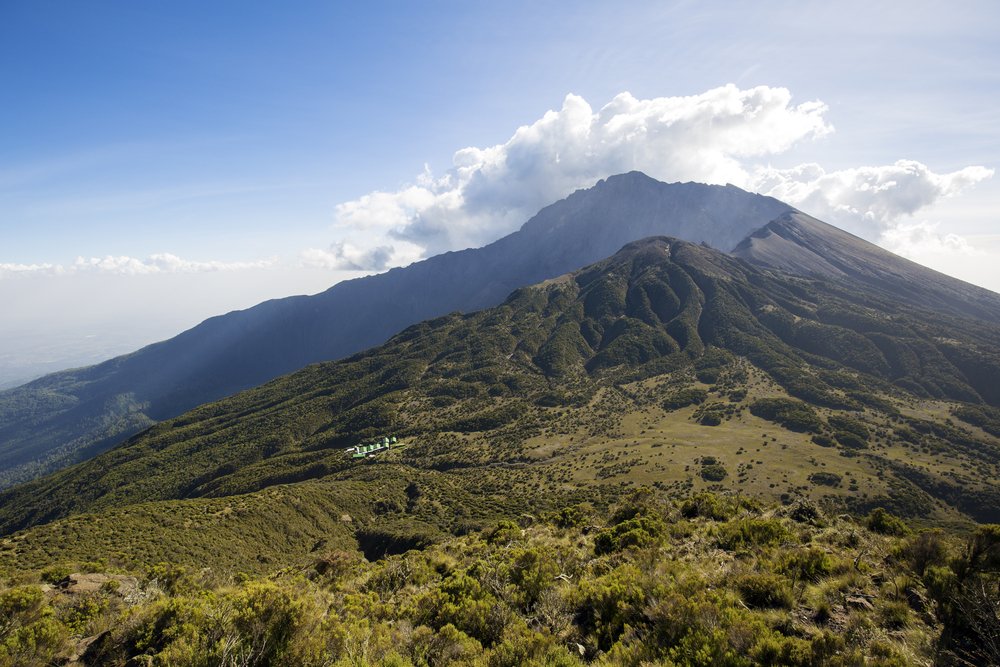
The dramatic peaks and forested slopes of Mahale Mountains National Park showcase the remote natural beauty of western Tanzania.
Mahale Mountains National Park changes the character of a Tanzania safari completely. Situated beside Lake Tanganyika in western Tanzania, Mahale combines forested mountains, lake scenery and primate encounters. Its most celebrated wildlife experience is tracking habituated chimpanzees through forest habitat.
This makes Mahale particularly valuable for travelers who want to contrast conventional savannah game drives with primate trekking. The experience focuses on searching for chimpanzees on foot and observing their behavior when conditions and movements allow.
Travelers interested in primate-focused additions can explore Anthill Safaris’ information about chimpanzee trekking in East Africa. Mahale can also work especially well with Katavi for travelers creating a remote western Tanzania safari.
Gombe Stream National Park
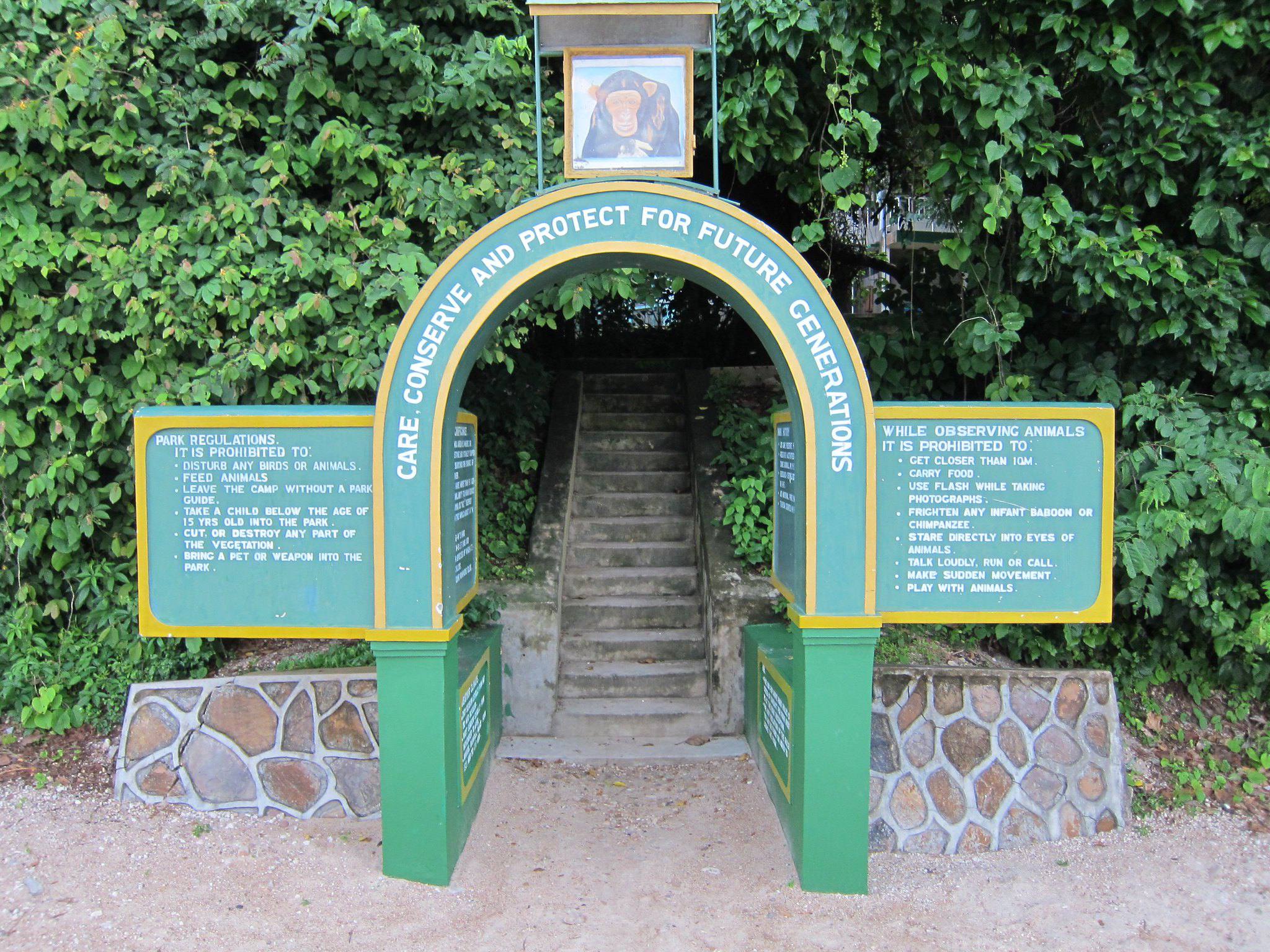
The entrance to Gombe Stream National Park, Tanzania’s famous chimpanzee sanctuary on the shores of Lake Tanganyika and a historic center of primate research.
Gombe Stream National Park is another western Tanzania destination strongly associated with chimpanzees. The park occupies forested terrain along Lake Tanganyika and is internationally known for the long-running study of wild chimpanzees associated with Jane Goodall’s research.
Gombe offers a fundamentally different experience from the country’s great savannah parks. Visitors come primarily for forest exploration, chimpanzees, primates, birdlife and the striking meeting of steep green landscapes with Lake Tanganyika.
Because Gombe requires dedicated logistics, it is generally most appropriate for travelers who deliberately want a primate-focused western Tanzania experience rather than those trying to add another destination to an already crowded northern safari itinerary.
Which Tanzania Safari Destination Should You Choose?
There is no single national park that is automatically best for every traveler. Serengeti suits visitors seeking vast savannahs and exceptional predator-and-prey interactions. Ngorongoro provides concentrated wildlife viewing within an extraordinary volcanic landscape. Tarangire is particularly attractive for elephants, baobabs and northern-circuit variety, while Lake Manyara provides a compact Rift Valley environment.
Travelers looking beyond the most established routes can consider Nyerere, Ruaha and Mikumi in southern Tanzania. Those prioritizing remote wilderness and primates can look toward Katavi, Mahale and Gombe in the west. Safari Vacations and Travel Services Ltd. can then connect the selected areas into a practical route rather than choosing parks simply because their names are famous.
For travelers interested in combining Tanzania’s wildlife with Uganda’s rainforest experiences, our Uganda gorillas and Serengeti safari guide provides an example of how contrasting ecosystems can form one East African journey.
Tanzania Safari Parks Comparison
The following comparison provides a quick planning overview. It is designed to help travelers identify which destinations deserve further consideration rather than replace personalized itinerary planning.
| Destination | Best Known For | Wildlife & Experience | Suggested Stay | Safari Circuit |
|---|---|---|---|---|
| Serengeti | Vast plains and major wildlife concentrations | Lions, cheetahs, leopards, wildebeest, zebras and extensive plains game | 2–4+ nights | Northern |
| Ngorongoro | Volcanic crater and concentrated wildlife | Big Five opportunities, hyenas, hippos and plains game | 1–2 nights | Northern |
| Tarangire | Elephants and baobab landscapes | Elephants, giraffes, buffaloes, predators and rich birdlife | 1–2 nights | Northern |
| Lake Manyara | Rift Valley scenery and varied habitats | Elephants, primates, hippos and birdlife | 1 night | Northern |
| Nyerere | Large southern wilderness | Elephants, lions, buffaloes, hippos, crocodiles and varied safari activities | 2–4 nights | Southern |
| Ruaha | Remote wilderness and predator viewing | Elephants, lions, buffaloes, antelopes and birdlife | 3–4 nights | Southern |
| Mikumi | Accessible southern game viewing | Buffaloes, elephants, giraffes, zebras and predators | 1–2 nights | Southern |
| Arusha | Scenery and convenient short safari | Forest wildlife, giraffes, primates and birdlife | Day trip–1 night | Northern |
| Katavi | Remote wilderness | Large mammals, predators and low-density safari experiences | 3–4 nights | Western |
| Mahale Mountains | Chimpanzees and Lake Tanganyika | Chimpanzee trekking, forest wildlife and lake scenery | 3–4 nights | Western |
| Gombe Stream | Chimpanzees and primate research heritage | Chimpanzees, forest walks, primates and Lake Tanganyika scenery | 2–3 nights | Western |
Mobile tip: Swipe horizontally to view the complete Tanzania safari parks comparison table on smaller screens.
Plan Your Tanzania National Parks Safari
Choosing destinations should ultimately be based on what you want to experience rather than how many park names can be fitted into the itinerary. Safari Vacations and Travel Services Ltd. can combine the most appropriate parks according to your travel dates, available days, accommodation preference and wildlife priorities. Travelers wanting an established northern circuit example can review our 7-day Tanzania safari before requesting a customized itinerary.
Serengeti Great Migration: Complete Seasonal Tanzania Safari Guide
The Serengeti Great Migration is one of the defining experiences of Tanzania safaris. Across the greater Serengeti-Mara ecosystem, enormous herds of wildebeest move with zebras and other grazing animals in response to changing rainfall, water availability and fresh pasture. The migration is not a single event that happens for a few weeks each year. It is a continuous ecological cycle, which means travelers can experience different stages of the Great Migration in Africa during different months.
For Safari Vacations and Travel Services Ltd., planning a migration-focused Tanzania safari begins with one important question: what part of the migration does the traveler most want to experience? Some visitors dream about newborn wildebeest on the southern plains, others want immense columns of animals moving north, while many photographers specifically hope for dramatic river crossings. Understanding these differences makes it much easier to choose the correct Serengeti region and accommodation area.
Understanding the Great Wildebeest Migration
The Great Migration is essentially a continuous search for water and nutritious grazing. Wildebeest form the majority of the migrating animals, accompanied by large numbers of zebras and other herbivores. Their movement through the ecosystem also creates opportunities for predators including lions, cheetahs, leopards, spotted hyenas and crocodiles.
Unlike an organized event, the migration does not operate according to fixed dates. Rainfall can arrive early, late or in unusual patterns, influencing when herds begin moving and how long they remain in particular areas. Anyone planning a Serengeti migration safari should therefore treat monthly migration calendars as planning guides rather than guarantees.
This distinction is extremely important. A traveler booking northern Serengeti in a historically favorable river-crossing period may have excellent opportunities, but nobody can responsibly guarantee that thousands of wildebeest will cross a particular river at a particular hour or even on a particular day. Patient game viewing and selecting the correct geographical area for the season provide a much better approach.
January to March: Southern Serengeti and Calving Season
The early months of the year bring one of the most fascinating stages of Tanzania’s Great Migration. Large numbers of wildebeest generally occupy the short-grass plains of the southern Serengeti ecosystem and Ndutu region. The nutritious grasses provide important feeding areas for pregnant females and nursing mothers.
Calving is the great attraction of this period. Large numbers of young wildebeest are born over a relatively concentrated period, transforming the plains into an enormous nursery. Newborn calves learn to stand and move remarkably quickly because survival in this ecosystem depends upon staying close to their mothers and the wider herd.
The concentration of vulnerable young animals inevitably attracts predators. Lions, cheetahs, spotted hyenas and other carnivores take advantage of hunting opportunities, making this a particularly interesting period for travelers fascinated by animal behavior and predator-prey relationships.
Travelers choosing this period should concentrate their accommodation and game-drive strategy around the southern migration areas rather than automatically staying in a famous part of Serengeti simply because of its name. Our broader African safari planning guide explains why seasonality should influence where travelers stay during a wildlife-focused journey.
April to May: Herds Begin Moving Toward Central and Western Serengeti
As conditions on the southern plains change, the migration gradually begins moving away from its principal calving areas. April and May are transitional months, and movement can vary considerably according to rainfall and grazing conditions. Herds may become increasingly spread out as they travel through central and western parts of the Serengeti ecosystem.
This period can produce spectacular scenes of wildebeest moving in long lines across green landscapes. The rains can create dramatic skies, fresh vegetation and excellent photographic conditions, although road conditions may become more challenging in some areas.
Central Serengeti remains particularly valuable because of its strong resident wildlife populations. Even when the largest migrating herds have moved elsewhere, lions, leopards, cheetahs, elephants, giraffes and numerous other species continue to make the region rewarding. Travelers can understand the different access areas through our guide to the Serengeti National Park gates.
June: Western Corridor and Grumeti Migration
By around June, migration attention increasingly turns toward the western Serengeti and the Grumeti region. Large concentrations of wildebeest and zebras can move through the corridor as the herds continue their journey northward.
The Grumeti River presents one of the migration’s natural obstacles. Crossings here can be exciting, although they should not be confused with the better-known Mara River crossings farther north. The timing and intensity vary considerably from year to year.
Travelers visiting during this transitional period can benefit from carefully selected camps that provide access to areas where the herds are most likely to be moving. A private vehicle can also be advantageous because it gives travelers more flexibility to spend time observing a developing wildlife situation rather than following a rigid shared-game-drive schedule.
A longer Tanzania safari experience can provide enough time to combine Serengeti game viewing with other northern Tanzania environments instead of making the entire holiday dependent upon one migration sighting.
July to October: Northern Serengeti and Mara River Season
From roughly July onward, many migrating herds move into northern Serengeti and toward the wider Mara ecosystem. This is the period most strongly associated with the famous Mara River crossings shown in wildlife documentaries.
Wildebeest may gather near a riverbank for hours or longer before crossing. Animals can approach the water, retreat, reorganize and move to another crossing point. When a crossing finally begins, large numbers may enter the river in a short period, creating one of the most dramatic scenes associated with Tanzania safaris.
Crocodiles, deep channels, steep banks and strong currents add danger to the crossing. However, it is important not to describe the event purely as spectacle. River crossings represent a demanding stage in a much larger survival journey driven by the need to reach grazing and water.
Travelers whose priority is a river crossing should allow several nights in northern Serengeti. A one-night visit provides limited time and places too much dependence on luck. Staying longer allows guides to follow reports of herd movements and investigate different crossing areas.
The migration also moves across the international landscape shared by Tanzania and Kenya. Travelers wanting to experience both sides can read Anthill Safaris’ guide to combining Kenya and Tanzania.
November to December: The Migration Turns South Again
As seasonal conditions change toward the end of the year, migrating herds generally begin moving south from the northern ecosystem. November can therefore become another transitional month, with animals distributed through different parts of Serengeti according to rainfall.
Fresh vegetation produced by the short rains helps draw animals toward central, eastern and eventually southern areas. By late December and into the beginning of the following year, significant numbers may again be reaching the southern plains, preparing the ecosystem for another calving cycle.
This southward return demonstrates why describing the Great Migration as a circular cycle is more accurate than imagining a simple journey from Tanzania to Kenya and back. The animals are continually responding to ecological conditions across a vast unfenced ecosystem.
Travelers interested in understanding wider seasonal movements can also explore our East African migration guide, which shows that Serengeti’s seasonal changes influence much more than wildebeest alone.
Predators During the Serengeti Great Migration
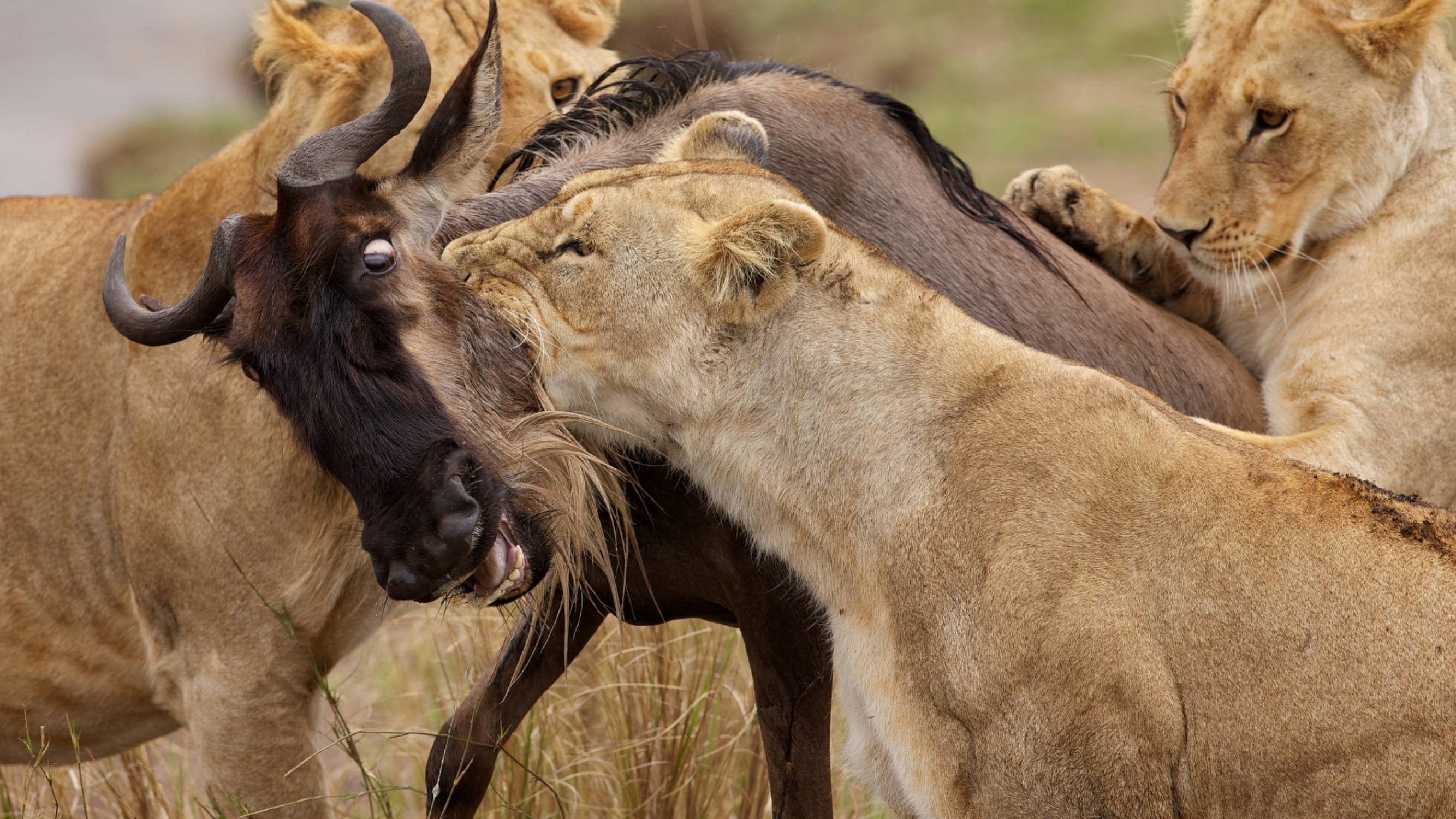
Lionesses hunt a wildebeest during the Serengeti Great Migration, revealing the dramatic predator-prey encounters that define Tanzania’s Serengeti ecosystem.
The Great Migration is equally compelling because of the predators that inhabit the Serengeti ecosystem. Lions, cheetahs, leopards and spotted hyenas do not simply disappear when the migrating herds move. Many predators maintain territories and take advantage of changing concentrations of prey as the migration passes through their areas.
Calving season can provide especially interesting predator interactions because young animals are vulnerable. In other periods, predators may follow or intercept migrating groups, while river environments create additional opportunities for crocodiles.
A professional safari guide therefore looks beyond the herd itself. Tracks, alarm calls, circling vultures, animal behavior and the positioning of grazing herds can all provide clues about nearby predators. Guided Tanzania wildlife game drives are about interpreting these relationships rather than simply driving from one sighting to another.
Travelers interested in how vehicle-based wildlife exploration works can also read Anthill Safaris’ guide to African game driving.
Which Great Migration Experience Should You Choose?
There is no single best Great Migration experience because different stages appeal to different travelers. Wildlife photographers interested in newborn animals and predator behavior may prefer the southern plains during the calving period. Travelers fascinated by enormous moving herds may prefer transitional periods when wildebeest form long columns across the Serengeti.
Visitors whose dream is specifically to witness a dramatic river crossing should concentrate on the appropriate northern migration period and allow several days rather than treating a crossing as a scheduled activity. Travelers wanting a broader wildlife safari can stay in regions offering excellent resident wildlife while treating any migration encounter as an additional highlight.
Those combining Tanzania with gorilla trekking have another consideration: balancing migration timing with conditions in Uganda or Rwanda. Our gorilla trekking and wildebeest migration guide provides useful information for travelers planning both experiences within one East African holiday.
Serengeti Great Migration Route Map
The route below provides a simplified visual overview of the annual migration cycle. It should not be interpreted as an exact GPS route because individual herds can split, move independently and respond differently to rainfall.
Serengeti Great Migration Month-by-Month Calendar
This mobile-friendly migration calendar provides a practical starting point for deciding where to concentrate a Tanzania safari. Exact locations should always be reassessed closer to travel because nature does not follow a fixed timetable.
| Period | General Migration Area | Main Experience | Good For | Planning Consideration |
|---|---|---|---|---|
| January | Southern Serengeti / Ndutu region | Large herds gathering on short-grass plains | Photography and plains wildlife | Herd position depends on rains |
| February | Southern plains | Peak calving activity typically associated with this period | Newborns and predator interactions | Popular camps can require early booking |
| March | Southern / south-central ecosystem | Herds and young calves | Predator-prey behavior | Movement may begin as conditions change |
| April–May | Central toward western Serengeti | Moving herds and green landscapes | Scenery and photography | Rain can affect roads and herd timing |
| June | Western Corridor / Grumeti | Large moving herds and possible river activity | Migration movement | Crossings cannot be scheduled or guaranteed |
| July–August | Northern Serengeti | Northern movement and possible Mara River crossings | River-crossing seekers | Allow several nights for better chances |
| September–October | Northern Serengeti / wider Mara ecosystem | Herd concentrations and possible river movements | Big herds and predators | Herds may move between Tanzania and Kenya |
| November | Moving south through Serengeti | Returning herds and fresh landscapes | Travelers seeking transitional migration | Rainfall strongly influences location |
| December | Central toward southern Serengeti | Herds returning toward southern plains | Holiday safaris and broad wildlife viewing | Exact distribution varies annually |
Mobile viewing: Swipe horizontally to see the complete Great Migration calendar on smaller screens.
Planning a Tanzania Great Migration Safari
The most effective migration safari is built around geography rather than simply selecting “Serengeti” as a destination. Serengeti is enormous, and staying in the wrong region can place travelers many hours from the seasonal concentration of migrating herds. Accommodation location should therefore be selected according to expected seasonal movements.
Safari Vacations and Travel Services Ltd. can structure the journey around the migration stage a traveler wants to experience while also including resident wildlife areas so that the safari remains rewarding even when the herds move differently from historical expectations.
Travelers who want a more diverse East African experience can also combine the Serengeti with mountain gorilla trekking. Our detailed Uganda gorillas and Serengeti Migration safari explains how the two experiences can fit into one journey, while travelers interested in a wider Tanzania wildlife itinerary can review our 7-day Tanzania safari.
For additional ideas about experiences that can complement conventional game drives, travelers can also explore Anthill Safaris’ guide to Tanzania safari activities.
Tanzania Safari Weather and Season Comparison
The table below summarizes the broad seasonal character of Tanzania safaris. Weather varies by year, altitude and location, so these periods should be treated as general planning guidance rather than precise forecasts.
| Travel Period | General Weather | Wildlife Viewing | Landscape | Visitor Levels | Best Suited To |
|---|---|---|---|---|---|
| January–February | Generally warm with relatively drier conditions in many areas; occasional rain remains possible | Excellent opportunities across major wildlife areas | Often greener than the late dry season | Moderate to high in popular areas | Wildlife, photography and multi-country safaris |
| March | Transitional; rainfall generally increases | Good, although conditions become more variable | Increasingly green | Often decreasing | Flexible travelers and photographers |
| April–May | Long-rain period with wetter and less predictable conditions | Wildlife remains present but may be more dispersed | Very green and photogenic | Generally lower in many safari areas | Green scenery, quieter travel and flexible itineraries |
| June | Drying conditions and generally comfortable safari weather | Very good | Green begins transitioning toward drier tones | Increasing | Classic wildlife safaris |
| July–August | Predominantly dry; cooler mornings and evenings can occur | Excellent in many destinations | Increasingly dry | High | First-time safaris and traditional game viewing |
| September–October | Generally dry, with warmer conditions developing toward the end of the period | Excellent, especially around dependable water | Dry and increasingly golden | Moderate to high | Big-game viewing and photography |
| November | Short rains may begin; showers are variable | Good with changing wildlife distribution | Freshening and greener | Often lower than peak dry season | Photography and travelers comfortable with variable weather |
| December | Mixed sunshine and possible short rains | Very good | Generally greener | Can become high during festive holidays | Christmas and New Year safari holidays |
Mobile viewing: Swipe horizontally to see all columns of the Tanzania safari season comparison table.
So, When Should You Book Your Tanzania Safari?
Choose June through October if your priority is generally drier weather, easier road conditions and classic wildlife viewing. Consider January and February if you want warm conditions, greener landscapes and excellent wildlife opportunities. November and December can suit travelers who appreciate changing landscapes, while March through May can appeal to visitors comfortable with rain who value lush scenery and potentially quieter safari environments.
There is therefore no need to regard Tanzania as a destination that can only be visited during one short annual window. A well-designed Tanzania wildlife safari can operate at different times of year when the itinerary, accommodation and expectations are matched intelligently to seasonal conditions.
Travelers considering Tanzania as part of a larger East African holiday can also explore our East Africa safari destinations guide, while Anthill Safaris provides additional inspiration for planning Kenya and Tanzania together.
Tanzania Safari Costs: Prices, Budget Levels and What Determines Your Safari Price
Understanding Tanzania safari costs is an important part of planning a realistic wildlife holiday. There is no single fixed price for Tanzania safaris because the final cost depends on the number of travelers, length of the trip, accommodation category, season, parks visited, transport method and optional experiences. A private Tanzania safari experience using comfortable lodges will naturally be priced differently from a shorter journey using simpler accommodation or an exclusive fly-in safari staying at high-end camps.
Rather than concentrating only on the cheapest advertised figure, travelers should examine what is actually included. Park and conservation charges, accommodation, meals, professional guiding, safari transportation and long driving distances can represent substantial portions of a Tanzania safari package. Safari Vacations and Travel Services Ltd. therefore recommends comparing complete packages on a like-for-like basis before making a booking decision.
What Determines the Cost of a Tanzania Safari?
Several major components combine to determine the final Tanzania safari price. Accommodation is one of the most significant variables because Tanzania offers everything from relatively simple camps to exceptionally luxurious properties. Transportation is another major factor, particularly when a private 4×4 safari vehicle and professional driver-guide are dedicated to a small group for several days.
The route itself matters as well. A compact northern circuit does not have the same logistical requirements as an itinerary involving remote destinations and domestic flights. The number of park days, conservation charges, accommodation location and transfers all affect the quotation. Our Tarangire National Park guide provides an example of one important northern Tanzania destination that can be incorporated into a wider safari.
Group size also influences per-person cost. A solo traveler using a private vehicle carries most of the vehicle, guide and transfer expenses alone. When two, four or more people travel together, several fixed costs can be shared. This is why requesting a quotation based on the exact number of travelers produces a much more useful Tanzania safari cost estimate than relying on a generic online figure.
Tanzania Safari Cost Comparison by Travel Style
Instead of publishing a misleading universal dollar figure, the comparison below shows how different safari styles affect the overall budget. Exact Tanzania safari prices should be quoted according to travel dates, group size, accommodation availability and the final itinerary.
| Safari Style | Typical Accommodation | Transport Approach | Relative Cost | Best Suited To |
|---|---|---|---|---|
| Budget Safari | Simple lodges, camps or value-oriented properties | Road-based; shared arrangements may reduce costs | Lowest | Travelers prioritizing wildlife over luxury |
| Midrange Safari | Comfortable lodges and permanent tented camps | Usually private or small-group road safari | Moderate | Couples, families and first-time visitors |
| Luxury Safari | Premium lodges and high-quality tented camps | Private 4×4 with possible domestic flights | High | Honeymoons, special occasions and comfort-focused travelers |
| Ultra-Luxury Safari | Exclusive camps, suites and premium wilderness properties | Private guiding, bush flights and highly personalized logistics | Very High | Travelers prioritizing privacy, time and exclusivity |
| Private Family/Group Safari | Chosen according to group budget | Dedicated private vehicle | Variable; per-person value improves as fixed costs are shared | Families and groups of friends |
| Fly-In Safari | Usually midrange-luxury to ultra-luxury camps | Scheduled or charter bush flights with local transfers | High to Very High | Travelers with limited time or preference for reduced road travel |
Mobile viewing: Swipe horizontally to see the complete Tanzania safari cost comparison table on smaller screens.
Why a Personalized Tanzania Safari Quote Is More Accurate
Two travelers asking, “How much does a Tanzania safari cost?” can receive completely different answers and both can be correct. A five-day journey for four people using midrange accommodation has a fundamentally different cost structure from a ten-day private honeymoon using luxury camps and domestic flights.
The most accurate approach is therefore to provide the travel month, number of travelers, desired number of days, accommodation preference and major experiences before requesting a quotation. Safari Vacations and Travel Services Ltd. can then calculate a package around the actual trip rather than presenting an attractive headline price that excludes important services.
Travelers ready to receive a personalized estimate can request a Tanzania safari quote. Our inquiry form already allows travelers to specify Tanzania, accommodation preference, number of people, number of days, travel date, budget estimate and safari interests, making it easier to build an appropriate proposal.
Travelers considering Tanzania alongside Uganda can also explore our Uganda wildlife and gorilla safari guide, while Anthill Safaris provides further information about combining Kenya and Tanzania for travelers planning a broader East African journey.
Best Tanzania Safari Itineraries and Route Maps: 3 to 14-Day Safari Ideas
Choosing the right Tanzania safari itinerary is about balancing wildlife time with realistic travel distances. A short Tanzania safari should concentrate on a compact route, while travelers with seven, ten or fourteen days can explore more extensively without turning the holiday into a succession of long transfers. Safari Vacations and Travel Services Ltd. recommends designing each route around the number of available days, arrival point and the experiences that matter most to the traveler.
The classic northern route usually begins around Arusha and connects some of Tanzania’s most important wildlife areas. Our existing 7-day Tanzania safari follows this principle by connecting Arusha, Tarangire, Serengeti and Ngorongoro. Longer journeys can spend additional time in individual wildlife areas or connect Tanzania with another East African country.
The itineraries below are planning frameworks rather than rigid packages. Accommodation, exact overnight locations and transfer arrangements should be customized according to travel dates and availability. Travelers interested in combining Tanzania with primate trekking can also consider our Uganda gorillas and Serengeti safari.
Northern Tanzania Safari Route Map
The Northern Circuit is the most practical route for many first-time Tanzania safaris. The simplified route below shows the general geographical progression. The final itinerary can run in a different direction depending on accommodation, road conditions and flight arrangements.
Serengeti and Ngorongoro Focused Route Map
Travelers with limited time who primarily want Serengeti and Ngorongoro can simplify the route rather than adding every northern park. This approach gives more of the available safari time to the two principal wildlife areas.
ARUSHA
→
NGORONGORO
→
SERENGETI
→
ARUSHA / FLIGHT
Southern Tanzania Safari Route Map
Southern Tanzania requires a different approach from the Northern Circuit. Travelers should not automatically try to connect northern and southern parks entirely by road within a short safari. Depending on the itinerary, flights can become important for preserving useful safari time.
Route sequence is illustrative. Road and air combinations should be selected according to available time and current operating schedules.
Western Tanzania Safari Route Map
Western Tanzania is sufficiently remote that air logistics often make more sense than imagining it as an extension of the standard northern road circuit. Katavi and Mahale can form a particularly distinctive wilderness combination for travelers prepared to dedicate sufficient time to western Tanzania.
Tanzania and Uganda Gorilla Safari Route
Travelers wanting two very different wildlife experiences can connect Tanzania’s savannahs with Uganda’s mountain forests. The most practical combinations normally use regional flights rather than attempting an extremely long overland connection.
A logical structure can be Tanzania wildlife safari → regional flight → Uganda → Bwindi or Mgahinga → gorilla trekking → departure through Entebbe or another appropriate gateway. Safari Vacations and Travel Services Ltd.’s Uganda and Serengeti combination explains this concept in greater detail.
Travelers interested in understanding the gorilla component separately can also explore our Bwindi gorilla safari guide. This makes it possible to create an East African itinerary combining open savannah game viewing with rainforest trekking rather than repeating similar wildlife environments throughout the holiday.
Tanzania and Rwanda Gorilla Safari Route
Rwanda provides another practical primate extension for Tanzania safaris. One established structure is Kigali → Volcanoes National Park → Kigali → flight connection to Tanzania → northern Tanzania wildlife circuit. Our Rwanda gorilla and Tanzania Big Five itinerary follows this general concept.
This combination is especially useful for travelers who want mountain gorillas but also want Serengeti-style wildlife viewing within the same East African holiday. The two components should be connected efficiently by air rather than sacrificing valuable vacation days to unnecessary road transfers.
Tanzania Safari Itinerary Comparison
The table below provides a quick comparison of the different safari durations. It should be used as a planning tool rather than a rigid schedule because the most appropriate route will depend on the traveler’s interests and arrival and departure arrangements.
| Safari Duration | Suggested Route | Safari Character | Best Suited To | Pace |
|---|---|---|---|---|
| 3 Days | Arusha → Tarangire → Ngorongoro / Manyara → Arusha | Compact northern introduction | Travelers with very limited time | Fast |
| 4 Days | Arusha → Tarangire → Serengeti → Ngorongoro → Arusha | Major northern highlights | First-time visitors comfortable with transfers | Fast |
| 5 Days | Arusha → Ngorongoro → Serengeti → Arusha | Serengeti-focused short safari | Wildlife-focused first-time travelers | Moderate-Fast |
| 6 Days | Arusha → Tarangire → Serengeti → Ngorongoro → Arusha | Balanced Northern Circuit | Couples and families | Moderate |
| 7 Days | Arusha → Tarangire → Serengeti → Ngorongoro → Arusha | Classic Tanzania safari | Most first-time Tanzania safari travelers | Balanced |
| 8 Days | Northern Circuit with additional Serengeti time | More immersive wildlife viewing | Photographers and wildlife enthusiasts | Balanced |
| 10 Days | Extended Northern Circuit or Tanzania + Rwanda | In-depth or multi-country | Travelers seeking greater variety | Relaxed |
| 12 Days | Extended Tanzania or Tanzania + neighboring country | Deeper exploration | Wildlife enthusiasts and photographers | Relaxed |
| 14 Days | In-depth Tanzania or multi-country East Africa | Comprehensive safari journey | Travelers seeking an immersive holiday | Relaxed |
Mobile viewing: Swipe horizontally to see the complete Tanzania safari itinerary comparison table.
How Many Days Should You Spend on a Tanzania Safari?
For travelers visiting Tanzania primarily for wildlife, approximately six to eight safari days provide an excellent balance for a classic northern circuit. Shorter trips are possible, but the route should remain compact. Ten to fourteen days allow considerably greater flexibility and are especially useful for travelers who prefer slower game viewing or want to combine Tanzania with another East African country.
The most important principle is not to confuse the number of destinations with the quality of the safari. Three carefully chosen areas explored properly can create a stronger experience than six parks visited hurriedly. Professional African safari planning should therefore prioritize useful wildlife time over collecting destination names.
Travelers can also learn more about the practical nature of vehicle-based exploration through Anthill Safaris’ guide to safari game drives. Those considering a cross-border extension can review its guide to Kenya and Tanzania safari combinations.
Let Safari Vacations Design the Right Tanzania Safari Route
The itineraries above are starting points rather than fixed formulas. Safari Vacations and Travel Services Ltd. can adjust the route according to the traveler’s number of days, arrival airport, wildlife interests, preferred pace and whether the journey will remain entirely within Tanzania or continue into Uganda, Rwanda or Kenya.
Travelers can begin with our existing Tanzania safari package and customize it, or use our Rwanda and Tanzania itinerary as inspiration for a multi-country journey.
Choosing the Right Tanzania Safari Style
Not every Tanzania safari should be designed the same way. Two travelers visiting exactly the same wildlife areas may require completely different arrangements because one values privacy and photography while another is traveling with children, celebrating a honeymoon or trying to minimize long road transfers. Choosing the right Tanzania safari experience therefore begins with understanding how you prefer to travel rather than simply selecting a list of national parks.
Safari Vacations and Travel Services Ltd. can adapt Tanzania safaris around privacy, comfort, group composition, mobility, photography interests and preferred pace. This section focuses exclusively on choosing a safari style. Detailed destination descriptions, seasonal conditions, prices and itineraries have already been covered in earlier sections and are intentionally not repeated here.
Tanzania Safari Style Comparison
The following mobile-responsive table helps identify which Tanzania safari style may best match your priorities. It intentionally avoids repeating the cost information from Section 5.
| Safari Style | Main Advantage | Best Suited To | Recommended Pace | Planning Priority |
|---|---|---|---|---|
| Private Safari | Maximum flexibility and privacy | Couples, families, photographers and private groups | Flexible | Dedicated vehicle and personalized guiding |
| Luxury Safari | Comfort, service and exclusivity | Comfort-focused travelers and special occasions | Relaxed | Location, accommodation and seamless logistics |
| Honeymoon Safari | Privacy and romantic wilderness experiences | Newlyweds and anniversary travelers | Relaxed | Privacy and atmospheric accommodation |
| Family Safari | Flexible schedule for different ages | Parents, children and multi-generational families | Moderate | Family rooms, breaks and manageable transfers |
| Senior-Friendly Safari | Comfortable wildlife viewing with limited physical demands | Older travelers and guests preferring easier logistics | Relaxed | Vehicle access, accommodation layout and transfer length |
| Photographic Safari | More control over sightings and positioning | Wildlife photographers and videographers | Slow and patient | Private vehicle, equipment space and specialist interests |
| Solo Safari | Complete personal freedom | Independent travelers | Flexible | Private versus shared arrangements |
| Fly-In Safari | Reduces long road transfers | Time-conscious and comfort-focused travelers | Relaxed | Flight schedules, luggage and airstrip transfers |
| First-Time Safari | Balanced introduction to African wildlife | First-time Africa visitors | Balanced | Simple routing and quality guiding |
| Repeat Safari | More specialized and unusual experiences | Experienced African safari travelers | Slow or specialist | Remote areas and specific wildlife interests |
Mobile viewing: Swipe horizontally to view the complete Tanzania safari style comparison table on phones and smaller screens.
How to Choose Your Tanzania Safari Style
Start by deciding what matters most to you. If privacy and flexibility are priorities, choose a private safari. If comfort and seamless logistics matter most, consider luxury or fly-in arrangements. Families should prioritize manageable travel days and suitable accommodation, while photographers should focus on vehicle space, patience and control over game-viewing time.
The safari style can then be combined with the appropriate route rather than allowing the route alone to dictate the experience. Travelers can use our 7-day Tanzania safari as a starting framework and request adjustments according to their preferred travel style.
Those interested in extending Tanzania into Uganda can explore our Uganda wildlife and gorilla safari guide. Travelers looking for additional Tanzania inspiration can also explore Anthill Safaris’ Tanzania safari experiences.
Design Your Tanzania Safari With Safari Vacations and Travel Services Ltd.
Safari Vacations and Travel Services Ltd. can tailor Tanzania safaris around the way you actually want to travel. Instead of selecting a generic package and adapting yourself to it, tell us whether you prefer private guiding, family-friendly arrangements, a photography-focused journey, a luxury safari, a fly-in experience or a relaxed first-time Tanzania safari.
You can contact our Tanzania safari specialists with your expected travel dates, number of travelers, preferred safari style and available number of days. These details give us a stronger foundation for developing an appropriate safari proposal.
Tanzania Safari and Zanzibar Beach Holidays: Combining Wildlife With the Indian Ocean
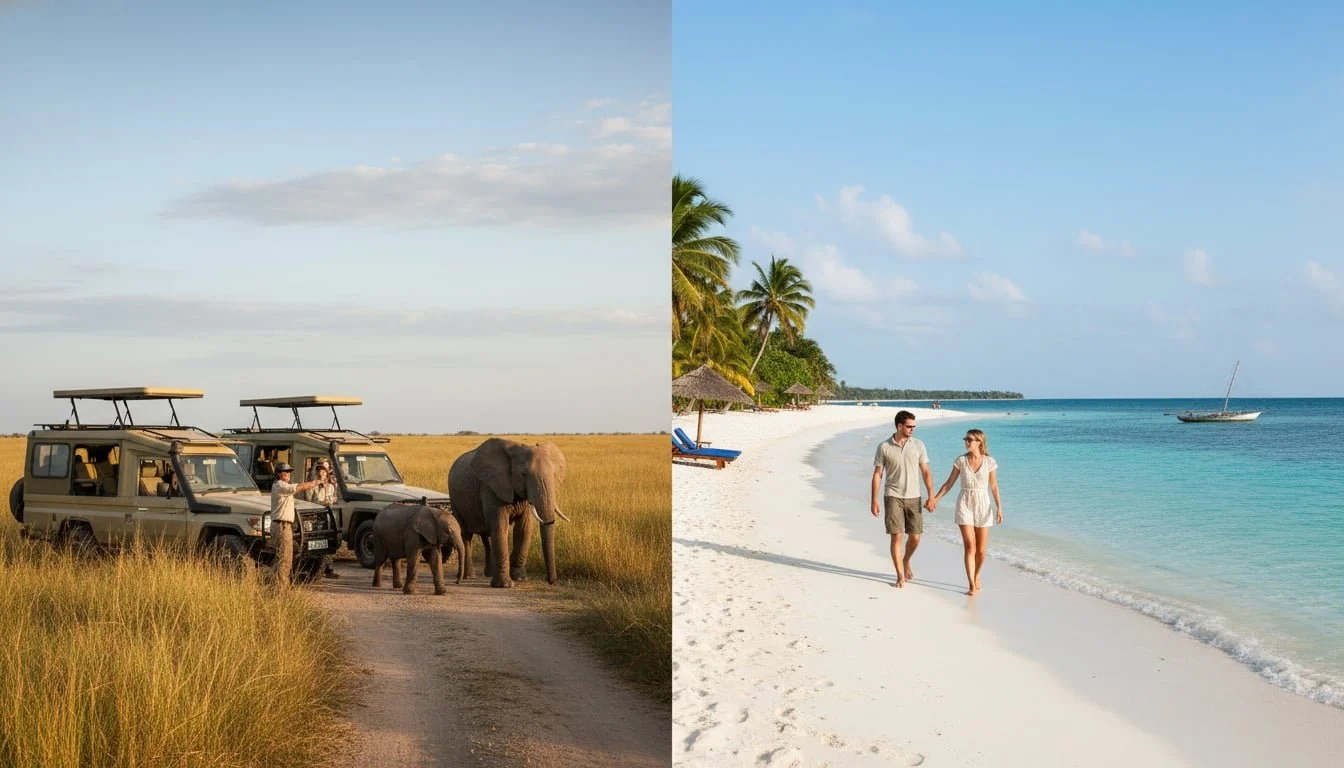
Combine thrilling Tanzania wildlife safaris with the white-sand beaches and turquoise waters of Zanzibar for the ultimate bush-and-beach holiday.
A Tanzania safari and Zanzibar beach holiday combines two completely different sides of the country in one journey. The first part can take travelers through Tanzania’s wildlife landscapes on game drives, while the second replaces early safari mornings and dusty tracks with white-sand beaches, warm Indian Ocean waters and a slower island atmosphere. For travelers who want adventure followed by relaxation, this combination can create one of East Africa’s most complete holidays.
Safari Vacations and Travel Services Ltd. can connect an established Tanzania safari with several nights on Zanzibar rather than treating the safari and beach holiday as two unrelated trips. This allows airport transfers, regional flights, accommodation and activities to be coordinated as one itinerary.
Zanzibar is particularly useful after a busy wildlife safari because travelers can slow down before their international journey home. Those wanting to understand what can be experienced beyond the beach can explore our detailed Zanzibar beach holiday guide, covering island activities, beaches and cultural experiences.
Why Combine a Tanzania Safari With Zanzibar?
The strongest reason to combine Tanzania safari and Zanzibar is contrast. A safari is active and unpredictable. Travelers wake early, follow wildlife movements, spend substantial time outdoors and often change accommodation as the route progresses. Zanzibar can provide the opposite rhythm: fewer transfers, slower mornings and several nights in one resort or beach hotel.
The contrast also creates greater variety within a single international trip. Instead of flying to East Africa solely for wildlife and arranging a separate tropical holiday later, travelers can experience savannahs and the Indian Ocean within one itinerary.
Zanzibar is more than a place to lie beside a swimming pool. Travelers can explore Stone Town, visit spice-growing areas, discover local food, snorkel, dive, take boat excursions and experience the island’s Swahili cultural heritage. Safari Vacations’ guide to the best activities in Zanzibar provides additional detail for travelers deciding how active they want the beach portion of their holiday to be.
Should You Do the Tanzania Safari or Zanzibar First?
For most travelers, completing the Tanzania safari first and Zanzibar second creates the most natural holiday rhythm. Wildlife safaris often involve early starts and active days, while finishing beside the ocean allows travelers to rest before returning home.
A typical journey might therefore begin around Arusha, continue through the selected wildlife areas and finish with a flight to Zanzibar. Travelers can then spend several nights on the island before departing internationally or connecting through an appropriate mainland airport.
However, Zanzibar first can also make sense. Travelers arriving after a demanding international journey may appreciate two or three nights beside the ocean before beginning their safari. This can be particularly attractive to honeymooners or visitors who want time to recover from jet lag.
There is therefore no universal rule. Safari Vacations and Travel Services Ltd. can arrange the sequence according to international flights, available days and personal preference. Travelers beginning with the wildlife component can use our 7-day Tanzania wildlife safari as a starting framework.
How Many Days Should You Spend on Safari and Zanzibar?
The ideal balance depends on the total length of the holiday. Travelers with only seven days should be careful about dividing the trip too aggressively because every flight and hotel change consumes useful vacation time. A short journey may work better with approximately four safari days and three beach nights.
With nine or ten days available, travelers can create a more balanced combination, such as five or six safari days followed by three or four nights in Zanzibar. This provides enough time for meaningful wildlife viewing without making the beach portion feel like a brief stopover.
Around twelve to fourteen days provides considerably greater flexibility. Travelers can dedicate seven or eight days to Tanzania safaris and still enjoy four to six nights on Zanzibar. Couples on honeymoon and travelers arriving from long-haul markets often appreciate this slower arrangement.
The objective is not to divide the holiday equally. Someone primarily visiting Africa for wildlife may want eight safari nights and four beach nights, while a honeymoon couple may prefer five safari nights followed by seven nights of relaxation.
Tanzania Safari and Zanzibar Route Map
The map below shows the basic structure of a northern Tanzania safari followed by Zanzibar. It is a planning framework rather than a fixed flight schedule.
ARUSHA
→
NORTHERN SAFARI CIRCUIT
→
SERENGETI / SAFARI AIRSTRIP
✈
ZANZIBAR
Route note: Actual air connections depend on travel dates, airline schedules, safari location and available services.
Southern Tanzania and Zanzibar Route Map
DAR ES SALAAM
→
SOUTHERN SAFARI CIRCUIT
✈
ZANZIBAR
Tanzania Safari and Zanzibar Holiday Length Comparison
The following table provides a simple way to balance wildlife and beach time. The examples are flexible and should be adjusted around flight schedules and individual travel priorities.
| Total Holiday | Safari Portion | Zanzibar Portion | Holiday Character | Best Suited To |
|---|---|---|---|---|
| 7 Days | Approx. 4 days | Approx. 3 days | Compact safari and beach escape | Travelers with limited vacation time |
| 9–10 Days | 5–6 days | 3–4 days | Balanced wildlife and beach holiday | First-time Tanzania visitors |
| 12 Days | 7 days | 4–5 days | Complete safari with meaningful beach relaxation | Couples, families and wildlife enthusiasts |
| 14 Days | 7–8 days | 5–6 days | Relaxed safari and Indian Ocean holiday | Honeymoons and long-haul travelers |
| 15+ Days | Flexible | Flexible | In-depth safari, beach and possible multi-country journey | Travelers wanting a comprehensive East African holiday |
Mobile viewing: Swipe horizontally to see the complete Tanzania safari and Zanzibar holiday comparison table.
Can You Add Uganda or Rwanda Before Zanzibar?
Travelers with more time can expand the journey beyond Tanzania. One particularly diverse combination is Uganda or Rwanda for mountain gorilla trekking, Tanzania for savannah wildlife and Zanzibar for beach relaxation. This creates three very different environments within one East African holiday.
Our Rwanda and Tanzania safari provides one foundation that can be extended to Zanzibar, while our Uganda gorillas and Serengeti safari demonstrates another possible regional combination.
Travelers considering a broader regional safari can also use Anthill Safaris’ guide to combining Kenya and Tanzania as additional inspiration for structuring a multi-country East African journey.
How to Plan a Smooth Tanzania Safari and Zanzibar Holiday
The best combinations minimize unnecessary backtracking. Safari accommodation, the final wildlife destination, the airport or airstrip used for the Zanzibar connection and the beach resort should all be considered as parts of the same route.
Travelers should also avoid making the Zanzibar portion too short. Spending only one night on the island after several days of transfers provides little opportunity to enjoy the beach. Three nights should generally be considered a short introduction, while four to six nights create considerably more time for relaxation.
The same principle applies to the safari. Cutting wildlife viewing to one or two rushed days simply to say that the holiday included both safari and Zanzibar usually weakens the overall experience. A better combination gives each component enough time to feel worthwhile.
Travelers can explore Safari Vacations and Travel Services Ltd.’s Zanzibar beach holiday activities before deciding how many island nights they need.
For additional East African safari inspiration, Anthill Safaris also provides information about Tanzania safari activities and wildlife game drives.
Plan Your Tanzania Safari and Zanzibar Holiday With Safari Vacations
Safari Vacations and Travel Services Ltd. can coordinate the safari and Zanzibar components as one complete journey. Tell us how many days you have, your preferred wildlife experience, accommodation category, number of travelers and how much time you would like to spend beside the Indian Ocean.
Travelers can begin with our Tanzania wildlife safari and add Zanzibar, or request a customized Tanzania safari and beach holiday designed around the entire trip from arrival to departure.
Tanzania Safari Travel Planning: Flights, Visas, Packing, Health, Money and Practical Tips
A successful Tanzania safari depends on more than choosing the right national parks and lodges. International flights, entry requirements, luggage, clothing, money, insurance, photography equipment and everyday safari etiquette all influence how smoothly the journey operates. Good preparation allows travelers to concentrate on wildlife once they arrive rather than solving avoidable logistical problems.
Safari Vacations and Travel Services Ltd. recommends beginning practical preparations as soon as your Tanzania safari itinerary is confirmed. Travelers should verify current entry and health requirements from official authorities before departure because regulations can change.
This section concentrates on Tanzania safari travel preparation. Weather and the best travel months were covered in Section 4, safari prices in Section 5, routes in Section 6 and Zanzibar combinations in Section 8, so those subjects are intentionally not repeated here.
International Airports for Tanzania Safaris
The most convenient international airport depends on the safari route. Kilimanjaro International Airport is an important gateway for travelers beginning northern Tanzania safaris around Arusha. This makes it particularly practical for itineraries involving destinations such as Tarangire, Ngorongoro and Serengeti.
Arusha itself is an important safari hub, while Arusha Airport mainly handles domestic and regional aviation rather than functioning as the principal long-haul international gateway.
Julius Nyerere International Airport in Dar es Salaam is particularly useful for travelers visiting southern Tanzania, the coast or connecting with Zanzibar. Zanzibar also has its own international airport, which can be useful when a Tanzania safari ends with an Indian Ocean stay.
Travelers should therefore book international flights only after considering the complete route. Flying into one airport and departing from another can sometimes eliminate unnecessary backtracking. Our African safari planning guide explains why transportation should be considered as part of the itinerary rather than as an afterthought.
Getting From Kilimanjaro International Airport to Arusha
Travelers arriving for a northern Tanzania safari commonly continue from Kilimanjaro International Airport toward Arusha, where many safari programs begin. Airport transfers should ideally be arranged in advance, particularly after long international flights.
Depending on arrival time, travelers may spend their first night around Arusha before beginning the safari the following morning. This is often more comfortable than arriving after a long-haul flight and immediately beginning a lengthy road journey.
Allowing an arrival night can also provide a useful buffer against delayed flights or baggage problems. Travelers joining our 7-day Tanzania experience safari can discuss arrival and departure arrangements when customizing the itinerary.
Tanzania Visa and Passport Requirements
International travelers should confirm the visa rules applicable to their nationality before departure. Requirements can vary according to citizenship, passport type and purpose of travel, and immigration regulations may change.
Your passport should meet Tanzania’s current immigration validity and blank-page requirements for the dates of travel. Travelers should check these conditions well before purchasing non-refundable services rather than discovering a passport problem shortly before departure.
Keep digital and paper copies of important documents separately from the originals. Useful documents can include your passport information page, visa documentation where applicable, travel insurance certificate, international flight itinerary, safari confirmation and emergency contact details.
Travelers combining several East African countries must check the entry requirements for each country separately. A visa that covers one country should never be assumed to provide entry into another.
Travel Insurance for Tanzania Safaris
Comprehensive travel insurance is strongly recommended for a Tanzania safari. A good policy should be appropriate for the activities and destinations included in the itinerary and should be reviewed carefully before purchase.
Travelers should consider cover for medical treatment, emergency assistance or evacuation, trip cancellation or interruption, delayed or lost baggage and other risks relevant to their journey. Safari Vacations and Travel Services Ltd.’s booking terms require participants to have valid medical insurance for the tour duration.
Do not simply purchase the cheapest policy without reading its exclusions. Travelers undertaking specialist activities or visiting remote wilderness areas should make sure those circumstances are compatible with their chosen coverage.
Health Preparation Before a Tanzania Safari
Travel health requirements depend on the traveler’s medical history, nationality, recent travel route and areas being visited. Medical questions should therefore be discussed with a qualified travel-health professional rather than relying solely on general internet advice.
Arrange any necessary consultation early enough before departure to complete recommended preparations. Travelers who take regular prescription medicines should bring enough for the entire journey, ideally with a reasonable additional supply in case of delays.
Keep essential medication in hand luggage rather than placing everything in checked baggage. A small personal health kit can also contain basic first-aid items, blister treatment, hand sanitizer and other products appropriate to the individual traveler.
Our safari preparation guide similarly recommends carrying personal medications and basic first-aid supplies when traveling on African wildlife safaris.
What Clothes Should You Wear on a Tanzania Safari?
Safari clothing should be comfortable, practical and easy to layer. Lightweight shirts, breathable trousers or safari pants and comfortable shoes work well for most daytime game drives. Neutral colors such as khaki, beige, brown and muted green are practical choices.
Avoid packing an entirely heavy wardrobe simply because you are traveling to Africa. Temperatures can change considerably between early morning and midday, so layers are generally more useful than one thick garment.
A fleece, sweater or light warm jacket can be useful for cool early departures, particularly in elevated areas. A lightweight rain layer is also useful even when traveling during a generally drier period.
Safari Vacations’ gorilla and Tanzania safari packing guide similarly recommends lightweight trousers, long-sleeved clothing, a warm sweater and waterproof protection for multi-country East African travel.
Essential Tanzania Safari Packing List
Pack light enough to move easily but do not leave behind essential safari equipment. A useful Tanzania safari packing list normally includes neutral-colored clothing, a warm layer, sun protection, comfortable footwear, camera equipment, binoculars, personal medication, travel documents and a small day bag.
A wide-brimmed hat, sunglasses and sunscreen are useful during open-vehicle and outdoor activities. Insect repellent should also form part of the travel kit. A reusable water bottle can be convenient where appropriate.
For wildlife viewing, binoculars can dramatically improve the experience. Animals are not always positioned beside the safari vehicle, and binoculars allow travelers to observe distant wildlife and birds without relying entirely on a camera’s zoom lens.
Our complete safari packing advice recommends neutral clothing, comfortable footwear, a hat, sunglasses, binoculars, camera equipment and a reusable water bottle.
Recommended Tanzania Safari Packing Checklist
| Category | What to Pack | Why You Need It | Packing Tip |
|---|---|---|---|
| Documents | Passport, visa documents where required, insurance and safari confirmations | Immigration and travel administration | Keep digital backup copies |
| Safari Clothing | Lightweight shirts, trousers and neutral-colored clothing | Comfort during game drives | Choose breathable, quick-drying fabrics |
| Warm Layer | Fleece, sweater or light jacket | Cool mornings, evenings and elevated areas | Layer rather than packing bulky coats |
| Footwear | Comfortable closed shoes plus casual footwear | Walking, game drives and lodge use | Break new footwear in before travel |
| Sun Protection | Hat, sunglasses and sunscreen | Protection during outdoor activities | Keep these in your day bag |
| Wildlife Viewing | Binoculars and camera | Viewing and photographing distant wildlife | Bring spare batteries or charging equipment |
| Personal Health | Prescription medication and personal first-aid essentials | Access may be limited in remote areas | Keep essential medicines in hand luggage |
| Weather Protection | Light waterproof jacket | Unexpected showers and changing conditions | Choose a packable design |
| Electronics | Phone, chargers, suitable adapter and power bank where permitted | Communication and photography | Charge equipment whenever power is available |
| Day Bag | Small backpack or camera bag | Keeps daily essentials accessible | Avoid an unnecessarily large bag inside the vehicle |
Mobile viewing: Swipe horizontally to view the complete Tanzania safari packing checklist.
Luggage for Domestic and Bush Flights
Travelers using small aircraft during Tanzania safaris should pay particular attention to luggage restrictions. Allowances can differ from international airline baggage rules and may vary according to the airline, aircraft and ticket conditions.
Soft-sided bags are often more practical than large rigid suitcases because baggage compartments on smaller aircraft can have limited dimensions. Before departure, check the exact weight and baggage requirements stated by the carrier operating your confirmed flight.
Do not assume that the allowance from your international airline also applies to a bush flight. Travelers carrying substantial photography equipment should mention this during planning so that baggage requirements can be considered before flights are confirmed.
Camera Equipment for a Tanzania Safari
You do not need professional equipment to enjoy Tanzania safaris, but travelers interested in wildlife photography should prepare carefully. A camera with a useful zoom range can help photograph animals that cannot or should not be approached closely.
Bring sufficient memory cards, batteries and charging equipment. Dust can also be a concern on dry safari roads, so lens-cleaning equipment and sensible protection for cameras can be useful.
Binoculars remain worthwhile even for travelers carrying powerful cameras. Wildlife observation should not become entirely dependent on looking through a viewfinder. Our Tanzania wildlife safari packing information also recommends cameras, spare batteries, lenses and binoculars for combined East African safaris.
Money and Paying for Expenses in Tanzania
Travelers should plan for a combination of payment methods rather than depending on a single card or carrying all spending money in one place. Tanzania’s local currency is the Tanzanian shilling, while the practical use of foreign currency and cards can vary between businesses and locations.
Major hotels and established tourism businesses may accept cards, while cash can remain useful for smaller purchases, gratuities and situations where electronic payments are unavailable. Travelers should confirm current payment arrangements with individual properties when necessary.
Notify your bank about international travel if required and make sure you can access more than one payment method. Keep emergency funds separate from your everyday wallet.
Tipping on a Tanzania Safari
Tipping is common within the safari industry as a way of recognizing good service, but travelers should understand the arrangements applicable to their particular itinerary rather than assuming one universal amount.
Safari guides, lodge staff and other service personnel may all be considered for gratuities. The amount can depend on service quality, group size, length of stay and the traveler’s discretion.
Safari Vacations’ general East Africa safari questions also notes that tipping is customary for good service while emphasizing that there is not one fixed amount applicable to every situation.
Internet, Phones and Charging Electronics on Safari
Mobile coverage and internet quality vary considerably across Tanzania. Urban areas and many lodges may have connectivity, while remote safari areas can have weak or intermittent service. Travelers should not expect constant high-speed internet throughout a wilderness safari.
Many safari vehicles and accommodation properties provide ways to charge phones and cameras, but electricity arrangements vary. Some remote camps generate power through solar systems and may have specific charging locations or hours.
A suitable travel adapter and organized charging routine are useful. Charge camera batteries whenever electricity is available rather than waiting until the night before an important game drive.
Safari Etiquette and Responsible Wildlife Viewing
Good safari etiquette protects wildlife and improves the experience for everyone. Travelers should listen to their professional guide, avoid unnecessary noise around animals and never pressure a guide to approach wildlife in an unsafe or inappropriate way.
Do not feed wild animals. Avoid leaving rubbish in protected areas, and respect instructions regarding where travelers may leave the vehicle. Wildlife remains unpredictable regardless of how relaxed an animal appears.
Photography should also respect people. When visiting communities or photographing individuals, ask permission before taking close personal photographs. Safari Vacations’ responsible safari planning guide similarly recommends asking permission before photographing people or their property.
Travelers wanting to understand the nature of guided wildlife viewing can also read Anthill Safaris’ African safari game drive guide.
What Not to Pack for a Tanzania Safari
Overpacking is one of the most common safari mistakes. Travelers rarely need a different outfit for every day, particularly where accommodation provides laundry services. Large rigid suitcases can also become inconvenient when using smaller vehicles or aircraft.
Avoid bringing unnecessary valuables and excessive jewelry. Clothing should prioritize comfort and practicality rather than formal fashion. Bright safari wardrobes are generally less practical than muted colors, while camouflage clothing can be subject to restrictions or unwanted attention in some destinations and is best avoided.
Travelers combining Tanzania with Uganda or Rwanda should pack according to the entire journey rather than only the savannah portion. Our gorilla trekking packing list is useful when a Tanzania safari will be followed or preceded by forest trekking.
Planning a Tanzania Safari From Uganda or Rwanda
Tanzania can be combined efficiently with Uganda or Rwanda when the journey is designed around suitable regional air connections. This allows travelers to combine savannah wildlife with mountain gorilla or chimpanzee experiences without wasting several days on unnecessary road transfers.
Our Uganda gorillas and Serengeti safari provides a practical example of combining the two countries, while the Rwanda and Tanzania Big Five safari demonstrates how Rwanda can be incorporated.
Travelers considering Kenya can also read Anthill Safaris’ guide to combining Kenya and Tanzania. For more Tanzania-specific ideas, Anthill Safaris also covers popular Tanzania safari activities.
Final Tanzania Safari Pre-Departure Checklist
Before leaving home: confirm your passport and applicable entry documents, international flights, safari itinerary, accommodation, transfers, insurance, any health documentation required for your route and the current baggage allowances for every flight in your itinerary.
Check that you have your prescription medication, camera equipment, binoculars, suitable clothing, sun protection, insect repellent, chargers and essential travel documents.
Keep important documents and medication in hand luggage. Store backup copies securely and provide a trusted person at home with your itinerary and appropriate emergency information.
Finally, reconfirm your arrival details with Safari Vacations and Travel Services Ltd. so that airport transfers and the beginning of your Tanzania safari are coordinated correctly.
Prepare for Your Tanzania Safari With Safari Vacations and Travel Services Ltd.
Good preparation should make a Tanzania safari easier, not more complicated. Once your itinerary is confirmed, Safari Vacations and Travel Services Ltd. can provide practical guidance about transfers, safari logistics, packing and the arrangements included in your particular journey.
Travelers can start with our Tanzania safari itinerary, explore our complete African safari planning guide, or contact Safari Vacations and Travel Services Ltd. for a customized Tanzania journey.
Tanzania Safari FAQs, Booking Advice and Why Travel With Safari Vacations and Travel Services Ltd.
Planning Tanzania safaris often creates practical questions that are not fully answered by destination descriptions alone. Travelers want to know whether Tanzania is suitable for a first African safari, how many days they need, whether private safaris are worthwhile, when they should book and how the reservation process works. This final section answers those high-intent questions while helping travelers move confidently from research to planning.
The earlier sections of this complete Tanzania safari guide have already covered destinations, wildlife, the Great Migration, seasons, safari costs, itineraries, travel styles, Zanzibar combinations and practical preparation. Rather than repeating those subjects, the Tanzania safari FAQs below concentrate on the questions travelers commonly ask immediately before requesting a quotation or confirming their trip.
Travelers who are already ready to begin planning can explore our 7-day Tanzania safari or request a customized Tanzania safari directly from Safari Vacations and Travel Services Ltd.
Is Tanzania Good for a First African Safari?
Yes. Tanzania is one of Africa’s strongest destinations for first-time safari travelers because it combines famous wildlife ecosystems, experienced safari infrastructure and a wide variety of wildlife experiences. A first-time visitor can experience open savannahs, predators, elephants, giraffes, zebras, wildebeest and numerous other species within a carefully designed itinerary.
The Northern Circuit is particularly practical for newcomers because several major safari destinations can be linked into one journey. Travelers do not need previous safari experience; a professional driver-guide handles the driving and helps interpret animal behavior, habitats and the wider ecosystem.
Is a Tanzania Safari Worth It?
For travelers interested in African wildlife, landscapes and nature, Tanzania safaris can be exceptionally rewarding. The country provides opportunities to spend several days inside major wildlife ecosystems rather than experiencing animals only during isolated excursions.
Value should be measured by the quality of the overall experience rather than simply the number of animals seen. Watching elephants interact, following predators across open plains, listening to wildlife around a tented camp and observing the scale of Tanzania’s landscapes can become as important as photographing individual species.
Anthill Safaris provides additional inspiration through its collection of Tanzania safari guides, including first-time travel advice and wildlife experiences.
How Many Days Are Enough for a Tanzania Safari?
Approximately six to eight safari days work particularly well for many first-time visitors exploring northern Tanzania. This provides enough time for meaningful game viewing without forcing travelers to change destinations continuously.
Three to five days can work when vacation time is limited, but the route should remain focused. Ten to fourteen days provide greater flexibility for photographers, slower travelers and visitors combining different regions or countries.
Our existing Tanzania safari itinerary provides a useful example of how a week can connect Tarangire, Serengeti and Ngorongoro.
Can I See the Big Five on a Tanzania Safari?
Tanzania provides opportunities to see lion, leopard, elephant, buffalo and black rhino, collectively known as the Big Five. However, wildlife remains wild and sightings can never be guaranteed.
A properly designed safari increases opportunities by allowing sufficient time in productive wildlife areas and using knowledgeable guides. Travelers should avoid treating a safari purely as a checklist. Tanzania’s cheetahs, giraffes, hippos, hyenas, wildebeest, zebras, antelopes, primates and exceptional birdlife can be equally memorable.
Will I Definitely See Lions in Tanzania?
Lions are among Tanzania’s most sought-after safari animals, and important ecosystems support healthy predator populations. Nevertheless, Safari Vacations and Travel Services Ltd. does not recommend guaranteeing any wild animal sighting.
Animals move freely and their behavior changes according to prey, weather, territory and other ecological conditions. An experienced guide uses knowledge of the landscape, animal behavior and recent sightings to improve the chances of productive wildlife viewing.
Can I See Leopards and Cheetahs in Tanzania?
Both species occur in Tanzania, although sightings vary. Cheetahs often favor open environments where their speed can be used effectively, while leopards are generally more secretive and can be considerably harder to locate.
Patience is important. Spending adequate time in an ecosystem generally provides better opportunities than rushing through multiple destinations simply to increase the number of parks visited.
Do Tanzania Safaris Operate All Year?
Yes. Tanzania safaris can operate throughout the year, although conditions and wildlife distribution vary seasonally. There is no single month that is perfect for every traveler.
Instead of repeating the month-by-month analysis here, travelers should refer to Section 4 of this guide, which explains dry-season travel, green-season conditions, rainfall, photography and seasonal differences in detail.
When Should I Book a Tanzania Safari?
Booking early is advisable when traveling during popular periods, when particular lodges are important to you, or when the itinerary requires limited-capacity camps and internal flights. Early planning gives travelers more accommodation choices and greater flexibility when constructing the route.
Last-minute Tanzania safaris may still be possible, but the itinerary may need to adapt around remaining accommodation and transportation availability. Anthill Safaris also provides guidance on planning and booking Tanzania safaris, including advice about advance reservations.
Should I Choose a Private or Group Tanzania Safari?
Choose a private safari when flexibility, privacy and control over the game-viewing schedule are priorities. Private safaris are particularly attractive for couples, families, photographers and small groups of friends.
Group departures can appeal to travelers who enjoy meeting others and want to share certain safari costs. The compromise is reduced control over daily timing and how long the vehicle remains at particular sightings.
Anthill Safaris’ Tanzania group safari guide provides additional information for travelers considering a shared departure.
Are Tanzania Safaris Suitable for Children?
Yes, Tanzania can be an excellent family safari destination when the itinerary is adapted to the children’s ages. Families should avoid unnecessarily long travel days, select suitable accommodation and discuss age restrictions for individual activities before booking.
Private vehicles are especially useful because the family can have greater control over stops and the daily pace. Parents should provide children’s ages during the initial inquiry so that Safari Vacations and Travel Services Ltd. can recommend appropriate arrangements.
Are Tanzania Safaris Suitable for Senior Travelers?
Yes. Standard vehicle-based wildlife viewing does not normally require the physical effort associated with mountain trekking. The more important considerations are vehicle access, long driving periods, accommodation layout and individual mobility.
Senior travelers who prefer shorter transfers can consider carefully paced routes or flights between selected safari areas. Any important mobility requirements should be communicated before accommodation and transport are confirmed.
Can I Travel Solo on a Tanzania Safari?
Yes. Solo travelers can undertake either private or shared Tanzania safaris. A private journey provides maximum independence, while shared arrangements can reduce the impact of fixed vehicle and guiding costs.
Solo travelers should tell Safari Vacations and Travel Services Ltd. whether they prioritize privacy or social interaction. This can influence the choice of safari format and accommodation.
Do I Need to Be Physically Fit for a Tanzania Safari?
Most conventional Tanzania wildlife safaris are vehicle based and therefore do not require exceptional physical fitness. Travelers enter and exit safari vehicles regularly and may walk around accommodation properties, but standard game drives are generally accessible to a broad range of travelers.
Specialist walking, climbing or adventure activities can have different requirements. Travelers with mobility concerns should communicate them before booking so the itinerary can be designed appropriately.
What Kind of Safari Vehicle Is Used in Tanzania?
Road safaris commonly use purpose-adapted 4×4 vehicles designed for wildlife viewing. Features vary between operators and vehicles, but safari configurations are intended to provide visibility and access to wildlife areas.
Vehicle quality matters because travelers can spend many hours inside the vehicle during a multi-day Tanzania safari. The guide is equally important: strong guiding turns a vehicle from simple transportation into a mobile wildlife-viewing platform.
Are Tanzania Safaris Safe?
Tanzania has a long-established safari industry, but travelers should still follow professional guidance and normal travel precautions. Inside wildlife areas, visitors should obey their guide and lodge staff because wild animals can be dangerous when approached irresponsibly.
Travelers should not leave vehicles where prohibited, feed animals or walk around unfenced wilderness accommodation after dark without following the property’s procedures. Current destination-specific travel advice should also be checked before departure.
Can I Combine Tanzania With Uganda Gorilla Trekking?
Yes. This is one of the most contrasting wildlife combinations available in East Africa. Tanzania provides open savannah game viewing, while Uganda introduces rainforest trekking with mountain gorillas.
Our Uganda gorillas and Serengeti safari guide explains how these experiences can form one journey. Anthill Safaris also has a dedicated Uganda gorilla and Tanzania safari guide.
Can I Combine Tanzania With Rwanda?
Yes. Rwanda can add mountain gorilla trekking, golden monkeys and other experiences before or after the Tanzania wildlife portion. Regional flights make this considerably more practical than trying to connect every destination overland.
Safari Vacations and Travel Services Ltd.’s Rwanda and Tanzania safari provides an example of a multi-country itinerary combining primates and classic savannah wildlife.
Can I Combine Tanzania Safari With Zanzibar?
Yes. Safari followed by Zanzibar is one of Tanzania’s most natural wildlife-and-beach combinations. Travelers can finish several active safari days with a more relaxed Indian Ocean stay.
Because this subject has already been covered comprehensively in Section 8, travelers should refer to that section rather than repeating the same information here. Our separate Zanzibar beach holiday guide provides additional island-specific information.
Can I Customize My Tanzania Safari?
Yes. Customization is one of the best ways to create a safari that fits the traveler rather than forcing the traveler into a generic itinerary. Safari Vacations and Travel Services Ltd. can design the journey according to available days, group size, accommodation preference, wildlife priorities and wider East African travel plans.
A traveler interested primarily in photography may need a different pace from a family with young children. A honeymoon couple may prioritize privacy, while a first-time visitor may prefer a balanced introduction to Tanzania’s major wildlife environments.
Can Safari Vacations Arrange Accommodation?
Yes. Accommodation forms an integral part of safari planning. Properties should be chosen according to comfort level, location, routing and availability rather than simply selecting the most recognizable lodge name.
Safari Vacations and Travel Services Ltd.’s inquiry form allows travelers to indicate their preferred accommodation level and approximate budget, helping the team design a proposal around individual priorities.
Can Safari Vacations Arrange Airport Transfers?
Yes. Airport and hotel transfers can be incorporated into the Tanzania safari arrangement according to the confirmed itinerary. Arrival information should be supplied accurately so the appropriate pickup can be coordinated.
Our published 7-day Tanzania safari, for example, begins with pickup from an airport or hotel in Arusha before continuing toward the safari circuit.
What Information Should I Send When Requesting a Tanzania Safari Quote?
The most useful inquiry includes your approximate travel dates, number of travelers, number of safari days, preferred accommodation level and main interests. It is also helpful to mention whether you want Tanzania only or intend to combine the safari with Zanzibar, Uganda, Rwanda or Kenya.
Providing this information from the beginning allows the safari consultant to prepare a relevant proposal rather than repeatedly asking basic questions. Safari Vacations’ safari inquiry form already includes fields for Tanzania, number of travelers, number of days, accommodation preference, budget estimate, travel date and interests.
What Happens After I Request a Tanzania Safari?
The first stage is itinerary development. Your travel dates, interests, group size and preferred travel style are used to build a suitable Tanzania safari proposal. Accommodation and routing can then be adjusted according to feedback and availability.
Before making payment, travelers should carefully review the proposed itinerary, inclusions, exclusions, accommodation, payment conditions and applicable booking terms. This reduces misunderstandings and ensures both traveler and operator are working from the same confirmed arrangements.
What Should I Check Before Confirming My Tanzania Safari?
Check that your names and travel dates are correct and that the itinerary clearly identifies the services being provided. Review accommodation, meals, transport arrangements, included activities, exclusions, payment conditions and cancellation terms.
Travelers should also make sure international flights provide sufficient time for the planned arrival and departure arrangements. Where domestic flights are involved, check the confirmed baggage restrictions rather than relying on international airline allowances.
Tanzania Safari Booking Checklist
The following table summarizes the most important information to review before confirming Tanzania safaris. It is designed as a final booking checkpoint rather than another itinerary or packing table.
| Booking Item | What to Confirm | Why It Matters | Best Practice |
|---|---|---|---|
| Travel Dates | Exact arrival and departure dates | Determines accommodation and logistics | Provide international flight details once confirmed |
| Travelers | Number of adults and ages of children | Influences rooms, vehicles and activity suitability | Declare the complete traveling party |
| Itinerary | Destinations, nights and transfers | Prevents unrealistic routing | Review each day before confirming |
| Accommodation | Property, room type and meal basis | Affects comfort and overall safari experience | Confirm the accommodation listed in the proposal |
| Transport | Private/shared vehicle, road transfers and flights | Determines comfort and flexibility | Ask how major transfers will operate |
| Inclusions | Meals, activities, transport and specified fees | Shows what the quotation actually covers | Read the written inclusion list |
| Exclusions | International flights, personal expenses and services not included | Helps establish the complete travel budget | Budget separately for exclusions |
| Payment Terms | Deposit, balance and deadlines | Required to secure arrangements | Use the terms supplied with your booking |
| Cancellation Terms | Applicable cancellation conditions | Important if travel plans change | Read before making payment |
| Insurance | Appropriate travel and medical coverage | Provides protection against eligible travel risks | Review policy wording carefully |
Mobile viewing: Swipe horizontally to view the complete Tanzania safari booking checklist.
Why Book a Tanzania Safari With Safari Vacations and Travel Services Ltd.?
A warm welcome from Safari Vacations and Travel Services Ltd, connecting travelers with professionally organized and personalized East African safari experiences.
A Tanzania safari involves several moving parts: accommodation, vehicles, guides, transfers, activities and sometimes domestic or regional flights. Safari Vacations and Travel Services Ltd. brings these components together within one coordinated itinerary instead of requiring travelers to organize each element separately.
The company specializes in customized East African travel and can build journeys around wildlife interests, available time and preferred accommodation style. This is especially useful when Tanzania is combined with Uganda or Rwanda, where the trip requires coordination across different ecosystems and international borders.
Rather than treating every traveler identically, the planning process can begin with your actual priorities. Families may need slower transfers, photographers may want additional game-viewing time, honeymooners may prioritize privacy and luxury travelers may prefer air connections that reduce road travel.